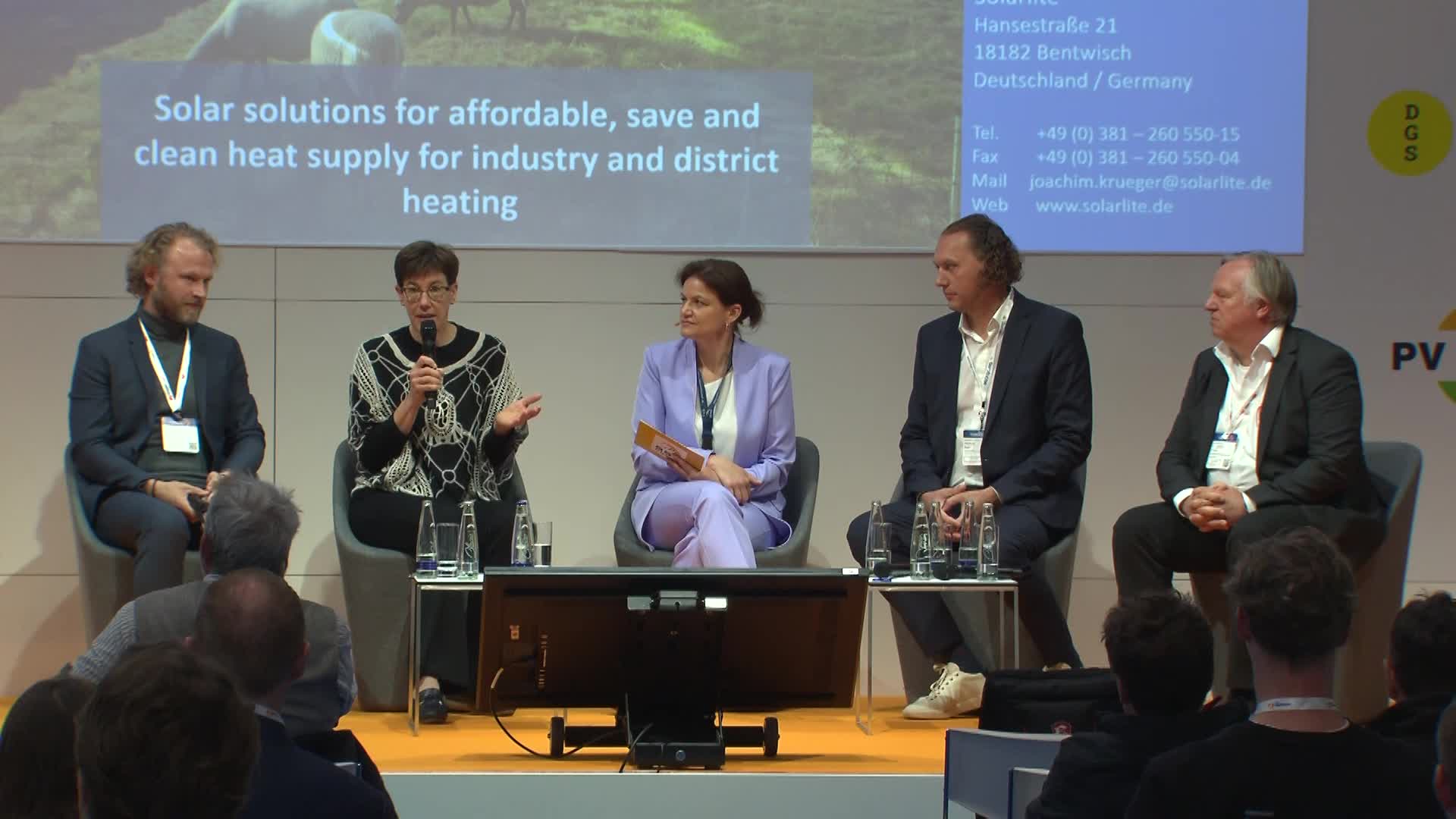
Panel Discussion: How Can Solar Process Heat Overcome Economic and Technological Barriers to Scale?

premium account

Recording of Thursday, May 08, 2025 | The smarter E Europe | Exhibition Program | Language: English | Duration: 23:48 .

Industry Experts Highlight Contracting Challenges in Solar Thermal Projects Despite Cost Benefits Over Fossil Fuels

Markus Balz from GlassPoint and Dr. Joachim Krüger of Solarlite discuss solar thermal projects aimed at providing cost-effective alternatives to fossil fuels by utilizing high solar radiation areas for steam supply in industrial processes. Projects like "Mira," a 300-megawatt installation, support enhanced oil recovery fields with temperatures between 200-450°C. Despite lower subsidies compared to places like Germany, these initiatives focus on process heat and district heating as key targets, with upcoming German projects around 50 megawatts each. Bärbel's market analysis highlights challenges such as financing hurdles and client education about the technology before contract signing can occur; incentives are crucial for adoption despite potential renewable benefits. The discussion underscores economic stability due to free fuel costs offered by solar energy systems which promise integration into future hybrid solutions without external dependency concerns over energy source decisions. A study in Germany reveals unexpected positive results regarding solar viability even under less sunlight exposure when integrated into hybrid systems—highlighting its economical resource potential internationally based on local conditions like CO2 pricing and radiation levels. Challenges persist around project development funding during engineering phases lacking financial support amid Europe's changing climate policies but strategic targeting within industries committed to climate protection goals accelerates adoption rates globally among sectors such as refineries aligning well temperature-wise or food/beverage producers integrating larger-scale district heating post thorough planning efforts worldwide indicating growing momentum towards widespread implementation soon enough!

Automated summarization by AI Conver

With the share of renewable energies in the heating sector remaining low, the heating transition is one of the major challenges on the way towards climate neutrality. Particularly in industry, where high temperatures are needed and cost pressure is high, reconciling profitability and decarbonization is an issue. Large solar thermal installations are on the rise in heating networks.This session will be discussing the potential of solar thermal technology, successful projects and current market developments. Presenters will provide exciting insights into applications, financing models and a glimpse into the future.

Further Talks of this session:

Video is not available.

Speaker

Bärbel Epp
Managing Director
Solrico

To Talk

Speaker

Dr. Gregor Bern
Head of Group Concentrating Systems and Technologies
Fraunhofer ISE

To Talk

Speaker

Magdalena Berberich
Executive Director
Solites - Steinbeis Research Institute for Solar and Sustainable Thermal Energy Systems

To Talk

Speaker

Dominik Bestenlehrer

To Talk

Speaker

Thorsten Lütten

To Talk

To Talk

Video is not available.

Further Content
Webinar Collection
Mixed Investment Solar Projects in Mexico: The 54% Model Explained

January 29, 2026

Mexico has introduced a new mixed investment scheme for renewable power generation, requiring a minimum 54% direct or indirect participation by CFE.

Adriana Fricke, Robin Berg
Has Vehicle-to-Grid Reached the Tipping Point?

The smarter E Podcast Episode 248 | Language: English

February 5, 2026

Why 2026 could be a turning point for bidirectional EV charging – from regulation to large V2G fleets in Europe.

The smarter E Europe Conferences 2025
Digital Tools for Planning and Monitoring: Insights from Mozambique

Wednesday, May 07, 2025, 02:00 pm - 03:30 pm

The smarter E Europe Conferences 2025 | Conference Program

premium account

This session explores how digitalization is revolutionizing off-grid energy projects, enabling scalability and efficiency in underserved areas. Experts will discuss cutting-edge solutions based on the use and application of digital tools to support planning, development, and operations ultimately enhancing affordability. Attendees will gain insights into leveraging digital tools for optimized planning and project management, customer engagement, monitoring, and sustainable growth. Real-world case studies will highlight successful implementations, showcasing how technology bridges the gap between innovation and impact in energy access.

The smarter E Europe Conferences 2025
Optimizing Island Energy Systems: Modeling Hydrogen Integration in the Asia-Pacific

Wednesday, May 07, 2025, 02:00 pm - 03:30 pm

The smarter E Europe Conferences 2025 | Conference Program

premium account

This session explores how digitalization is revolutionizing off-grid energy projects, enabling scalability and efficiency in underserved areas. Experts will discuss cutting-edge solutions based on the use and application of digital tools to support planning, development, and operations ultimately enhancing affordability. Attendees will gain insights into leveraging digital tools for optimized planning and project management, customer engagement, monitoring, and sustainable growth. Real-world case studies will highlight successful implementations, showcasing how technology bridges the gap between innovation and impact in energy access.

The smarter E Europe Conferences 2025
Factors That Influence the Success of a Minigrid Project

Wednesday, May 07, 2025, 11:00 am - 12:30 pm

The smarter E Europe Conferences 2025 | Conference Program

premium account

Off-grid solar systems are often the least expensive option for rural electrification. Solar home systems can power individual households, while mini-grids can supply entire villages. Each comes with its own advantages, disadvantages, and challenges. The aim of this session is to explore challenges as well as success stories. It takes well-functioning components such as battery systems, charge management and inverters to make projects successful. Proper system sizing, maintenance and repair management, as well as a robust financial concept are also necessary. If one of these elements is missing, the electrification will not be sustainable. This session will focus on the aspects mentioned above. The speakers will present successful and unsuccessful approaches and discuss what can be learned from them.

You are using an outdated browser

The website cannot be viewed in this browser. Please open the website in an up-to-date browser such as Edge, Chrome, Firefox, or Safari.