Recording of Thursday, May 08, 2025 | The smarter E Europe | Exhibition Program | Language: English | Duration: 13:57 .
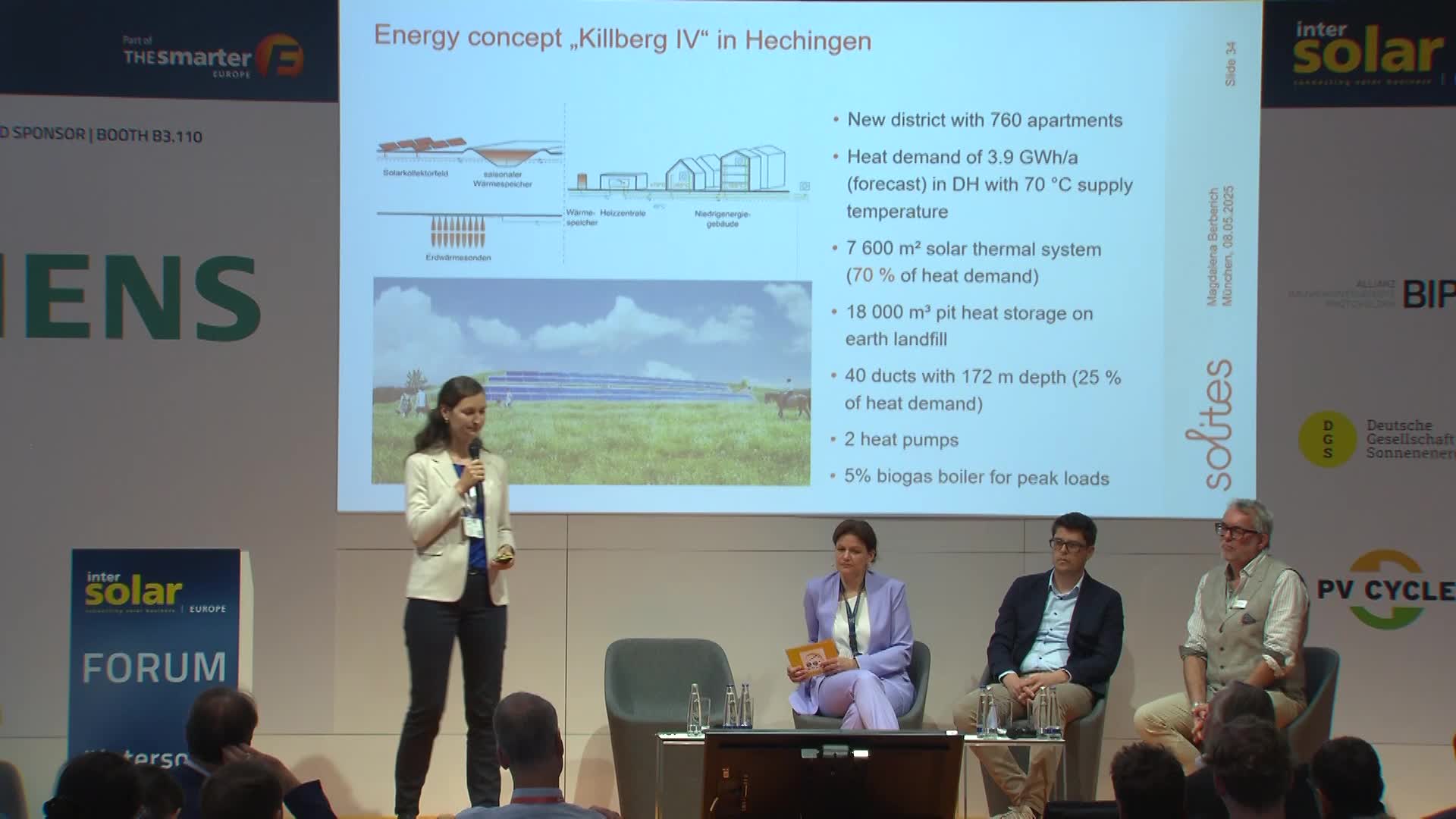
The presentation discusses solar district heating in Germany and Europe, highlighting the work of Solites, a research institute focused on renewable energy systems. A key project involves developing a sustainable heat supply for 760 apartments in southern Germany using solar thermal technology combined with pit heat storage and shallow geothermal methods to achieve 100% renewable heating. The speaker emphasizes the need to decarbonize Europe's approximately 17,000 district heating networks by integrating solar thermal solutions that offer stable costs despite high initial investments. While Denmark leads this market segment alongside Germany and Austria, new players like Italy are emerging. Challenges remain around adapting technologies for higher temperature networks and scaling up installations from current levels (170,000 square meters) to meet future demands (10 million square meters). Success depends on supportive policies, funding programs, best practices dissemination through knowledge transfer initiatives such as databases or YouTube content while addressing organizational hurdles within communities transitioning towards renewables without bias against other green alternatives like PVs or heat pumps.
Automated summarization by AI Conver
Magdalena Berberich
Executive Director
Solites - Steinbeis Research Institute for Solar and Sustainable Thermal Energy Systems
With the share of renewable energies in the heating sector remaining low, the heating transition is one of the major challenges on the way towards climate neutrality. Particularly in industry, where high temperatures are needed and cost pressure is high, reconciling profitability and decarbonization is an issue. Large solar thermal installations are on the rise in heating networks.This session will be discussing the potential of solar thermal technology, successful projects and current market developments. Presenters will provide exciting insights into applications, financing models and a glimpse into the future.
Further Talks of this session:
Video is not available.
Speaker
Bärbel Epp
Managing Director
Solrico
Speaker
Dr. Gregor Bern
Head of Group Concentrating Systems and Technologies
Fraunhofer ISE
Speaker
Dominik Bestenlehrer
Speaker
Thorsten Lütten
Video is not available.