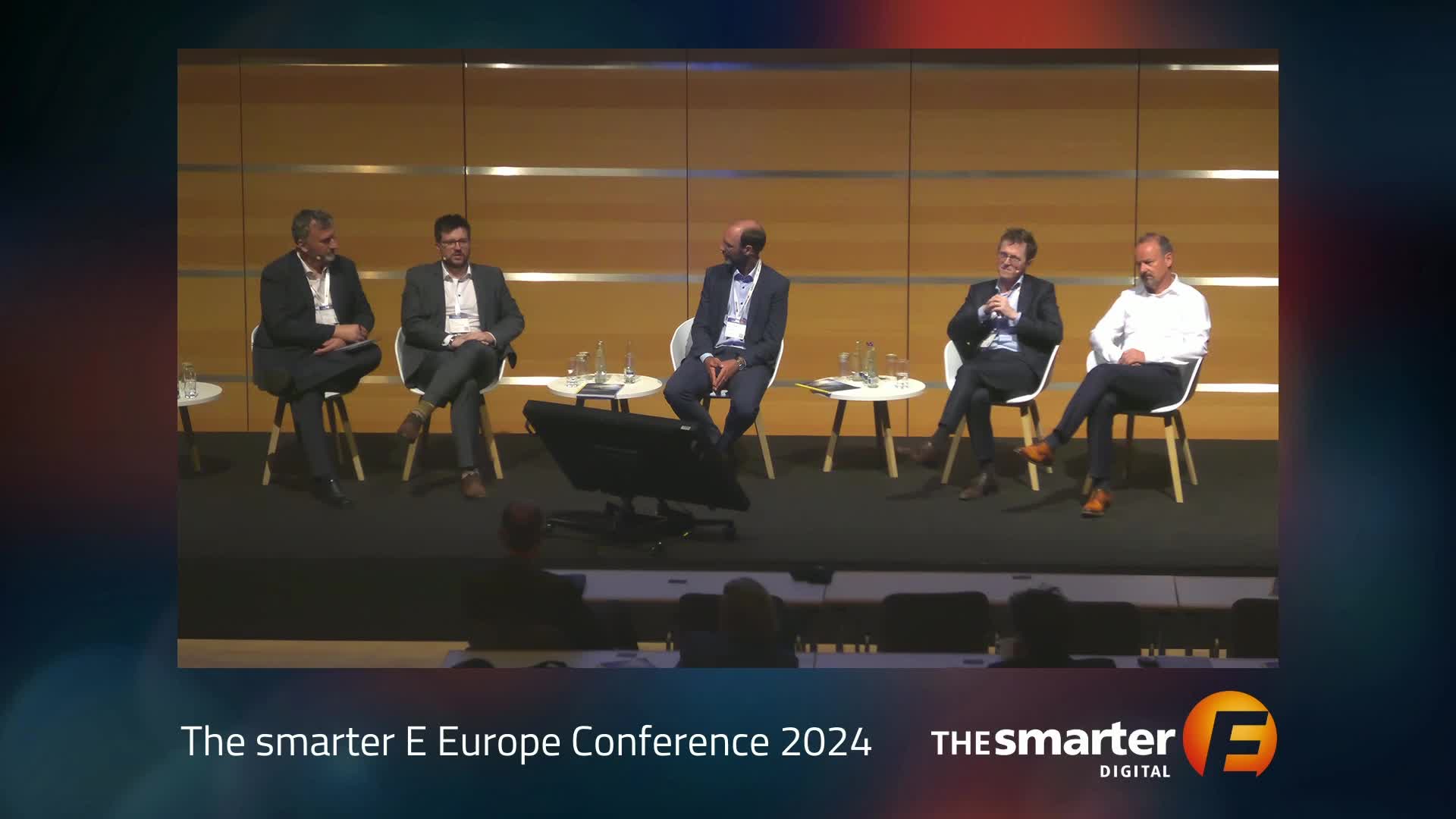
Panel Discussion: How Realistic Are Germany's Ambitious Solar Installation Targets?

premium account

Recording of Tuesday, June 18, 2024 | The smarter E Europe | Conference Program | Language: English | Duration: 34:59 .

Solar Industry Faces Volatility But Optimism Remains High for Future Growth and Market Achievability

The discussion among panelists revolves around the current state and future prospects of the solar energy market. The conversation highlights that despite facing numerous challenges—such as fluctuating prices for solar modules, issues with grid infrastructure, and a general sense of economic instability in Germany—the industry remains optimistic about achieving significant growth targets by 2030. Dr. Dirk Haft discusses how the cost reductions in solar systems are making investments more attractive globally, especially in Europe. Stefan Müller emphasizes enduring cyclical nature of the industry dubbed "the solar coaster," but also indicates a positive trend driven by dynamic market conditions and growing public interest. Dr. Christoph Kost points out that while legislative hurdles exist (specifically regarding tenant use of photovoltaic electricity), there is potential to meet substantial installation goals if these obstacles are addressed. Erik Schöller observes that consumer reluctance due to successive crises has been notable; however, skilled labor force shortages have eased somewhat through proactive recruitment efforts. Overall, amidst various ups and downs ("solar coaster"), stakeholders believe sustained effort can meet ambitious renewable energy targets essential for climate goals.

Automated summarization by AI Conver

The German solar market has always played an outstanding role in the development of PV in Europe. The country has almost continually been the EU's largest market and operated nearly one third of the EU's solar power installations. But can the market grow fast enough and install more than 20 GW per year? This will be necessary to meet its ambitious target of 215 GW of solar capacity by 2030. This session will take a close look at:

  • Status of solar power in Germany today
  • Strategy for meeting the country's ambitious installation targets
  • Analysis of different market segments - residential,
  • C&I and utility-scale The German PV and Battery Storage Market

Further Talks of this session:

Speaker

David Wedepohl
Managing Director International Affairs
BSW - German Solar Association
Germany

To Talk

Speaker

Dr. Christoph Kost
Head of Department Energy System Analysis
Fraunhofer Institute for Solar Energy Systems ISE
Germany

To Talk

Speaker

Stefan Müller
COO
Enerparc AG
Germany

To Talk

Speaker

Dr. Dirk Haft
CEO
IBC Solar AG
Germany

To Talk

Speaker

Erik Schöller
Chief Operating Officer
Schoenergie
Germany

To Talk

Further Content
Webinar
Growth of the European Solar Market, Specifically, Romania

February 24, 2026

Webinar: EU Solar Market Overview with Focus on Romania

Webinar Collection
Mixed Investment Solar Projects in Mexico: The 54% Model Explained

January 29, 2026

Mexico has introduced a new mixed investment scheme for renewable power generation, requiring a minimum 54% direct or indirect participation by CFE.

Adriana Fricke, Robin Berg
Has Vehicle-to-Grid Reached the Tipping Point?

The smarter E Podcast Episode 248 | Language: English

February 5, 2026

Why 2026 could be a turning point for bidirectional EV charging – from regulation to large V2G fleets in Europe.

Webinar
Mexico’s commercial and industrial solar thermal: from potential to projects

February 19, 2026

Discover Mexico’s C&I solar thermal market, opportunities, trends and successful projects

The smarter E Europe Conferences 2025
Q&A Session of of the Session Off-Grid: Rural Electrification Based on Solar Systems - Lessons Learned

Wednesday, May 07, 2025, 11:00 am - 12:30 pm

The smarter E Europe Conferences 2025 | Conference Program

premium account

Off-grid solar systems are often the least expensive option for rural electrification. Solar home systems can power individual households, while mini-grids can supply entire villages. Each comes with its own advantages, disadvantages, and challenges. The aim of this session is to explore challenges as well as success stories. It takes well-functioning components such as battery systems, charge management and inverters to make projects successful. Proper system sizing, maintenance and repair management, as well as a robust financial concept are also necessary. If one of these elements is missing, the electrification will not be sustainable. This session will focus on the aspects mentioned above. The speakers will present successful and unsuccessful approaches and discuss what can be learned from them.

You are using an outdated browser

The website cannot be viewed in this browser. Please open the website in an up-to-date browser such as Edge, Chrome, Firefox, or Safari.