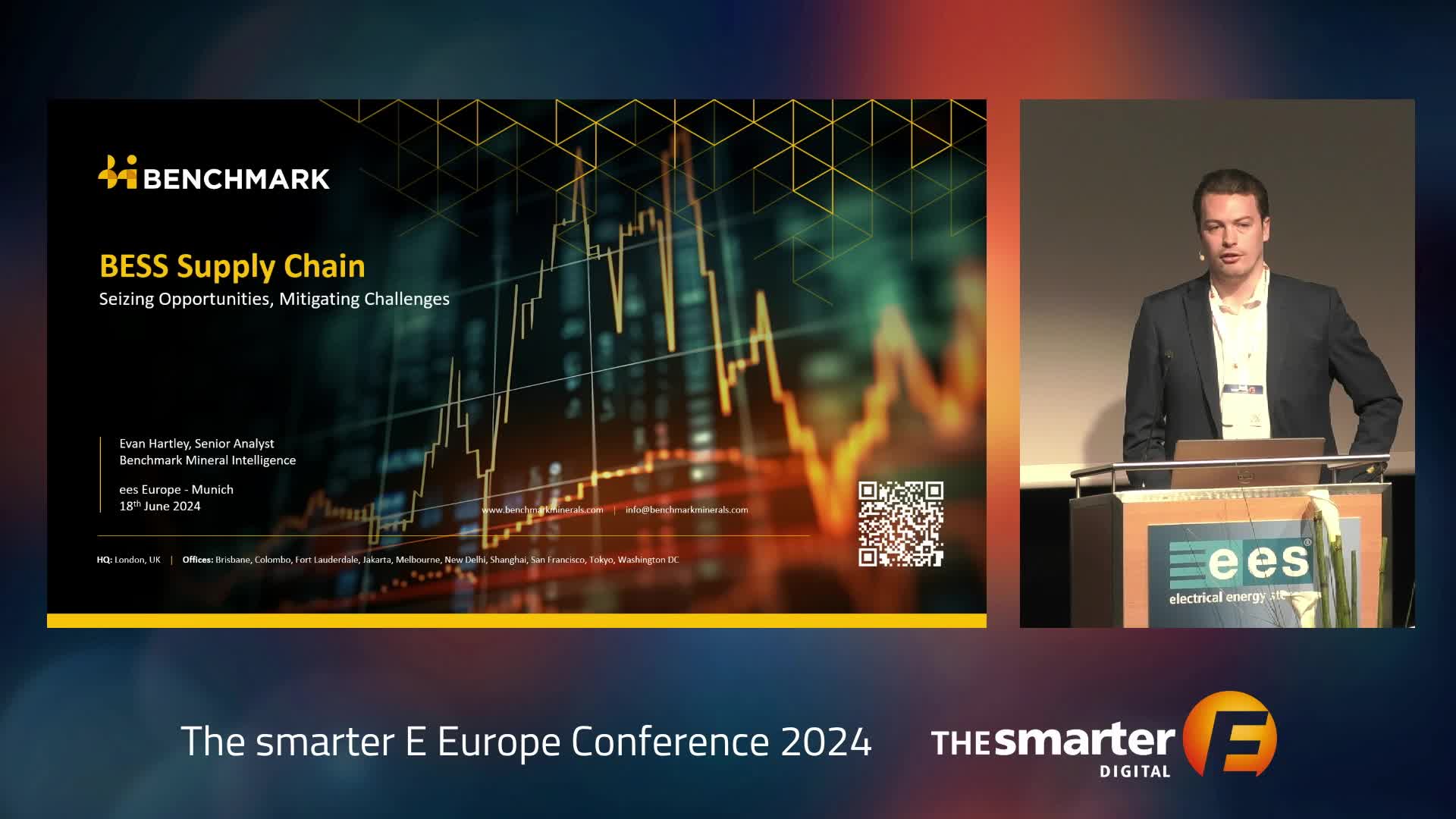
Recording of Tuesday, June 18, 2024 | The smarter E Europe | Conference Program | Language: English | Duration: 6:32 .
The speaker from Benchmark Mineral Intelligence discusses the current state and future outlook of the lithium-ion battery supply chain, focusing primarily on Europe. Despite significant price drops in raw materials over recent years—most notably a nearly 90% decrease in lithium prices—the European market remains heavily reliant on Chinese producers. For Europe to develop a self-sufficient energy storage supply chain, substantial investment and innovation are required, particularly in local production technologies like Lithium Iron Phosphate (LFP). The presentation highlights planned capacities for battery cell production both within China and globally by the end of the decade, noting China's shift towards LFP dominance while other regions remain focused on Nickel Cobalt Manganese (NCM) or Nickel Cobalt Aluminum Oxide (NCA) batteries. Moreover, ongoing projects by companies such as Stellantis and Mercedes indicate potential shifts toward LFP ventures to mitigate issues like sodium sulfate waste associated with NCM cathode capacity. Ultimately, fostering a homegrown supply chain will necessitate continued investment despite falling material costs.
Automated summarization by AI Conver
Evan Hartley
Senior Analyst
Benchmark Mineral Intelligence
United Kingdom
The worst appears to be over. After significant bottlenecks in the battery energy storage systems (BESS) supply chain, the supply of lithium-ion batteries is expected to far exceed demand, helping to resupply the market. However, a closer look reveals that BESS players should continue to actively manage their supply chain, given the continued market dominance of EV OEMs, rising ESG concerns, increasing barriers to free trade and the notorious "pork cycles" of the mining industry. But how should players respond?In this panel, key players will discuss key trends in the BESS value chain, share their perspectives on the resulting challenges and opportunities, and discuss the best strategies to secure supply at optimal cost.
Further Talks of this session:
Speaker
Florian Mayr
Partner
Apricum - The Cleantech Advisory
Germany
Speaker
Violette Coquatrix
Vice President Supply Chain Operations EMEA
Fluence
United Kingdom
Speaker
Corrine Lin
Chairman and Chief Analyst
InfoLink Consulting Co,. Ltd.
China
Speaker
Jérôme Bersano
Director of Products ESS
Northvolt
Sweden