Recording of Wednesday, June 19, 2024 | The smarter E Europe | Conference Program | Language: English | Duration: 16:08 .
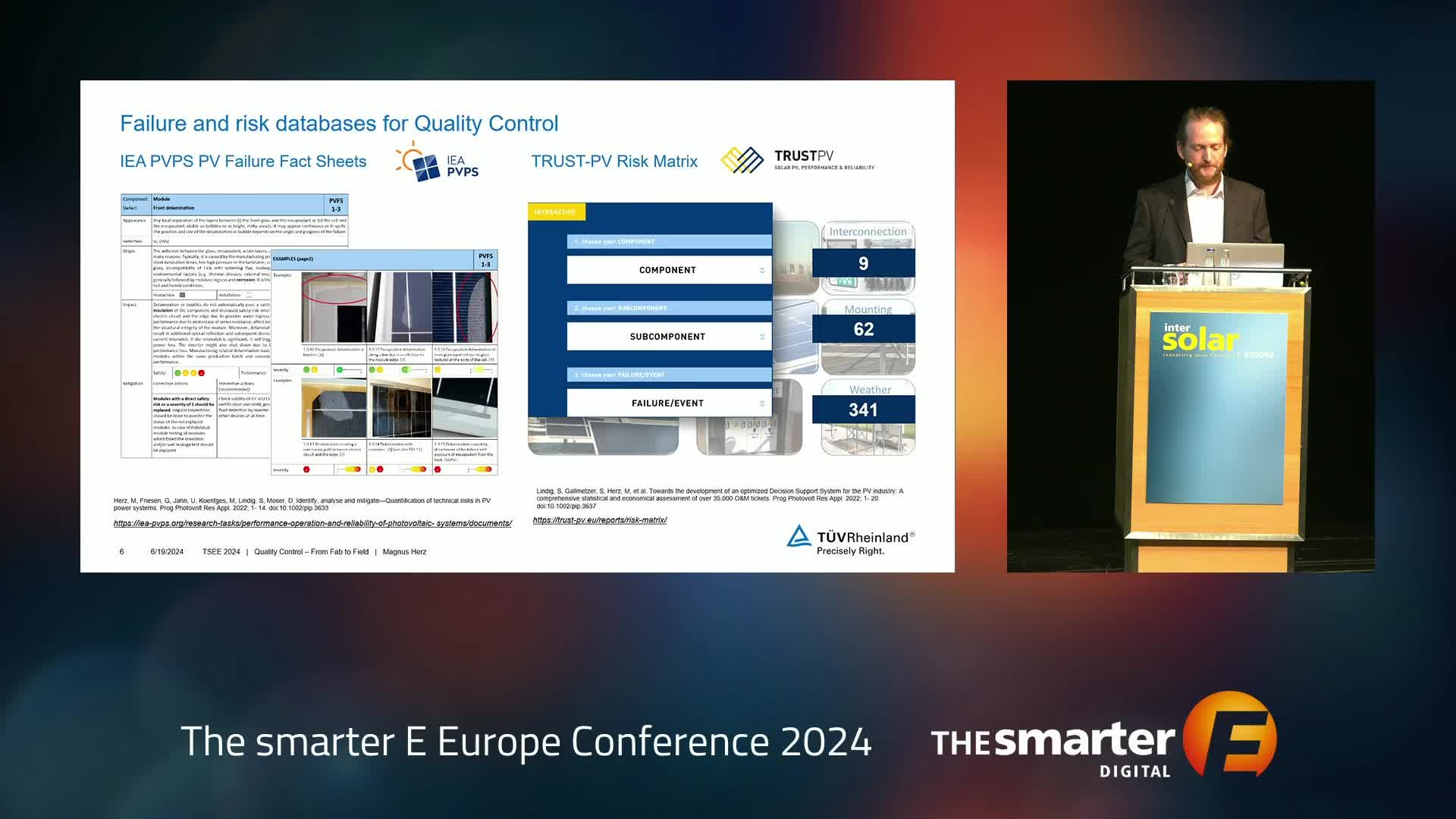
Quality control and quality assurance are foundational to TÜV Rheinland's services, spanning from development through operation. The presentation highlights the importance of continuous quality control in light of rapid advancements in photovoltaic (PV) technology. Historical data shows a shift from aluminum back surface field modules, phased out by 2023, to emerging technologies like Topcon N-type and heterojunction cells. This evolution introduces new risks related to changing wafer thicknesses and module sizes. Potential risks associated with these changes include mechanical durability issues due to thinner glass and larger module sizes, UV-induced degradation affecting glass integrity, and failures arising during transportation or manufacturing. To address these challenges, databases such as PV failure fact sheets developed by IEA PVPS Task 13 provide crucial information on potential failures and mitigation strategies. Furthermore, mobile laboratories equipped for onsite testing can detect deviations in power measurements across different manufacturers' batches. Such inspections often reveal transport-related cracks or pre-existing manufacturing defects not identified at production stages. Effective sample picking is essential to account for variations within different performance classes of the same manufacturer. During construction monitoring using tools like LED solar simulators helps identify inconsistencies early on while ensuring that damaged modules do not reach operational sites without detection. Lastly, ongoing operational checks focus on structural vulnerabilities where installation clamps can create stress points leading to fractures.
Automated summarization by AI Conver
Magnus Herz
Project Manager
TÜV Rheinland Energy GmbH
Germany
If designed and maintained well, solar systems can function for several decades. However, every PV power plant's life ends at some point - even if high-quality components have been used, whether because of age, financial feasibility or extreme weather events. The resulting waste streams need to be managed, but also generate a huge potential for repowering solar installations.
This session will provide:
Further Talks of this session:
Speaker
Adele Ara
Chief Technology Officer
Lightsource bp
UK
Speaker
Sishir Garemella
Head of Interational Business Development
Kiwa PVEL
USA
Speaker
Tomaso Charlemont
Head of PV Revamping / Repowering EMEA
BayWa r.e. AG
Germany
Speaker
Ulrike Jahn
Senior Scientist
Fraunhofer Center for Silicon-Photovoltaics CSP
Germany