Understanding the Latest in PV Module Performance and Reliability

premium account

Recording of Wednesday, June 19, 2024 | The smarter E Europe | Conference Program | Language: English | Duration: 15:24 .

Kiwa PVEL Highlights Increased Top Performers and Failures in Latest Solar Module Reliability Scorecard

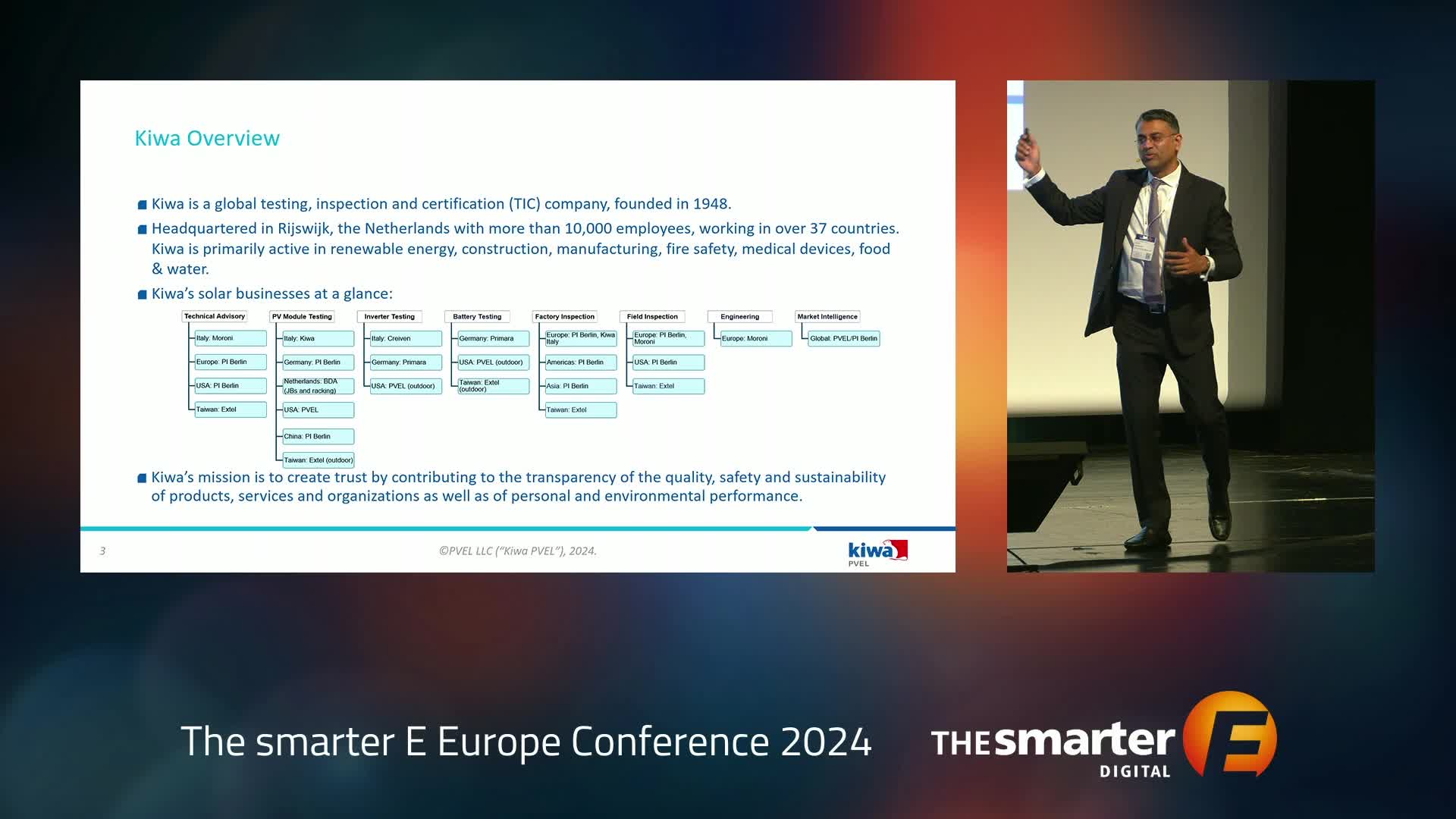
Sishir Garemella, head of international business development at Kiwa PVEL, addressed an audience in Munich about the latest developments in module testing by his reliability lab based in California. The lab has gained prominence for its Product Qualification Program (PQP), a rigorous 10-step process designed to evaluate solar modules' longevity under environmental stress. Modules are manufactured and tested under controlled conditions to ensure they meet or exceed standards set out by IEC 61215. This year's PQP findings were encapsulated in the Kiwa PVEL PV Module Reliability Scorecard released on June 5th. Key insights included an increase in top-performing modules and greater geographical diversity among manufacturers, debunking the myth that high-quality solar production is limited to one country. However, there was also a notable rise in failure rates: two-thirds of bills of materials experienced at least one failure during testing. Only four BOMs achieved top performer status across all seven assessment categories. The presentation emphasized balancing industry enthusiasm with caution due to rapid technological changes and underscored the importance of thoroughly vetted products before procurement decisions are made.

Automated summarization by AI Conver

Sishir Garemella
Head of Interational Business Development
Kiwa PVEL
USA

If designed and maintained well, solar systems can function for several decades. However, every PV power plant's life ends at some point - even if high-quality components have been used, whether because of age, financial feasibility or extreme weather events. The resulting waste streams need to be managed, but also generate a huge potential for repowering solar installations.

This session will provide:

  • Overview of end-of-life management best practices
  • Product quality control from fab to field
  • Module reliability & performance
  • Repowering solar power plants
  • The impact of extreme weather on climate

Further Talks of this session:

Speaker

Adele Ara
Chief Technology Officer
Lightsource bp
UK

To Talk

Speaker

Magnus Herz
Project Manager
TÜV Rheinland Energy GmbH
Germany

To Talk

Speaker

Tomaso Charlemont
Head of PV Revamping / Repowering EMEA
BayWa r.e. AG
Germany

To Talk

Speaker

Ulrike Jahn
Senior Scientist
Fraunhofer Center for Silicon-Photovoltaics CSP
Germany

To Talk

Further Content
Webinar Collection
Growth of the European Solar Market, Specifically, Romania

February 24, 2026

free account

Webinar: EU Solar Market Overview with Focus on Romania

Webinar
Green Hydrogen & PV in Brazil: 24/7 Renewable Energy Opportunities in the Northeast

March 26, 2026

Explore how Brazil advances toward 24/7 clean energy by combining solar power and green hydrogen.

Webinar Collection
Mexico’s commercial and industrial solar thermal: from potential to projects

February 19, 2026

free account

Discover Mexico’s C&I solar thermal market, opportunities, trends and successful projects

Webinar
5 Challenges in the Electrification of Commercial Vehicle Fleets

April 29, 2026

Save on fleet costs by asking the right questions

The smarter E Europe Conferences 2025
Q&A Session of of the Session Off-Grid: Rural Electrification Based on Solar Systems - Lessons Learned

Wednesday, May 07, 2025, 11:00 am - 12:30 pm

The smarter E Europe Conferences 2025 | Conference Program

premium account

Off-grid solar systems are often the least expensive option for rural electrification. Solar home systems can power individual households, while mini-grids can supply entire villages. Each comes with its own advantages, disadvantages, and challenges. The aim of this session is to explore challenges as well as success stories. It takes well-functioning components such as battery systems, charge management and inverters to make projects successful. Proper system sizing, maintenance and repair management, as well as a robust financial concept are also necessary. If one of these elements is missing, the electrification will not be sustainable. This session will focus on the aspects mentioned above. The speakers will present successful and unsuccessful approaches and discuss what can be learned from them.

You are using an outdated browser

The website cannot be viewed in this browser. Please open the website in an up-to-date browser such as Edge, Chrome, Firefox, or Safari.