Regulatory Conditions for Sustainable Financing in Europe

premium account

Recording of Wednesday, June 19, 2024 | The smarter E Europe 2024 | Conference Program | Language: English | Duration: 22:58 .

Europe Accelerates Green Investments Amidst Global Competitiveness and Regulatory Challenges

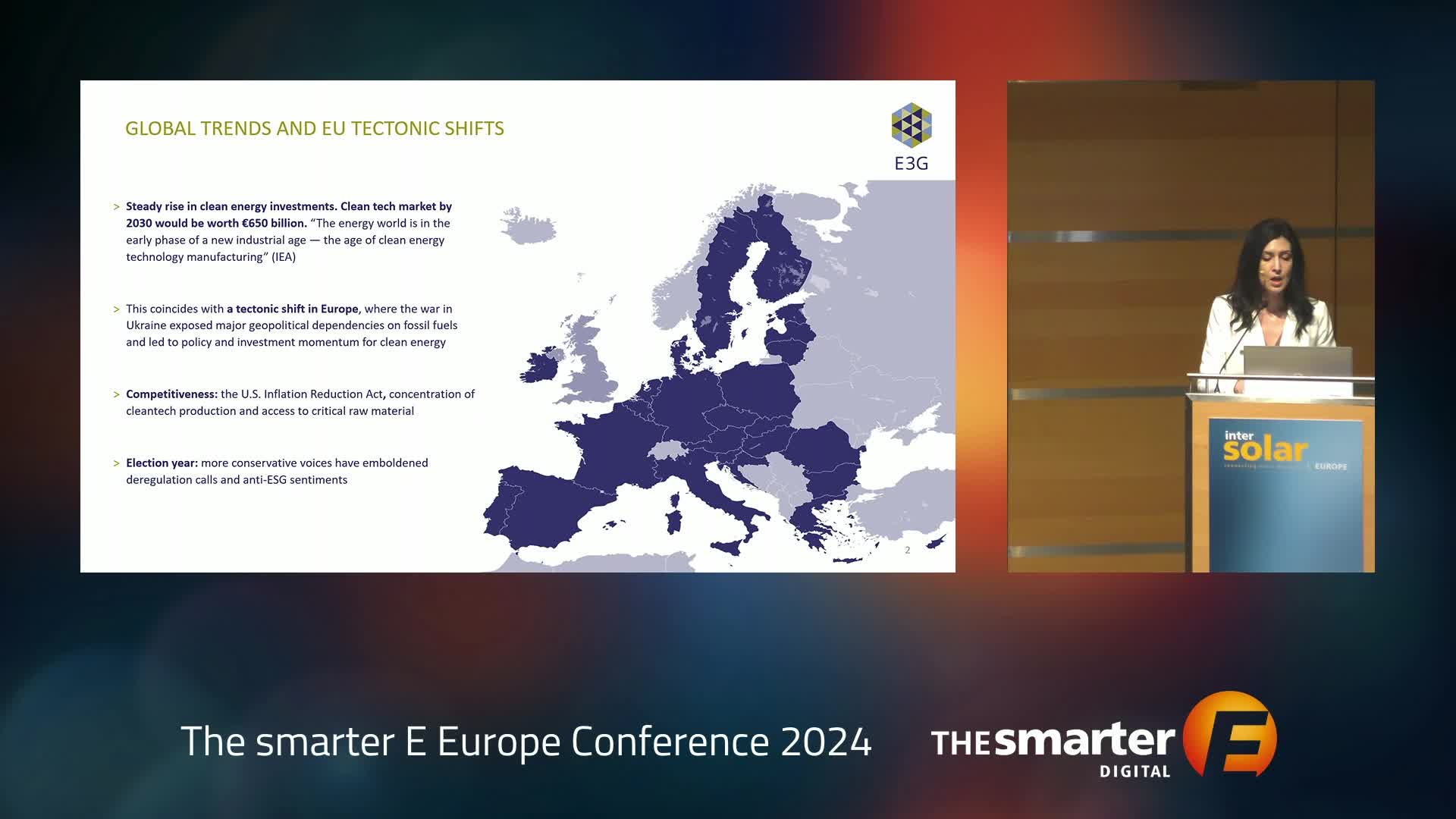
Tsvetelina Kuzmanova, speaking at a panel of women in finance, delves into the current state and future trends of financial flows in Europe. Based in Brussels with E3G -Third Generation Environmentalism, a climate think tank, she collaborates closely with EU policymakers to design tools and policies that boost green investments. The geopolitical context spurred by the war in Ukraine has significantly accelerated Europe's shift from fossil fuels to renewables like solar energy. Notably, Europe leads globally in renewable investment ratios compared to fossil fuels (10:1). The competitiveness sparked by the U.S.’s Inflation Reduction Act and China's dominance in clean tech production is shaping European market dynamics post-European elections. This conservative shift has emboldened deregulation efforts against green finance rules. Despite global election-year politics influencing ESG movements negatively as seen through recent American court rulings against institutional investors for green energy focus, there's an upward trend overall for clean investments worldwide—predominantly solar. Kuzmanova highlights sustainable debt issuance as crucial for scaling up investments outside China; public funding's importance grows alongside private sector contributions due to affordability needs for end users. Green bonds emerge as key instruments within Europe's toolkit—Europe being the world's largest issuer of these bonds amounting to over €800 billion issued over a decade.

Automated summarization by AI Conver

Tsvetelina Kuzmanova
Senior Policy Advisor
E3G -Third Generation Environmentalism
Belgium

Despite the global exponential growth of solar power, challenges currently loom large — from soaring debt costs to dwindling capture prices and escalating curtailment rates. These hurdles threaten to impede deployment growth in the urgent race to triple renewables installation by 2030. The pressure for innovative solutions and rapid action is high, and financing is key. Our session will therefore convene investors, developers and financing institutions to analyze key issues and explore new perspectives on solar finance, with the aim of driving the realization of a sustainable and prosperous future through advanced solar initiatives.

Topics will include:
1. Assessing financing conditions for solar power plants
2. Analyzing the impact of policy shifts on PV project financing
3. Strategizing to enhance solar project financing

This panel discussion is organized by the Bundesverband Solarwirtschaft (BSW-Solar) in cooperation with the Women Energize Women (WEW) initiative. Women Energize Women (#womenenergize) is a campaign for the global empowerment of women in the energy sector by the Federal Ministry for Economic Affairs and Climate Action (BMWK). It is implemented by the Deutsche Gesellschaft für Internationale Zusammenarbeit (GIZ) within the scope of BMWK's global project Bilateral Climate and Energy Partnerships and Dialogues. (https://www.womenenergize.org/)

Speaker

Katarzyna Rezza Vega
Head of Women Energize Women
German Corporation for International Cooperation (GIZ) GmbH
Madagascar

To Talk

Speaker

Dr. Konstanze Kinne
Head of Treasury Aquila Clean Energy EMEA
Aquila Capital
The Netherlands

To Talk

Speaker

Rosa Tarragó
Investment Director
EBG compleo GmbH
Germany

Rethabile Melamu
CEO
South African Photovoltaic Industry Association
South Africa

Tsvetelina Kuzmanova
Senior Policy Advisor
E3G -Third Generation Environmentalism
Belgium

Dr. Konstanze Kinne
Head of Treasury Aquila Clean Energy EMEA
Aquila Capital
The Netherlands

To Talk

Further Content
Webinar
Mixed Investment Solar Projects in Mexico: The 54% Model Explained

January 29, 2026

Mexico has introduced a new mixed investment scheme for renewable power generation, requiring a minimum 54% direct or indirect participation by CFE.

Anna Darmani, Principal Analyst from Wood Mackenzie
Big BESS Is Here to Save the Day

The smarter E Podcast Episode 246 | Language: English

January 8, 2026

Utility-scale batteries are booming in Europe. Discover key BESS trends, market impacts, and what to expect for large-scale storage in 2026.

The smarter E Europe Conferences 2025
Setting the Scene "Off-Grid"

Wednesday, May 07, 2025, 04:00 pm - 05:30 pm

The smarter E Europe Conferences 2025 | Conference Program

premium account

Photovoltaic prices have fallen continuously in recent years - a trend that should translate into a growing market for off-grid solutions. Declining costs are crucial for rural electrification in particular, making sustainable energy supply economically viable in remote regions. However, so far many of these price advantages have not yet reached the people that need them most. Do existing framework conditions to foster rural electrification still work in this new market reality? Which measures are needed to ensure that cost reductions reach our target group? This session discusses strategies for improving the availability of low-cost off-grid solutions, financing and innovative business models. A look at successful practical examples shows which political, economic and technological levers need to be pulled to make off-grid PV accessible on a large scale.

The smarter E Europe Conferences 2025
Factors That Influence the Success of a Minigrid Project

Wednesday, May 07, 2025, 11:00 am - 12:30 pm

The smarter E Europe Conferences 2025 | Conference Program

premium account

Off-grid solar systems are often the least expensive option for rural electrification. Solar home systems can power individual households, while mini-grids can supply entire villages. Each comes with its own advantages, disadvantages, and challenges. The aim of this session is to explore challenges as well as success stories. It takes well-functioning components such as battery systems, charge management and inverters to make projects successful. Proper system sizing, maintenance and repair management, as well as a robust financial concept are also necessary. If one of these elements is missing, the electrification will not be sustainable. This session will focus on the aspects mentioned above. The speakers will present successful and unsuccessful approaches and discuss what can be learned from them.

The smarter E Europe Conferences 2025
Q&A Session of of the Session Off-Grid: Rural Electrification Based on Solar Systems - Lessons Learned

Wednesday, May 07, 2025, 11:00 am - 12:30 pm

The smarter E Europe Conferences 2025 | Conference Program

premium account

Off-grid solar systems are often the least expensive option for rural electrification. Solar home systems can power individual households, while mini-grids can supply entire villages. Each comes with its own advantages, disadvantages, and challenges. The aim of this session is to explore challenges as well as success stories. It takes well-functioning components such as battery systems, charge management and inverters to make projects successful. Proper system sizing, maintenance and repair management, as well as a robust financial concept are also necessary. If one of these elements is missing, the electrification will not be sustainable. This session will focus on the aspects mentioned above. The speakers will present successful and unsuccessful approaches and discuss what can be learned from them.

You are using an outdated browser

The website cannot be viewed in this browser. Please open the website in an up-to-date browser such as Edge, Chrome, Firefox, or Safari.