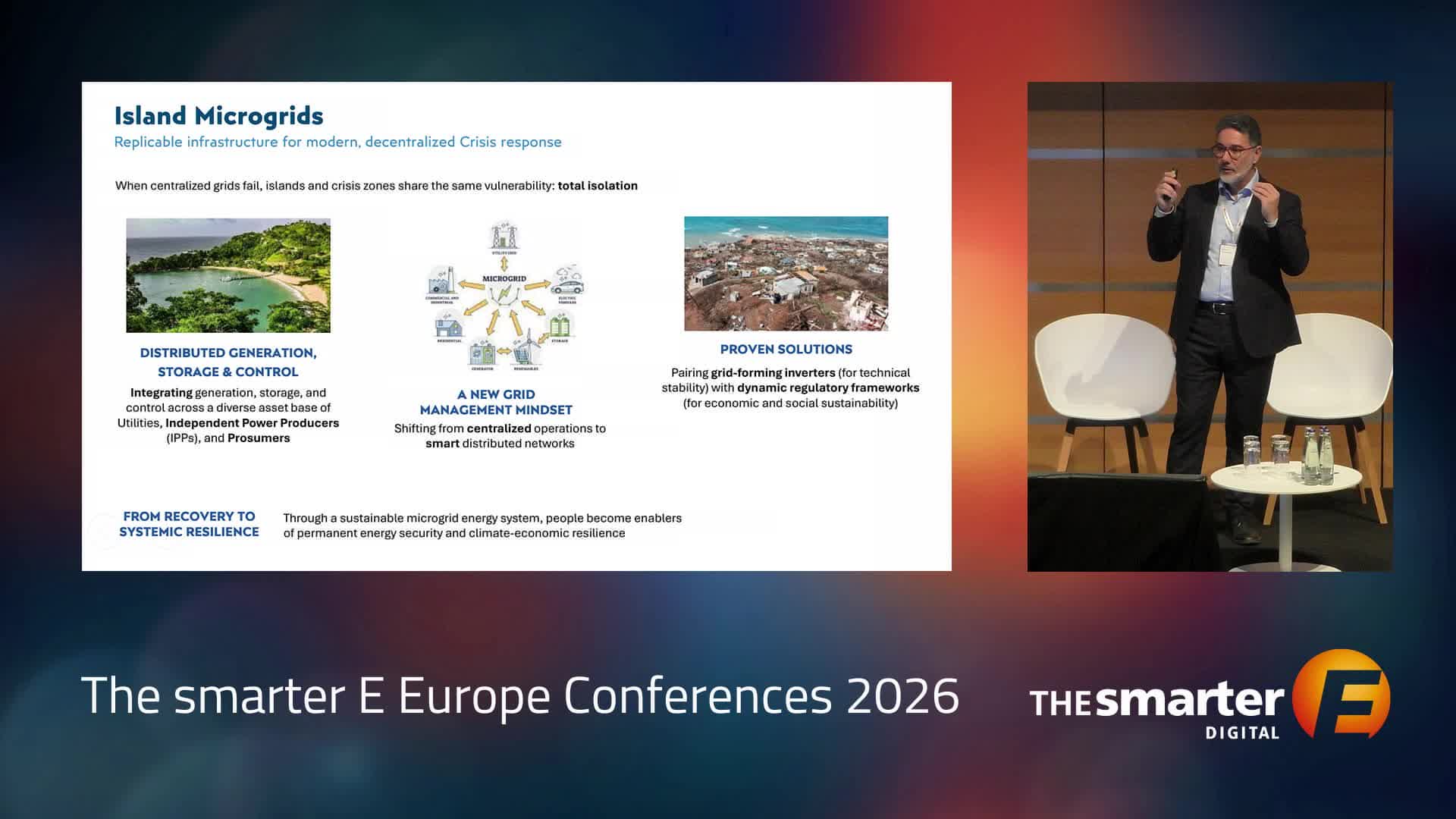
Recording of Tuesday, June 23, 2026 | The smarter E Europe Conferences 2026 | Language: English | Duration: 17:45 .
Greening the Islands is a global non-profit foundation dedicated to creating economically resilient communities on remote islands through 100% renewable energy. It emphasizes multi-sectoral cooperation, advocating for sustainable development and climate resilience at events like COP and New York Climate Week. Political will is crucial for phasing out fossil fuels and ensuring effective sustainable energy policies. Comprehensive planning for electricity demand is essential for transitioning existing methods to renewable sources. Full electrification enhances local demands, attracting investment and contributing to national security and economic growth. The initiative launched the 100% Renewable Islands Initiative to provide a roadmap for islands, utilizing microgrids and advocating for partnerships with global organizations. Notable projects include a multi-stakeholder committee in St. Kitts and Nevis focused on optimizing energy infrastructure, and training programs aimed at building local capacity in remote areas. Overall, the integration of innovative technologies and community involvement is vital for overcoming challenges unique to island environments.
Automated summarization by AI Conver
Speaker
Gianni Chianetta
Chair
Greening the Islands Foundation
Italy
In this urgent and forward-looking session of the Intersolar Europe Conference, we bring together voices from the frontlines of decentralized energy: representatives from Syria, Ukraine and Ethiopia - spanning immediate crisis response and longer-term energy market development - alongside practitioners who build and operate these systems at scale. What unites all perspectives is a shared insight: decentralized renewable energy proves its reliability precisely where conventional grids are absent, destroyed or isolated - from war-torn regions to island communities cut off from mainland supply.The initial focus is on the immediate, life-saving needs: hospitals, schools and water supply systems. We then move to the medium-term goal - interconnecting mini-grids, rebuilding resilient infrastructure, creating new jobs and livelihoods. A central question runs through both phases: how do we train local workforces through vocational training, apprenticeships and certification programs, so that rebuilding is not only about hardware, but about people and enduring capacity?Join us to examine how off-grid solar transitions from emergency stop-gap to the sustainable backbone of recovery and growth.
Further Talks of this session:
Speaker
Lea Dunst
International Project Manager
BSW - German Solar Association
Dr. Tania Rödiger-Vorwerk
Director, Climate, Environment, Health, Federal Ministry for Economic Cooperation and Development
Bundesministerium für wirtschaftliche Zusammenarbeit und Entwicklung (BMZ)
Speaker
Vladyslav Sokolovskyi
Chairman of the Board of the Solar Energy Association of Ukraine
Solar Energy Association of Ukraine
Ukraine