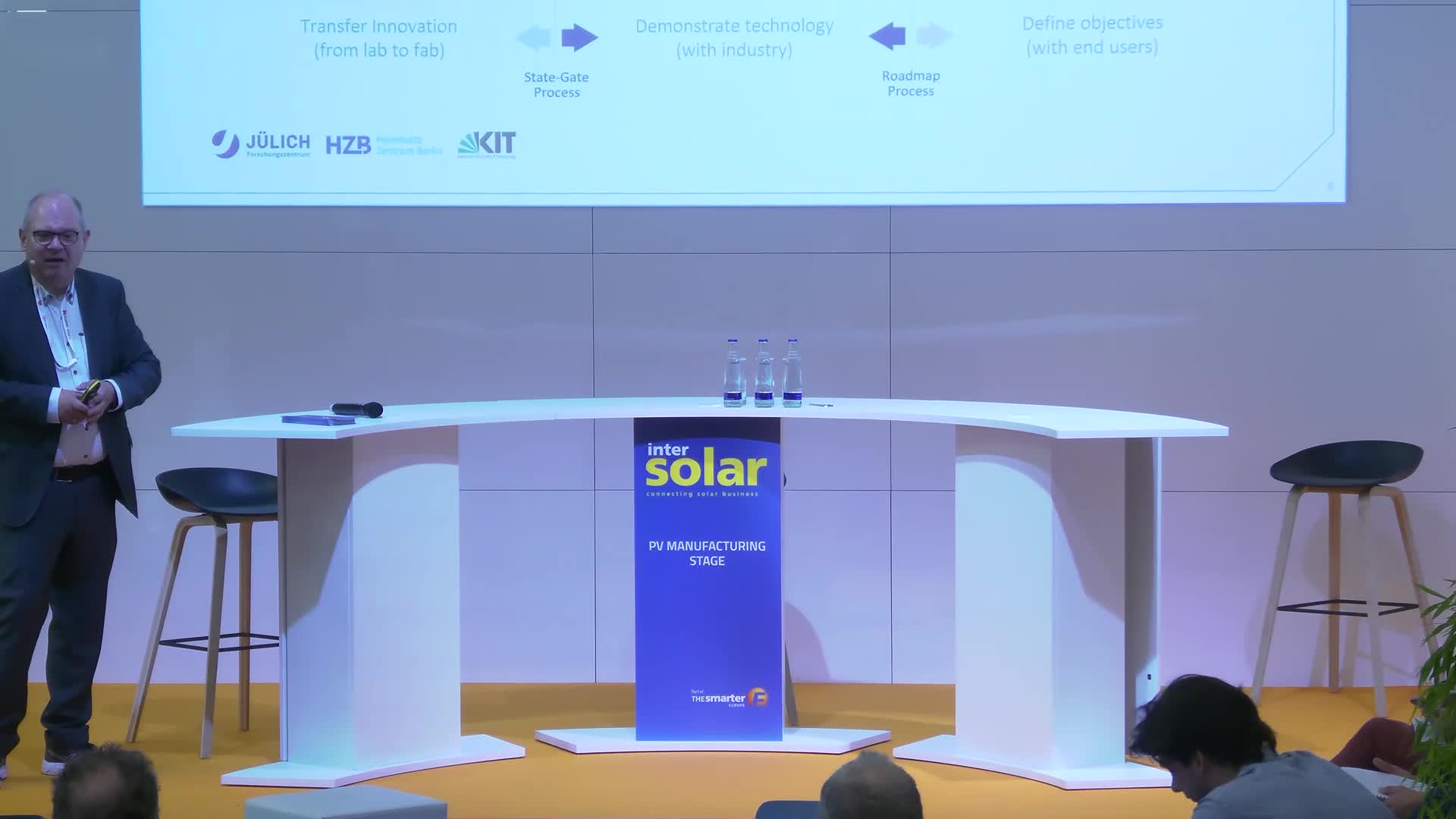
Solartap - Initiating Emerging Pv - from the Lab to the Fab

premium account

Recording of Thursday, June 20, 2024 | The smarter E Europe | Exhibition Program | Language: English | Duration: 13:56 .

"Germany's Helmholtz Institutes Launch SolarTEP to Bridge Research and Industry for Advanced Solar Technology Integration Across New Applications."

The context revolves around the efforts to scale up solar energy production, particularly in Germany. Currently, global solar capacity stands at one terawatt (2022), with an ambitious goal of reaching 80 terawatts. Given limited landscape space for traditional installations, innovative approaches are needed. Helmholtz Institutes have been pivotal in developing adaptable and scalable solar technologies such as printed photovoltaic (PV) panels—lightweight, flexible, and suitable for diverse applications like agriculture, buildings, and mobility infrastructure. To facilitate industrial adoption of these innovations, SolarTEP was founded. This initiative aims to bridge research and industry through structured collaboration mechanisms like roadmaps identifying research gaps and stage-gate processes ensuring systematic progress towards application targets. Helmholtz's labs play a crucial role by providing physical laboratories equipped with advanced machinery alongside "living labs" that test applications in real-world settings. A digital twin lab further enhances testing capabilities through simulations. Overall, SolarTEP seeks active industry participation to transform ongoing research into practical solutions efficiently.

Automated summarization by AI Conver

European research institutes are leaders in solar cell research, as evidenced by impressive results in TOPCon, SHJ, and IBC cells. Promising laboratory results paint a bright future for the technological development, with the next frontier involving the integration of clean room technologies into production lines. Additionally, innovative approaches by forward-thinking companies aim to conserve resources, such as silicon, silver, and process consumables, through consumption reduction or the use of alternative materials and processes. This session brings together pioneering approaches, alongside steady and robust R&D development on the journey from lab to fab. Solar device development is high-tech.

Further Talks of this session:

To Talk

To Talk

To Talk

To Talk

To Talk

Further Content
Rutger Schlatmann and Angelika Harter
Perovskites: The Race for the Future of PV?

The smarter E Podcast Episode 258 | Language: English

June 25, 2026

HZB researchers explore perovskite tandem solar cells, efficiency gains, and the challenges of bringing the technology to market.

Tim Meyer
Can Renewables Deliver 24/7 Power?

The smarter E Podcast Episode 259 | Language: English

July 2, 2026

Can renewables power an industrial nation 24/7? Tim Meyer and expert guests discuss breakthrough insights from The smarter E Europe 2026.

Publications
European Battery Market Outlook 2026-2030

June 24, 2026

European Battery Market Outlook 2026-2030: How utility-scale storage drives energy sovereignty and grid flexibility despite looming target gaps.

Publications
Global Market Outlook for Solar Power 2025–2029

SolarPower Europe’s annual Global Market Outlook for Solar Power is the most authoritative market analysis for the solar sector.

The smarter E Europe Conferences 2026
Panel Discussion of the Session: Turning Industrial and Commercial Demand Side Flexibility into Value

Tuesday, June 23, 2026, 02:30 pm

The smarter E Europe Conferences 2026 | Conference Program

premium account

Industrial and commercial flexibility is no longer experimental - it is becoming a core part of network operation and market participation. Across Europe, DSOs, transmission system operators (TSOs), aggregators and retailers are moving from isolated pilots to coordinated programs that avoid grid upgrades and deliver real capacity and financial value for all participants.This session focuses on the operational integration of C&I flexibility into routine grid workflows through dispatch, settlement, verification and commercial models. It highlights how flexibility is embedded in daily operations: from automated dispatch and verification tools to new contractual models that reward large energy users for adapting consumption. You will gain insight into replicable approaches for scaling flex portfolios, integrating them into control-room workflows and ensuring fair value-sharing across utilities, service providers and industrial consumers.

You are using an outdated browser

The website cannot be viewed in this browser. Please open the website in an up-to-date browser such as Edge, Chrome, Firefox, or Safari.