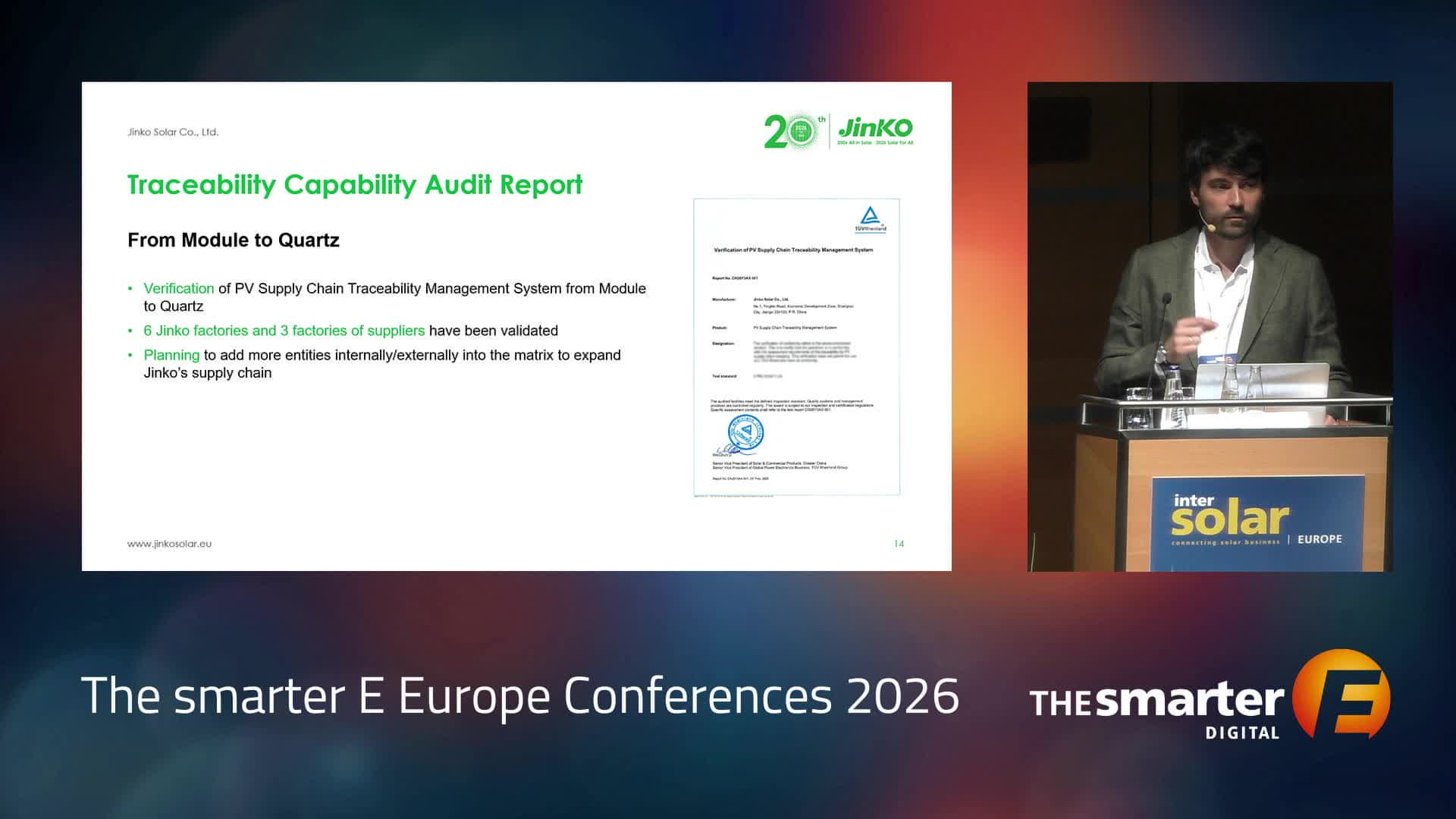
Recording of Monday, June 22, 2026 | The smarter E Europe Conferences 2026 | Language: English | Duration: 10:35 .
Companies must achieve transparency in their supply chains and communicate their sustainability commitments effectively. A robust sustainability policy and management system focused on environmental, social, and governance (ESG) criteria are essential for navigating regulatory changes. Third-party verification is crucial for assessing operations and supply chain practices, as demonstrated by Ginkgo's alignment with initiatives like RE100 and EP100. Jinko emphasizes its commitment to low-carbon products, collaborating with certifiers like ICMQ and EPDC to certify carbon footprint reductions. Jinko conducts audits to ensure compliance with ESG standards, employing third-party firms to enhance transparency. The company also implements a trustability program validated by external entities, monitoring supplier adherence to ESG practices. Regular ESG audits on suppliers promote proactive engagement, with a focus on rewarding high performers and enhancing supply chain management amid evolving regulations.
Automated summarization by AI Conver
Speaker
Mario Quintana Aroca
ESG Manager Europe
JinkoSolar
China
Europe's solar market has lately been influenced by ESG and supply chain transparency. Yet shifting political priorities and tighter project budgets have been refocusing attention on feasibility and cost. How essential are sustainability criteria today? Considering supply security, raw material availability and circular economy principles, this session will explore how new EU regulations and market demands are reshaping ESG strategies in solar system design and the procurement of components.
Key topics:
Further Talks of this session:
Speaker
Mate Heizs
Chairman
SolarPower Europe
Belgium
Speaker
Alexander Plonka
Product Lifecycle Manager
KACO new energy GmbH - A Siemens Company
Speaker
Matthias Stucki
Head of LCA Research Group
ZHAW - University of Applied Sciences Zurich
Switzerland
Speaker
Lukas Braun
E&D Engineer
SOLAR MATERIALS GmbH
Germany