The End of Subsidy-Driven PV: How System-Level Optimization Turns Homes into Market Participants

premium account

Recording of Thursday, June 25, 2026 | The smarter E Europe Exhibition Program 2026 | Language: English | Duration: 10:07 .

GridX and the Future of Renewable Energy for Prosumers

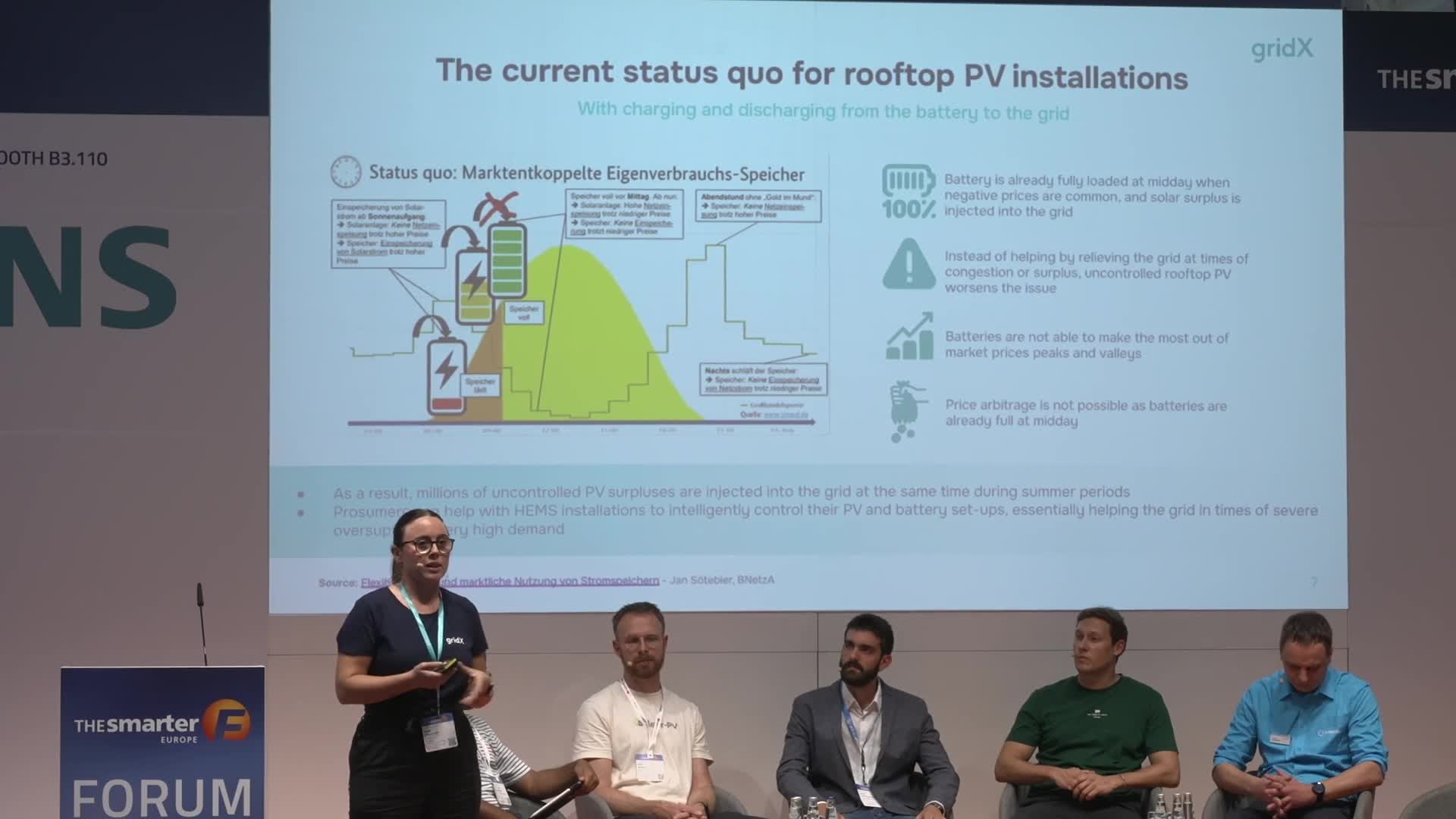
GridX is positioning itself as a leader in renewable energy accessibility, aiming to make it affordable for all. The company has over 240,000 connected assets that activate 40 megawatt hours of flexibility daily, targeting utilities and energy retailers amid regulatory changes in Germany. A significant shift occurs in 2027 when new photovoltaic installations will no longer receive feed-in tariffs, prompting prosumers to explore innovative business models for sustainability. Prosumers currently receive about €370 annually from subsidies, potentially decreasing with a switch to direct marketing. To mitigate potential revenue losses and enhance profitability, GridX proposes aggregating prosumer households into a trading pool that can access various market opportunities. The implementation of dynamic grid fees and bidirectional charging technology is also being explored to optimize energy usage and stabilize the grid. The upcoming Agnes reforms in 2029 may necessitate equitable cost-sharing measures among photovoltaic generators to support grid expansion. Overall, adapting to these changes is critical for prosumers' success in a competitive energy landscape.

Automated summarization by AI Conver

Speaker

Irene Guerra Gil
Energy Market Expert
gridX

Home and Building Energy Management Systems (HEMS & BEMS) are becoming essential tools for installers and system integrators delivering smart, energy-efficient buildings. From PV, EV charging and storage to heating, automation and grid interaction, modern EMS solutions must be easy to integrate, interoperable and future-ready. This session highlights practical solutions, standards and real-world implementations shaping the next generation of smart homes and buildings.

Further Talks of this session:

Speaker

Dr. Anurag Mohapatra
Group Leader, Center for Combined Smart Energy Systems
Technical University of Munich

To Talk

Speaker

Stefan Feilmeier
Deputy CEO
Fenecon

To Talk

Speaker

Niklas Hemberger
Head of Bidi Home
The Mobility House GmbH

To Talk

Speaker

Jorge López Lanzuela
Product Manager
meteocontrol GmbH

To Talk

Speaker

Willi Appler
Co-Founder and CCO
clever-PV

To Talk

To Talk

Further Content
Publications
Cost-optimal Transformation of the German Energy System by 2045

June 23, 2026

New Fraunhofer ISE study for The smarter E Europe: Pathways to a resilient, cost-effective & climate-neutral energy system by 2045.

The smarter E Europe Conferences 2026
Panel Discussion of the Session: User Success Stories and Best Cases

Tuesday, June 23, 2026, 02:30 pm

The smarter E Europe Conferences 2026 | Conference Program

premium account

For more than two decades, Norway has been steadily building a marketplace for electric transport. Having started out with inexpensive short-range electric cars and household charging sockets, Norway has now moved to mass-market solutions where fast charging (DC) and grid balancing (AC) plays an ever more vital role. With more than 1,000,000 electric cars and over 10,000 fast chargers in a relatively small market, Norway offers a rare early view of large-scale electrification. Over the past decade, electric cars have seen substantial improvements, which is now making it easier for new markets to advance electrification. At the same time, Norway has to deal with challenges years before other markets do. Yet despite different starting points, we can see that most markets are facing the same core challenges. From grid-smart charging strategies to innovative business models, there are excellent examples of best practices emerging elsewhere in Europe. What will the next thing in electrification be, both in mature and in emerging markets? And what will be possible when the right people and companies come together, sharing knowledge, solving common problems and accelerating the shift to cleaner mobility?

Battery Business & Development Forum
BESS Routes-to-Market in Europe: Merchant, Capacity, and Tolling — What Works Where

Tuesday, March 31, 2026 11:45am–1:00pm

premium account

This session breaks down the three dominant routes-to-market in Europe and examines where they work in practice, how they are structured, and what risks they carry.

Battery Business & Development Forum
Future-Proof BESS: Procurement, Design and Lessons from Operating Projects

Wednesday, April 1, 2026 2:45pm–4:00pm

premium account

This session examines how procurement, system design and construction choices affect project outcomes — and what developers should do differently.

Battery Business & Development Forum
Deep Dive: Resilient Grids with Grid-Forming Batteries: Market Opportunities and Technical Pathways

Tuesday, March 31, 2026 11:45am–1:00pm

premium account

This session highlights their growing role in grid stability, including grid-forming, voltage control, congestion management and system support across transmission and distribution networks.

You are using an outdated browser

The website cannot be viewed in this browser. Please open the website in an up-to-date browser such as Edge, Chrome, Firefox, or Safari.