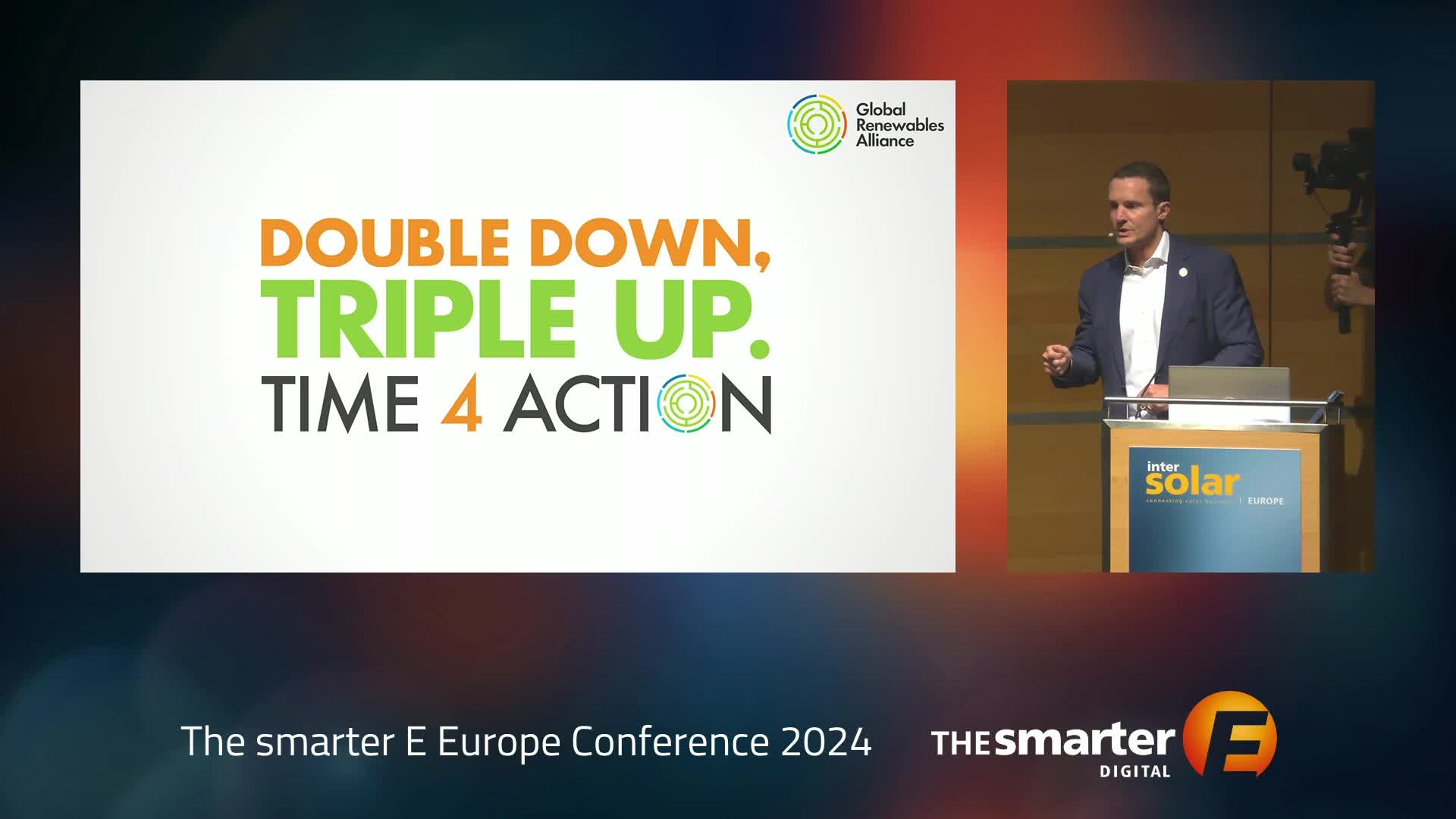
Tripling Renewable Energy by 2030 - Time 4 Action: Status and Next Steps

premium account

Recording of Tuesday, June 18, 2024 | The smarter E Europe | Conference Program | Language: English | Duration: 10:23 .

Global Renewables Alliance CEO Bruce Douglas Highlights Need for Accelerated Renewable Energy Deployment and Massive Financing to Meet COP28 Commitments by 2030

Bruce Douglas, CEO of the Global Renewables Alliance (GRA), highlights the organization's mission to triple global renewable energy capacity by 2030. The GRA supports a broad spectrum of renewable sources including solar, wind, geothermal, and hydropower. Emphasizing the necessity for long-duration energy storage and green hydrogen to meet their goals, Bruce discusses past achievements such as securing commitments at COP28. The target involves installing around 7,000 gigawatts in seven years or roughly three gigawatts per day. The GRA’s agenda includes urgent reforms in permitting processes, grid infrastructure development, supply chain management, financing solutions amounting to $10 trillion cumulative investment by 2030 ($1.5 trillion annually), and workforce skill enhancements. While there has been record-breaking growth in renewables deployment globally—evidenced by new investments outpacing fossil fuels—fossil fuel subsidies persistently drain resources needed for renewable expansion. Douglas stresses significant regional disparities: some areas like sub-Saharan Africa need up to twelve-fold increases in renewable installations. Despite positive trends such as declining costs leading to higher capacity installations with equal investments and exponential growth highlighted by recent reports from RMI on solar EVs and battery technology advancements—the transition away from fossil fuels remains insufficiently addressed.

Automated summarization by AI Conver

Bruce Douglas
CEO
Global Renewables Alliance
Belgium

As solar energy continues its strong global growth trajectory, exceeding all expectations, more and more obstacles are appearing on the long way towards completing the energy transition. The question is: what is needed to unleash solar's full potential in Europe and globally, and what can realistically be achieved? This session will discuss:

  • Global Market Outlook for Solar Power 2024–2028 (report launch)
  • Solar power's role in European and global decarbonization strategies
  • Solutions for unlocking the vast potential of solar

Further Talks of this session:

Speaker

Michael Schmela
Executive Advisor
SolarPower Europe
Belgium

To Talk

Speaker

Dr. Juan Rivier
Head of Global Regulation
Iberdrola
Spain

To Talk

Speaker

Vegard Vollset
VP- Head of EMEA Renewable
Rystad Energy
Norway

To Talk

Speaker

Sonia Dunlop
CEO
Global Solar Council
United Kingdom

Dr. Rodrigo Lopes Sauaia
CEO
ABSOLAR - Associação Brasileira de Energia Solar Fotovoltaica
Brazil

Walburga Hemetsberger
CEO
SolarPower Europe
Belgium

To Talk

Further Content
Webinar
Growth of the European Solar Market, Specifically, Romania

February 24, 2026

Webinar: EU Solar Market Overview with Focus on Romania

Webinar Collection
Mixed Investment Solar Projects in Mexico: The 54% Model Explained

January 29, 2026

Mexico has introduced a new mixed investment scheme for renewable power generation, requiring a minimum 54% direct or indirect participation by CFE.

Adriana Fricke, Robin Berg
Has Vehicle-to-Grid Reached the Tipping Point?

The smarter E Podcast Episode 248 | Language: English

February 5, 2026

Why 2026 could be a turning point for bidirectional EV charging – from regulation to large V2G fleets in Europe.

Webinar
Mexico’s commercial and industrial solar thermal: from potential to projects

February 19, 2026

Discover Mexico’s C&I solar thermal market, opportunities, trends and successful projects

The smarter E Europe Conferences 2025
Factors That Influence the Success of a Minigrid Project

Wednesday, May 07, 2025, 11:00 am - 12:30 pm

The smarter E Europe Conferences 2025 | Conference Program

premium account

Off-grid solar systems are often the least expensive option for rural electrification. Solar home systems can power individual households, while mini-grids can supply entire villages. Each comes with its own advantages, disadvantages, and challenges. The aim of this session is to explore challenges as well as success stories. It takes well-functioning components such as battery systems, charge management and inverters to make projects successful. Proper system sizing, maintenance and repair management, as well as a robust financial concept are also necessary. If one of these elements is missing, the electrification will not be sustainable. This session will focus on the aspects mentioned above. The speakers will present successful and unsuccessful approaches and discuss what can be learned from them.

You are using an outdated browser

The website cannot be viewed in this browser. Please open the website in an up-to-date browser such as Edge, Chrome, Firefox, or Safari.