Yield, Performance & Cost Analysis of FPV Projects

premium account

Recording of Tuesday, June 18, 2024 | The smarter E Europe | Conference Program | Language: English | Duration: 16:50 .

Dr. Anna Heimsath Discusses Floating Solar Potential and Modeling Validations at Fraunhofer Institute for Solar Energy Systems

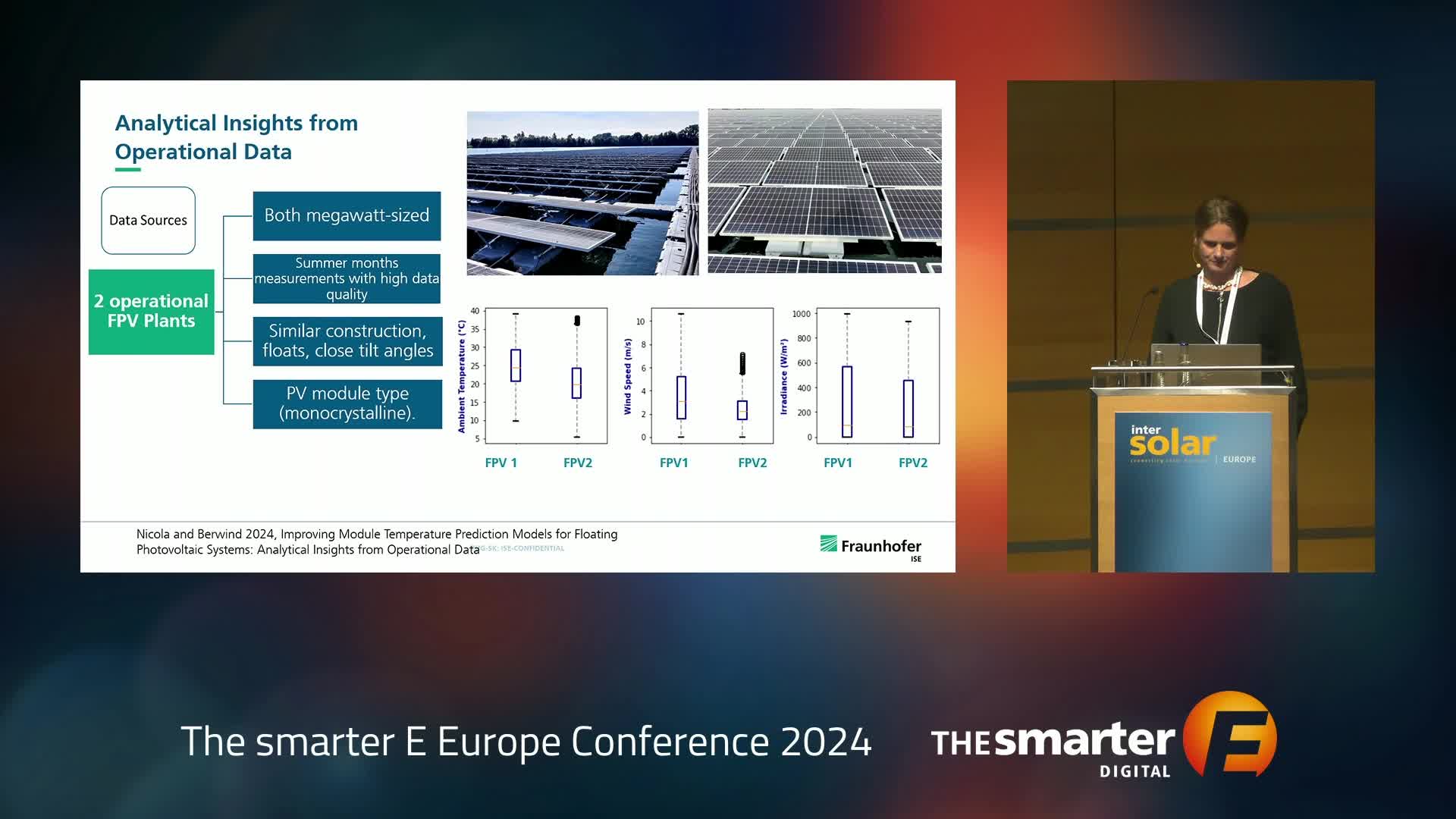
Dr. Anna Heimsath from the Fraunhofer Institute for Solar Energy Systems discusses the potential of floating photovoltaics (FPV) due to increasing land scarcity. She emphasizes FPV's benefits, such as conserving valuable land and integrating with other renewable energy sources like hydropower and offshore systems. The research aims to understand and enhance these systems by leveraging operational data from two megawatt-sized FPV plants featuring similar constructions and silicon modules. Heimsath explains their methodology of using existing PV models but adapting coefficients based on empirical data. Initial findings show that traditional ground-mounted PV models underestimate FPV yield and overestimate module temperature without coefficient adjustments. By fine-tuning with initial plant data, predictive accuracy improves significantly when applied to a different plant dataset, validating this adaptive modeling approach as an effective preliminary method. Future work focuses on refining these models further for industry-standard procedures in yield development while improving environmental sustainability through better resource management strategies.

Automated summarization by AI Conver

Dr. Anna Heimsath
Head of Department "Analysis PV Modules and Power Plants"
Fraunhofer Institute for Solar Energy Systems ISE
Germany

Floating photovoltaics (FPV) is an established alternative PV power plant application for regions with space constraints and for bodies of water that need protection from pollution and evaporation. The total FPV onshore deployment is expected to reach a double-digit GW output soon. That is why the industry is turning its attention to the vast potential of offshore installations. Despite considerable technical progress, much still remains to be done - from standardization, cost reduction, to environmental assessments and social acceptance - before FPV becomes widely accepted.

The session will discuss:

  • Market & technology developments
  • On and offshore case studies
  • Biodiversity research results
  • Yield and cost comparison FPV vs. traditional PV power plants

Further Talks of this session:

Speaker

Michele Tagliapietra
Head of Product Management Floating-PV
BayWa r.e.
Belgium

To Talk

Speaker

Stanislas Merlet
Senior Consultant Solar PV
Multiconsult
Norway

To Talk

Speaker

Jasper Lemmens
Senior Consultant
DNV Netherlands B.V.
The Netherlands

To Talk

Speaker

Michele Tagliapietra
Head of Product Management Floating-PV
BayWa r.e.
Belgium

To Talk

Speaker

Dr. Benjamin Lehner
CEO
Dutch Marine Energy Centre
The Netherlands

To Talk

To Talk

Further Content
Webinar
Growth of the European Solar Market, Specifically, Romania

February 24, 2026

Webinar: EU Solar Market Overview with Focus on Romania

Webinar Collection
Mixed Investment Solar Projects in Mexico: The 54% Model Explained

January 29, 2026

Mexico has introduced a new mixed investment scheme for renewable power generation, requiring a minimum 54% direct or indirect participation by CFE.

The smarter E Europe Conferences 2025
Factors That Influence the Success of a Minigrid Project

Wednesday, May 07, 2025, 11:00 am - 12:30 pm

The smarter E Europe Conferences 2025 | Conference Program

premium account

Off-grid solar systems are often the least expensive option for rural electrification. Solar home systems can power individual households, while mini-grids can supply entire villages. Each comes with its own advantages, disadvantages, and challenges. The aim of this session is to explore challenges as well as success stories. It takes well-functioning components such as battery systems, charge management and inverters to make projects successful. Proper system sizing, maintenance and repair management, as well as a robust financial concept are also necessary. If one of these elements is missing, the electrification will not be sustainable. This session will focus on the aspects mentioned above. The speakers will present successful and unsuccessful approaches and discuss what can be learned from them.

The smarter E Europe Conferences 2025
Q&A Session of of the Session Off-Grid: Rural Electrification Based on Solar Systems - Lessons Learned

Wednesday, May 07, 2025, 11:00 am - 12:30 pm

The smarter E Europe Conferences 2025 | Conference Program

premium account

Off-grid solar systems are often the least expensive option for rural electrification. Solar home systems can power individual households, while mini-grids can supply entire villages. Each comes with its own advantages, disadvantages, and challenges. The aim of this session is to explore challenges as well as success stories. It takes well-functioning components such as battery systems, charge management and inverters to make projects successful. Proper system sizing, maintenance and repair management, as well as a robust financial concept are also necessary. If one of these elements is missing, the electrification will not be sustainable. This session will focus on the aspects mentioned above. The speakers will present successful and unsuccessful approaches and discuss what can be learned from them.

The smarter E Europe Conferences 2025
Welcome of of the Session Off-Grid: When Will Off-Grid PV Follow the Affordability Trend?(BSW)

Wednesday, May 07, 2025, 04:00 pm - 05:30 pm

The smarter E Europe Conferences 2025 | Conference Program

premium account

Photovoltaic prices have fallen continuously in recent years - a trend that should translate into a growing market for off-grid solutions. Declining costs are crucial for rural electrification in particular, making sustainable energy supply economically viable in remote regions. However, so far many of these price advantages have not yet reached the people that need them most. Do existing framework conditions to foster rural electrification still work in this new market reality? Which measures are needed to ensure that cost reductions reach our target group? This session discusses strategies for improving the availability of low-cost off-grid solutions, financing and innovative business models. A look at successful practical examples shows which political, economic and technological levers need to be pulled to make off-grid PV accessible on a large scale.

You are using an outdated browser

The website cannot be viewed in this browser. Please open the website in an up-to-date browser such as Edge, Chrome, Firefox, or Safari.