Best Practice & Standards

premium account

Recording of Tuesday, June 18, 2024 | The smarter E Europe | Conference Program | Language: English | Duration: 14:53 .

Best Practices and Standards in Floating Solar: Bridging the Gap between Solar and Offshore Industries to Ensure Safe, Durable Projects

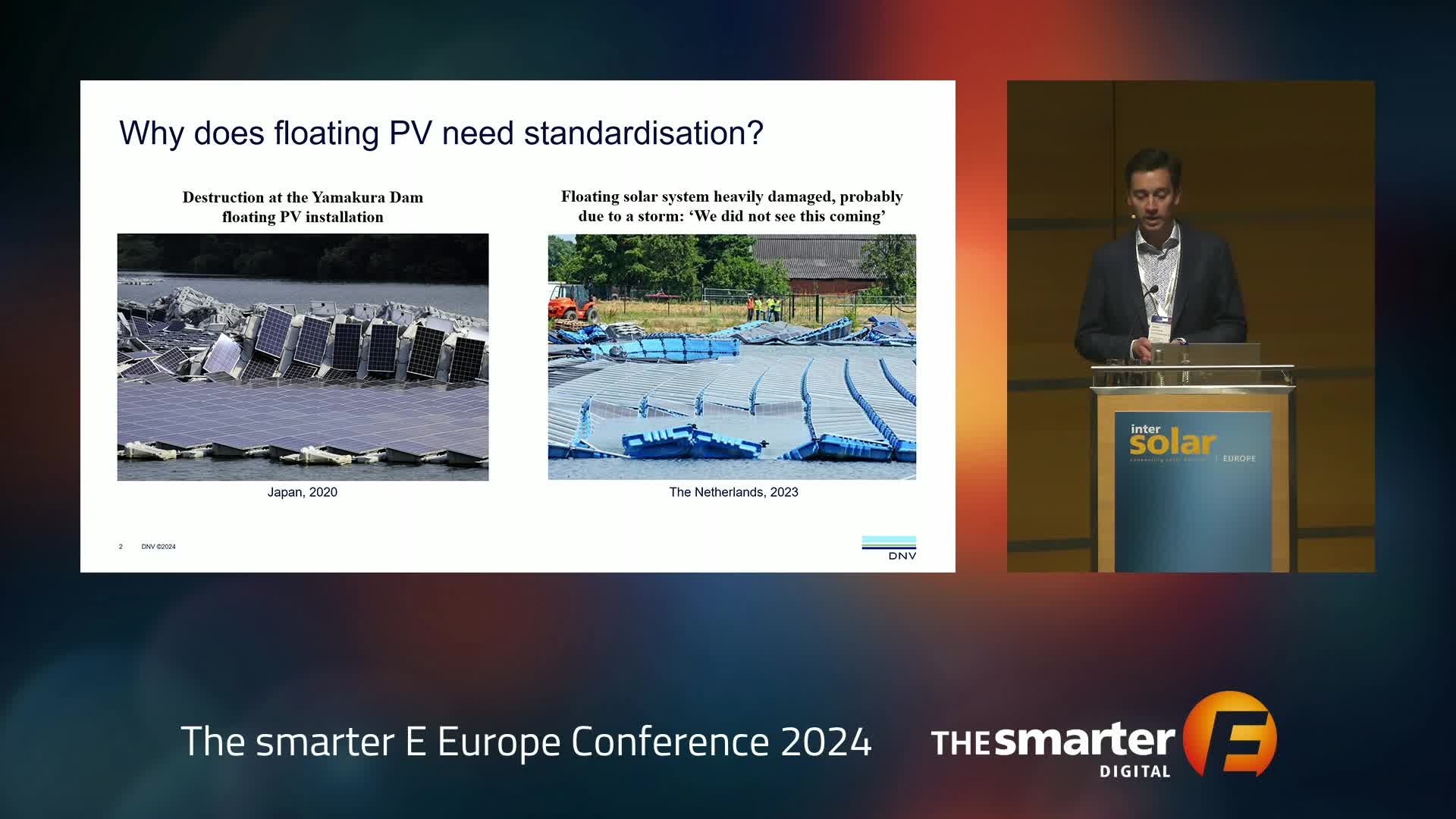
Standards and best practices in floating solar energy are crucial given the industry's growing importance, as highlighted by the speaker after acknowledging Stanislas's presentation. Many consider standards to be uninteresting or tedious; however, they are essential for ensuring safety and durability in this emergent sector. Despite many successful projects, incidents arising from inadequate systems underscore this necessity. The talk delves into how standardization can bridge offshore engineering experience with renewable energy mandates. The organization behind these efforts has a rich history spanning over 160 years in maritime and renewable sectors, merging knowledge to support floating solar since 2017 through consultancy and certification. A significant milestone was achieved around 2019 when World Bank reports provided an overview of floating solar technologies. Identifying gaps in standard requirements led to developing recommended practices issued globally by 2021. However, more specific international standards on components and system design were needed for higher quality outcomes. Consequently, detailed chapters evolved into formal standards aimed at creating safe designs reflecting industry needs accurately.

Automated summarization by AI Conver

Jasper Lemmens
Senior Consultant
DNV Netherlands B.V.
The Netherlands

Floating photovoltaics (FPV) is an established alternative PV power plant application for regions with space constraints and for bodies of water that need protection from pollution and evaporation. The total FPV onshore deployment is expected to reach a double-digit GW output soon. That is why the industry is turning its attention to the vast potential of offshore installations. Despite considerable technical progress, much still remains to be done - from standardization, cost reduction, to environmental assessments and social acceptance - before FPV becomes widely accepted.

The session will discuss:

  • Market & technology developments
  • On and offshore case studies
  • Biodiversity research results
  • Yield and cost comparison FPV vs. traditional PV power plants

Further Talks of this session:

Speaker

Michele Tagliapietra
Head of Product Management Floating-PV
BayWa r.e.
Belgium

To Talk

Speaker

Stanislas Merlet
Senior Consultant Solar PV
Multiconsult
Norway

To Talk

Speaker

Dr. Anna Heimsath
Head of Department "Analysis PV Modules and Power Plants"
Fraunhofer Institute for Solar Energy Systems ISE
Germany

To Talk

Speaker

Michele Tagliapietra
Head of Product Management Floating-PV
BayWa r.e.
Belgium

To Talk

Speaker

Dr. Benjamin Lehner
CEO
Dutch Marine Energy Centre
The Netherlands

To Talk

To Talk

Further Content
The smarter E Europe Conferences 2026
Panel Discussion of the Session: Solar Made in the EU

Tuesday, June 23, 2026, 02:30 pm

The smarter E Europe Conferences 2026 | Conference Program

premium account

Despite strong research capabilities and the presence of leading production equipment suppliers, Europe has been struggling to rebuild competitive wafer-to-module manufacturing, while the USA and India have enabled a local renaissance in solar manufacturing. In Europe, even long-established inverter manufacturers have been losing considerable ground. With the EU's Net Zero Industry Act yet to deliver momentum, attention is turning to the upcoming Industry Accelerator Act. This session examines how policy, investment and value-chain strategies can strengthen domestic manufacturing and increase internal value creation.Key topics:Overview of EU and national policy frameworks to support local manufacturingStatus of Europe's solar manufacturing value chainInvestment gaps and competitiveness challenges Strategies for triggering a sustainable solar manufacturing revival 

Rutger Schlatmann and Angelika Harter
Perovskites: The Race for the Future of PV?

The smarter E Podcast Episode 258 | Language: English

June 25, 2026

HZB researchers explore perovskite tandem solar cells, efficiency gains, and the challenges of bringing the technology to market.

The smarter E Europe Conferences 2026
Panel Discussion of the Session: Off-Grid: PV-Based Hydrogen Microgrid Projects Around the World

Tuesday, June 23, 2026, 02:30 pm

The smarter E Europe Conferences 2026 | Conference Program

premium account

Discover how green hydrogen and fuel cell technologies are transforming decentralized energy systems worldwide. This session will be presenting hands-on experience from pioneering projects in Thailand, Ghana, Namibia and South Africa. Find out how solar-powered hydrogen microgrids can replace diesel generators, strengthen energy resilience and enable short- to long-term storage, while supporting environmental and climate goals. Project partners including German SMEs and research institutes, share insights on lessons learned, local benefits and the replication potential of these systems. Selected projects were implemented with the support from the Export Initiative Environmental Protection, a funding programme of the German Federal Ministry for the Environment, Climate Action, Nature Conservation and Nuclear Safety. 

Publications
Global Market Outlook for Solar Power 2025–2029

SolarPower Europe’s annual Global Market Outlook for Solar Power is the most authoritative market analysis for the solar sector.

Publication
The German PV and Battery Storage Market

The first of its kind, this study offers an overview of the photovoltaics and battery storage market in Germany.

You are using an outdated browser

The website cannot be viewed in this browser. Please open the website in an up-to-date browser such as Edge, Chrome, Firefox, or Safari.