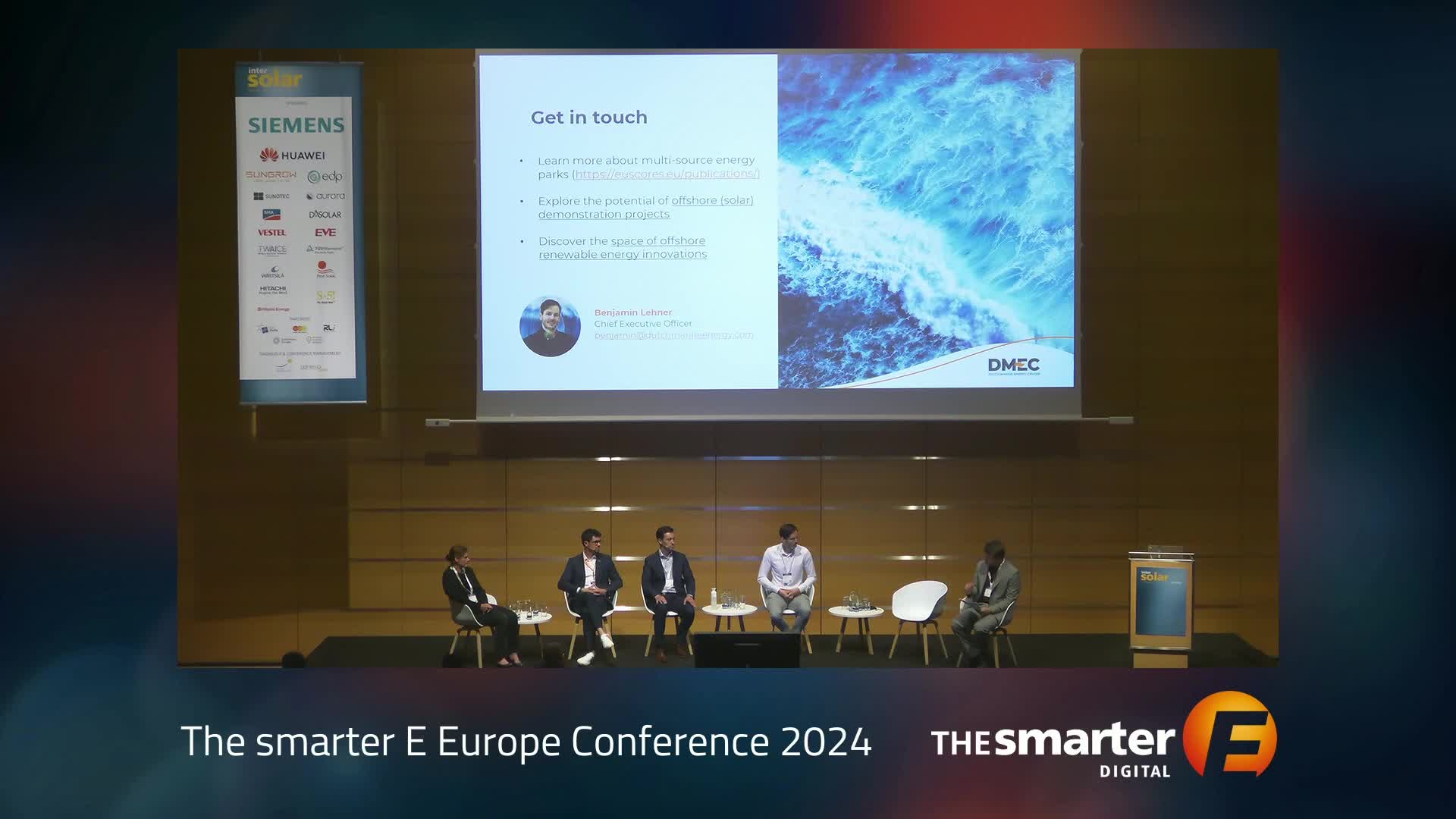
Q&A

premium account

Recording of Tuesday, June 18, 2024 | The smarter E Europe 2024 | Conference Program | Language: English | Duration: 15:10 .

Offshore Solar Projects in the Netherlands Show Promise, Await Certification Standards for Wider Adoption

The discussion centers around the commercial feasibility and development of offshore solar technology compared to inland floating solar systems. Dr. Benjamin Lehner highlights that the first commercial offshore solar projects are underway in the Netherlands, with installations by Ocean of Energy (0.5 MW), Solar Duck and RWE (5 MW), and a newly announced 50 MW project. These developments show promising viability, particularly in harsh environments like those found in the Middle East. Jasper Lemmens discusses balancing environmental conditions between inland waters and offshore locations for certification purposes. Inland bodies experience lower wave heights compared to oceans, making it necessary to adapt standards accordingly. Offshore standards need rigorous application due to extreme conditions, though current projects still lack comprehensive certification schemes similar to wind farms. An examination of global markets reveals Asia's lead driven by land scarcity and cost-focused utility projects, contrasting Europe’s mature market with more focus on operational sustainability over long periods. Regulatory frameworks also play a critical role; for instance, Europe's structured approach contrasts sharply with complex U.S regulations influenced by federalism and low population density. Finally, Dr. Anna Heimsath addresses ongoing research into energy yield assessments for floating photovoltaics (FPV). More accurate simulations are crucial as current methods present varying results; thus enhancing precision is essential for improving bankability across these emerging technologies.

Automated summarization by AI Conver

Floating photovoltaics (FPV) is an established alternative PV power plant application for regions with space constraints and for bodies of water that need protection from pollution and evaporation. The total FPV onshore deployment is expected to reach a double-digit GW output soon. That is why the industry is turning its attention to the vast potential of offshore installations. Despite considerable technical progress, much still remains to be done - from standardization, cost reduction, to environmental assessments and social acceptance - before FPV becomes widely accepted.

The session will discuss:

  • Market & technology developments
  • On and offshore case studies
  • Biodiversity research results
  • Yield and cost comparison FPV vs. traditional PV power plants

Speaker

Michele Tagliapietra
Head of Product Management Floating-PV
BayWa r.e.
Belgium

To Talk

Speaker

Stanislas Merlet
Senior Consultant Solar PV
Multiconsult
Norway

To Talk

Speaker

Jasper Lemmens
Senior Consultant
DNV Netherlands B.V.
The Netherlands

To Talk

Speaker

Dr. Anna Heimsath
Head of Department "Analysis PV Modules and Power Plants"
Fraunhofer Institute for Solar Energy Systems ISE
Germany

To Talk

Speaker

Michele Tagliapietra
Head of Product Management Floating-PV
BayWa r.e.
Belgium

To Talk

Speaker

Dr. Benjamin Lehner
CEO
Dutch Marine Energy Centre
The Netherlands

To Talk

Further Content
Renate Egan, Executive Director of ACAP
What’s Next in PV Cell and Module Tech

The smarter E Podcast Episode 244 | Language: English

November 27, 2025

UNSW and ACAP drive advances in solar tech. Prof. Renate Egan shares new PV research and how innovation will shape the industry in 2026.

The smarter E Europe Conferences 2025
Digital Tools for Planning and Monitoring: Insights from Mozambique

Wednesday, May 07, 2025, 02:00 pm - 03:30 pm

The smarter E Europe Conferences 2025 | Conference Program

premium account

This session explores how digitalization is revolutionizing off-grid energy projects, enabling scalability and efficiency in underserved areas. Experts will discuss cutting-edge solutions based on the use and application of digital tools to support planning, development, and operations ultimately enhancing affordability. Attendees will gain insights into leveraging digital tools for optimized planning and project management, customer engagement, monitoring, and sustainable growth. Real-world case studies will highlight successful implementations, showcasing how technology bridges the gap between innovation and impact in energy access.

The smarter E Europe Conferences 2025
Panel Discussion of of the Session Off-Grid: When Will Off-Grid PV Follow the Affordability Trend?(BSW)

Wednesday, May 07, 2025, 04:00 pm - 05:30 pm

The smarter E Europe Conferences 2025 | Conference Program

premium account

Photovoltaic prices have fallen continuously in recent years - a trend that should translate into a growing market for off-grid solutions. Declining costs are crucial for rural electrification in particular, making sustainable energy supply economically viable in remote regions. However, so far many of these price advantages have not yet reached the people that need them most. Do existing framework conditions to foster rural electrification still work in this new market reality? Which measures are needed to ensure that cost reductions reach our target group? This session discusses strategies for improving the availability of low-cost off-grid solutions, financing and innovative business models. A look at successful practical examples shows which political, economic and technological levers need to be pulled to make off-grid PV accessible on a large scale.

The smarter E Europe Conferences 2025
Factors That Influence the Success of a Minigrid Project

Wednesday, May 07, 2025, 11:00 am - 12:30 pm

The smarter E Europe Conferences 2025 | Conference Program

premium account

Off-grid solar systems are often the least expensive option for rural electrification. Solar home systems can power individual households, while mini-grids can supply entire villages. Each comes with its own advantages, disadvantages, and challenges. The aim of this session is to explore challenges as well as success stories. It takes well-functioning components such as battery systems, charge management and inverters to make projects successful. Proper system sizing, maintenance and repair management, as well as a robust financial concept are also necessary. If one of these elements is missing, the electrification will not be sustainable. This session will focus on the aspects mentioned above. The speakers will present successful and unsuccessful approaches and discuss what can be learned from them.

Webinar Collection
Kenya’s Solar Landscape 2025: Policy Shifts, Market Signals, and Opportunities for Scalable PV Deployment

December 2, 2025

free account

Join our free webinar on December 2 and learn about the current situation of the Kenyan solar industry, its opportunities, and challenges.

You are using an outdated browser

The website cannot be viewed in this browser. Please open the website in an up-to-date browser such as Edge, Chrome, Firefox, or Safari.