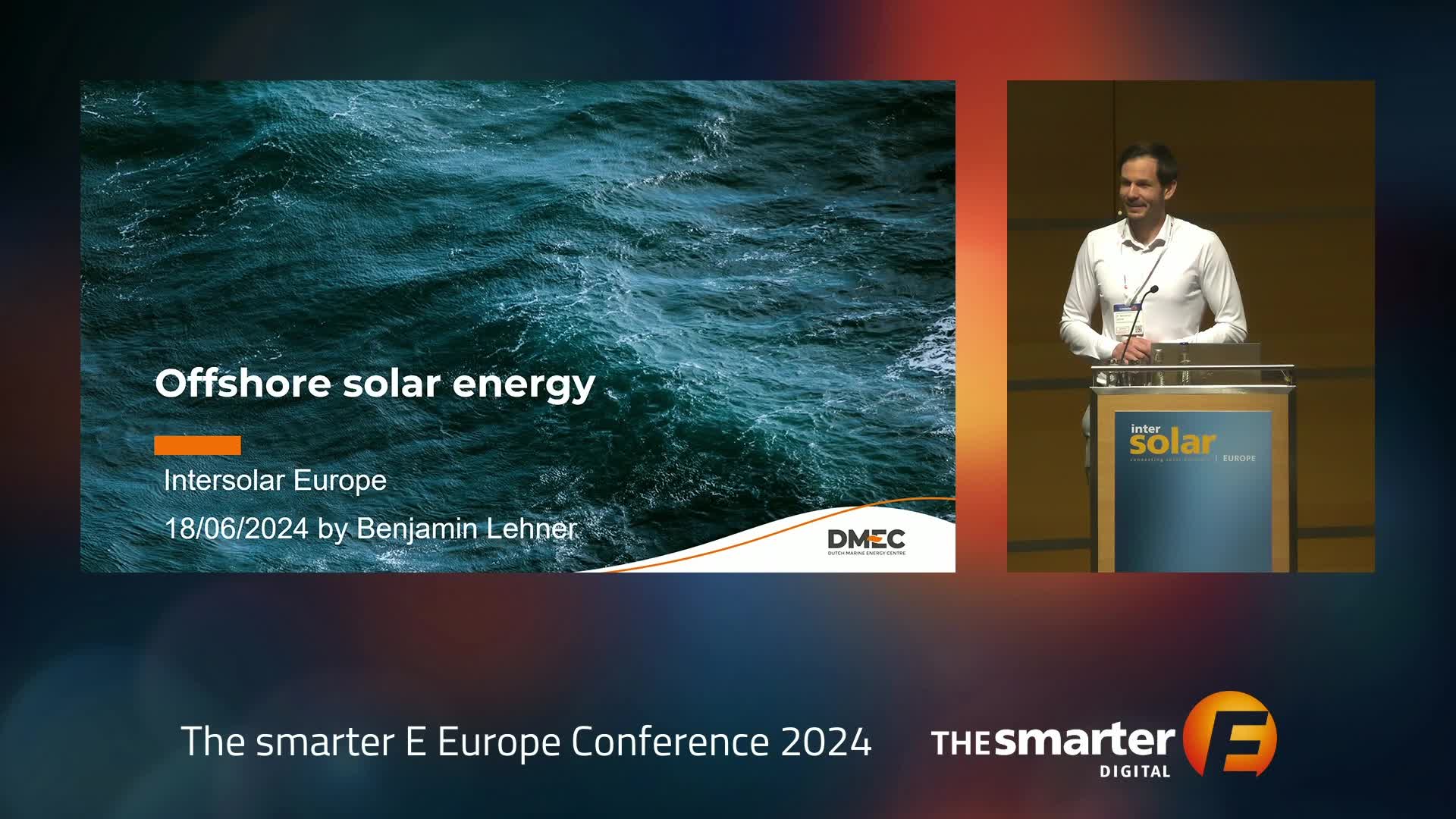
What Offshore Floating Solar Can Learn From Offshore Wind

premium account

Recording of Tuesday, June 18, 2024 | The smarter E Europe 2024 | Conference Program | Language: English | Duration: 13:49 .

Exploring the Future of Offshore Solar Energy and Its Challenges: Dr. Benjamin Lehner Reviews Dutch Marine Energy Centre’s Groundbreaking Projects

The context provided is a presentation by Dr. Benjamin Lehner, discussing the potential and challenges of offshore solar energy. He sets the stage with an evocative description of sailing towards Athens to illustrate the massive energy needs of coastal mega-cities like Tokyo, Shanghai, Barcelona, and The Hague. As part of DMEC (an accelerator for offshore renewable energy), Dr. Lehner explains current projects: EU-SCORES off Belgium’s coast and NauticalSunrise near Hollandse Kust Vest Wind Tender in collaboration with RWE and SolarDuck. These initiatives aim to integrate offshore solar with wind power due to high grid connection costs. Offshore solar faces significant technical challenges such as surviving severe weather conditions (e.g., 5-7 meter waves and strong winds) which necessitate robust systems that can withstand these forces while maintaining electrical infrastructure integrity. Issues like soiling from seabirds also pose additional hurdles. Despite these challenges, Cushman highlights key advantages including scalability—installing gigawatts over square kilometers—and complementarity with existing offshore wind infrastructures without major modifications or visual impacts on coastal landscapes.

Automated summarization by AI Conver

Dr. Benjamin Lehner
CEO
Dutch Marine Energy Centre
The Netherlands

Floating photovoltaics (FPV) is an established alternative PV power plant application for regions with space constraints and for bodies of water that need protection from pollution and evaporation. The total FPV onshore deployment is expected to reach a double-digit GW output soon. That is why the industry is turning its attention to the vast potential of offshore installations. Despite considerable technical progress, much still remains to be done - from standardization, cost reduction, to environmental assessments and social acceptance - before FPV becomes widely accepted.

The session will discuss:

  • Market & technology developments
  • On and offshore case studies
  • Biodiversity research results
  • Yield and cost comparison FPV vs. traditional PV power plants

Speaker

Michele Tagliapietra
Head of Product Management Floating-PV
BayWa r.e.
Belgium

To Talk

Speaker

Stanislas Merlet
Senior Consultant Solar PV
Multiconsult
Norway

To Talk

Speaker

Jasper Lemmens
Senior Consultant
DNV Netherlands B.V.
The Netherlands

To Talk

Speaker

Dr. Anna Heimsath
Head of Department "Analysis PV Modules and Power Plants"
Fraunhofer Institute for Solar Energy Systems ISE
Germany

To Talk

Speaker

Michele Tagliapietra
Head of Product Management Floating-PV
BayWa r.e.
Belgium

To Talk

To Talk

Further Content
Webinar
Mixed Investment Solar Projects in Mexico: The 54% Model Explained

January 29, 2026

Mexico has introduced a new mixed investment scheme for renewable power generation, requiring a minimum 54% direct or indirect participation by CFE.

Anna Darmani, Principal Analyst from Wood Mackenzie
Big BESS Is Here to Save the Day

The smarter E Podcast Episode 246 | Language: English

January 8, 2026

Utility-scale batteries are booming in Europe. Discover key BESS trends, market impacts, and what to expect for large-scale storage in 2026.

The smarter E Europe Conferences 2025
Setting the Scene "Off-Grid"

Wednesday, May 07, 2025, 04:00 pm - 05:30 pm

The smarter E Europe Conferences 2025 | Conference Program

premium account

Photovoltaic prices have fallen continuously in recent years - a trend that should translate into a growing market for off-grid solutions. Declining costs are crucial for rural electrification in particular, making sustainable energy supply economically viable in remote regions. However, so far many of these price advantages have not yet reached the people that need them most. Do existing framework conditions to foster rural electrification still work in this new market reality? Which measures are needed to ensure that cost reductions reach our target group? This session discusses strategies for improving the availability of low-cost off-grid solutions, financing and innovative business models. A look at successful practical examples shows which political, economic and technological levers need to be pulled to make off-grid PV accessible on a large scale.

The smarter E Europe Conferences 2025
Factors That Influence the Success of a Minigrid Project

Wednesday, May 07, 2025, 11:00 am - 12:30 pm

The smarter E Europe Conferences 2025 | Conference Program

premium account

Off-grid solar systems are often the least expensive option for rural electrification. Solar home systems can power individual households, while mini-grids can supply entire villages. Each comes with its own advantages, disadvantages, and challenges. The aim of this session is to explore challenges as well as success stories. It takes well-functioning components such as battery systems, charge management and inverters to make projects successful. Proper system sizing, maintenance and repair management, as well as a robust financial concept are also necessary. If one of these elements is missing, the electrification will not be sustainable. This session will focus on the aspects mentioned above. The speakers will present successful and unsuccessful approaches and discuss what can be learned from them.

The smarter E Europe Conferences 2025
Q&A Session of of the Session Off-Grid: Rural Electrification Based on Solar Systems - Lessons Learned

Wednesday, May 07, 2025, 11:00 am - 12:30 pm

The smarter E Europe Conferences 2025 | Conference Program

premium account

Off-grid solar systems are often the least expensive option for rural electrification. Solar home systems can power individual households, while mini-grids can supply entire villages. Each comes with its own advantages, disadvantages, and challenges. The aim of this session is to explore challenges as well as success stories. It takes well-functioning components such as battery systems, charge management and inverters to make projects successful. Proper system sizing, maintenance and repair management, as well as a robust financial concept are also necessary. If one of these elements is missing, the electrification will not be sustainable. This session will focus on the aspects mentioned above. The speakers will present successful and unsuccessful approaches and discuss what can be learned from them.

You are using an outdated browser

The website cannot be viewed in this browser. Please open the website in an up-to-date browser such as Edge, Chrome, Firefox, or Safari.