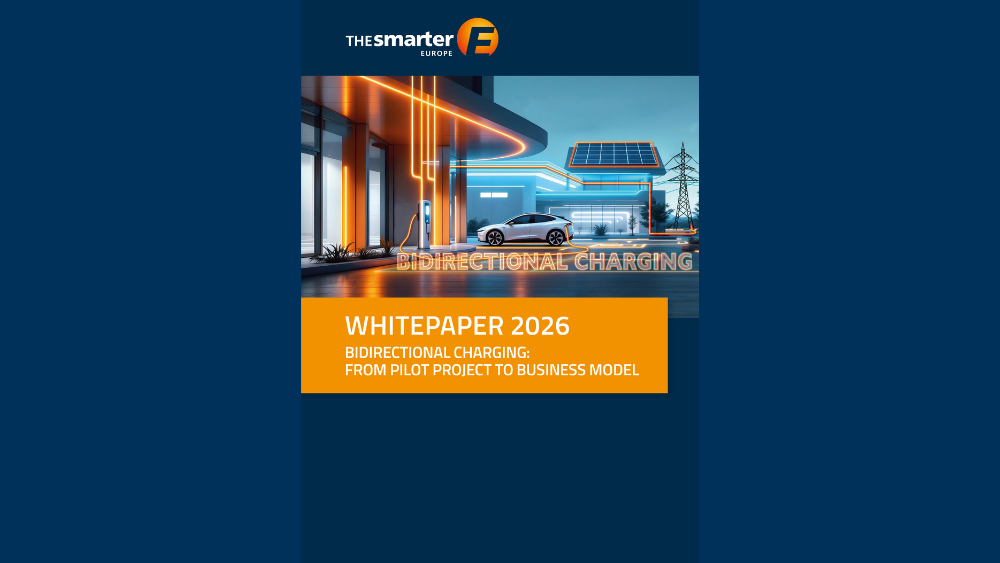
Bidirectional Charging: From Pilot Project to Business Model

Bidirectional charging has officially transitioned from a pilot-stage innovation into the regulated market, acting as a key lever for making the transformation of our energy system a success. It allows us to use electric vehicles not just as a means of transport, but also as flexible, mobile electricity storage systems. Excess energy from renewable sources can be efficiently stored until it is needed, and then be fed back into residential buildings, company infrastructures or the public grid.

The technology opens up new perspectives for intelligent sector coupling by balancing out fluctuations between generation and consumption. This helps to reduce peak loads and eases the burden on the grid, minimizing the need for costly grid expansion. What’s more, bidirectional charging can now generating tangible income for private households, companies, fleet operators and utilities.

Commercial maturity is proven by citywide networks like Utrecht's car-sharing initiative and Germany's first mass-market residential V2G tariffs (such as the E.ON and BMW plan). These milestones highlight the arrival of the necessary pillars for widespread adoption: The reform of the German Energy Industry Act (EnWG) in November 2025 officially ended the "double burden" of stored electricity, while the MiSpeL process in April 2026 simplified market integration by eliminating secondary meters. Furthermore, the mandatory implementation of the ISO 15118-20 standard ensures Europe-wide technical standardization, guaranteeing that by 2027 all new charging points will be V2G-capable with seamless interoperability across all vehicle brands.

Backed by these harmonized regulatory frameworks and technical standards, bidirectional charging is no longer just a pioneering concept, but an operational reality ready to shape a renewable 24/7 energy supply by 2030.

Publishers: Solar Promotion GmbH

Download

When you download a publication, we will process the data you enter for the purpose of creating and performing a contract. By downloading, you agree to your email address being transferred to the institutions listed under "Publishers". You may object to the use of your email address for marketing purposes at any time without incurring any costs other than the transmission costs according to the basic rates. You may withdraw your consent by, for example, clicking on the “unsubscribe” link at the end of an email advertisement. Our website is only aimed at commercial enterprises (traders, business people, freelancers). (Privacy policy).

Agreed, start download

Further Content
Gaëtan Masson and Delfina Muñoz
The Challenge in Turning Europe’s PV Research into an Industrial Reality

The smarter E Podcast Episode 266 | Language: English

October 1, 2026

Europe leads in solar research but lags in manufacturing. Jonathan Gifford explores industrial policy and tandem tech with experts.

Thaddäus Kreisig
Stack ’Em Up: Germany’s Big Battery Inflection Point – with Thaddäus Kreisig

The smarter E Podcast Episode 265 | Language: English

September 16, 2026

Discover how Germany's solar surge is driving a gigawatt-scale battery boom, the revenue models making projects viable, and the hurdles ahead.

Intersolar Middle East Conference 2026
Hype vs. Financial Close: What Separates the 20% of Solar Projects That Reach Construction

Wednesday, September 02, 2026, 02:30 pm

Intersolar Middle East Conference 2026 | Conference Program

premium account

This session explores how effective policy frameworks, streamlined regulations, and innovative financing solutions can work together to accelerate the global expansion of solar energy. Bringing together perspectives from policymakers, investors, and industry leaders, it will examine how supportive regulatory environments reduce investment risk, attract private capital, and enable the successful development of solar and hybrid energy projects. Through best practices, emerging funding mechanisms, and real-world case studies, participants will gain practical insights into mobilizing capital, fostering investor confidence, and creating the conditions for sustainable growth across both established and emerging solar markets.

Intersolar Middle East Conference 2026
The Self Managing Solar Farm: From AI and Digital Twins to Autonomous Energy Infrastructure

Wednesday, September 02, 2026, 01:15 pm

Intersolar Middle East Conference 2026 | Conference Program

premium account

Discover how advanced digital technologies are transforming solar operations. This session explores AI-driven analytics, IoT-enabled monitoring, and blockchain-based transparency to optimize performance, streamline maintenance, and enhance profitability. Learn how smart grids and data intelligence are shaping the next generation of efficient, resilient solar energy systems.

Intersolar Middle East Conference 2026
Optimizing the Solar Asset Lifecycle: Resilience, Digitalization, and Circular Economy

Thursday, September 03, 2026, 12:45 pm

Intersolar Middle East Conference 2026 | Conference Program

premium account

Explore strategies for maximizing the resilience, performance, and sustainability of solar assets throughout their entire lifecycle. This session brings together best practices in resilient system design, advanced monitoring, predictive operations and maintenance (O&M), and asset lifetime optimization with circular economy approaches such as PV panel recycling, battery repurposing, and ESG-driven business strategies. Learn how innovation, digitalization, and evolving regulations are helping the industry improve reliability, extend asset value, recover critical materials, and reduce environmental impact while creating more sustainable and profitable solar ecosystems.

You are using an outdated browser

The website cannot be viewed in this browser. Please open the website in an up-to-date browser such as Edge, Chrome, Firefox, or Safari.