Recording of Tuesday, June 23, 2026 | The smarter E Europe Conferences 2026 | Language: English | Duration: 10:29 .
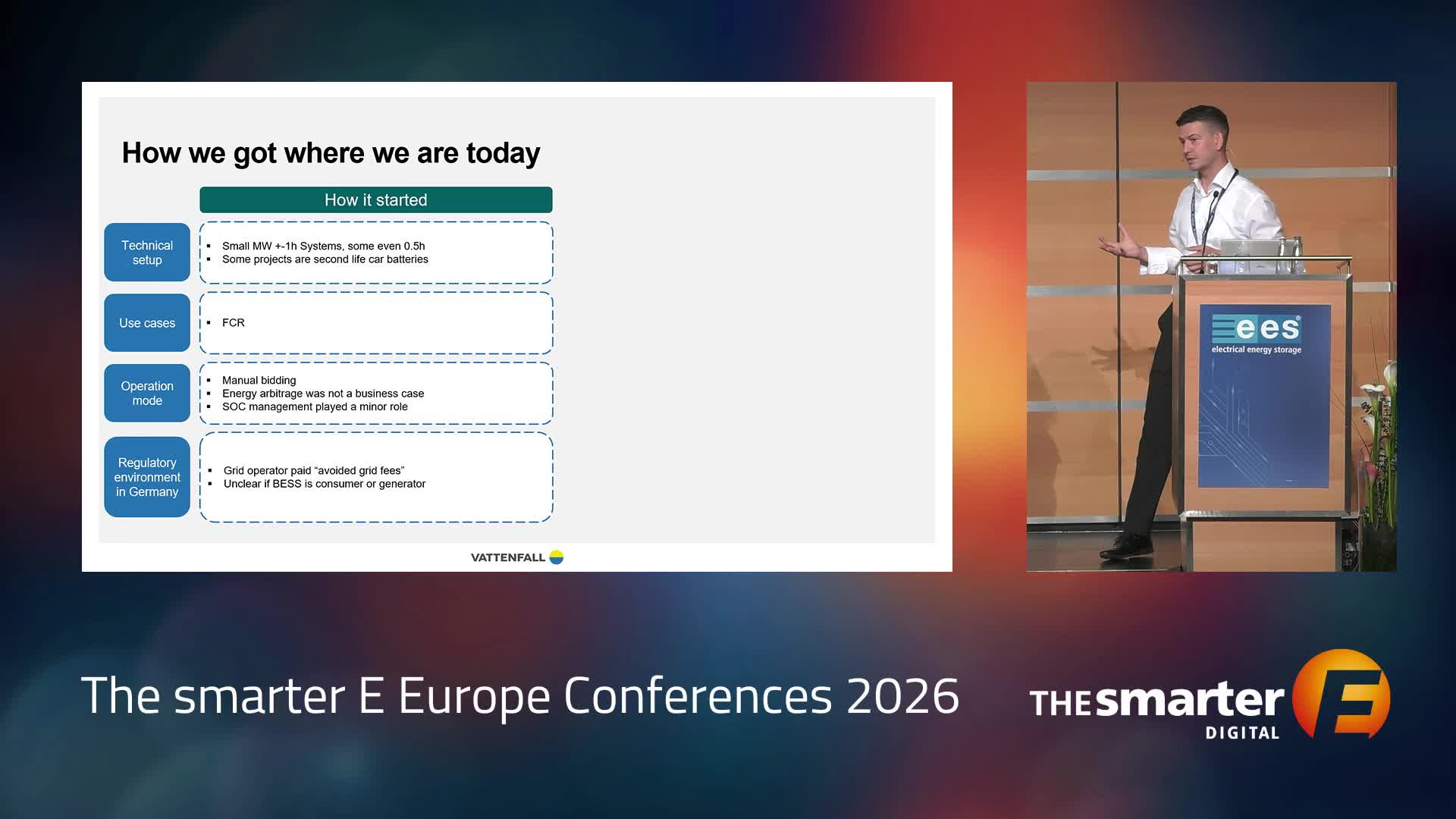
Sebastian Gliebitsch, a transaction manager at Vattenfall, examines the evolution of revenues in the German energy market, highlighting four crucial components: technical setup, use cases, operational modes, and regulatory factors. The technical setup includes parameters such as duration, power capacity, and inverter technology. Battery energy storage systems, which have been utilized for over a decade, are shifting from initial short-duration systems to larger, more sophisticated setups. A significant change occurred with the elimination of the avoided grid fees at the end of 2022, impacting operators who relied on this for profitability. The current market environment is characterized by limited volatility, affecting battery energy arbitrage's feasibility and profitability. Moreover, the expansion of battery storage systems in Germany leads to increased grid connection challenges, with a trend towards hybrid projects that combine various energy sources. The regulatory landscape has improved, offering clearer pathways for battery assets and recognizing their economic viability by exempting them from grid fees. Vattenfall’s hybrid optimization strategy aims to balance long-term and short-term investments, navigating complexities within the revenue stack caused by regulatory and operational factors.
Automated summarization by AI Conver
Speaker
Sebastian Glibic
Transaction Manager
Vattenfall
Netherlands
As the energy storage market has evolved, one of the biggest barriers to battery storage deployment is grid connection. In Germany, one of Europe's most attractive markets, several gigawatts of storage remain stuck in connection queues, which questions project business cases as long-term revenues are unknown and projects cannot go online soon to benefit from existing prices and market conditions. Limited grid capacity means developers must act proactively and think creatively. Possible solutions include closer collaboration with DSOs to enable system-friendly integration, co-locating batteries with PV to use existing infrastructure, or cable pooling to optimize grid usage. Therefore, beyond trading and arbitrage, strategies like infrastructure sharing, partnerships with optimizers, and renting out batteries through tolling instead of developing projects are gaining ground. This session will examine how to navigate grid constraints and unlock the full value of storage in today's evolving energy system.
Further Talks of this session:
Speaker
Anna Darmani
Principal Analyst, Energy Storage Europe
Wood Mackenzie
United Kingdom
Speaker
Genna Boyle
Chief Commercial Officer & Head of EMEA
Gridcog
United Kingdom
Speaker
Dr. Stefan Englberger
Head of Commercial & Investment Analysis
ECO STOR GmbH
Germany
Speaker
Dr. Oliver Schmidt
CEO
dvlp.energy
Germany
Speaker
Eva Zimmermann
Senior Research Associate Flexible Energy
Aurora Energy Research
Germany