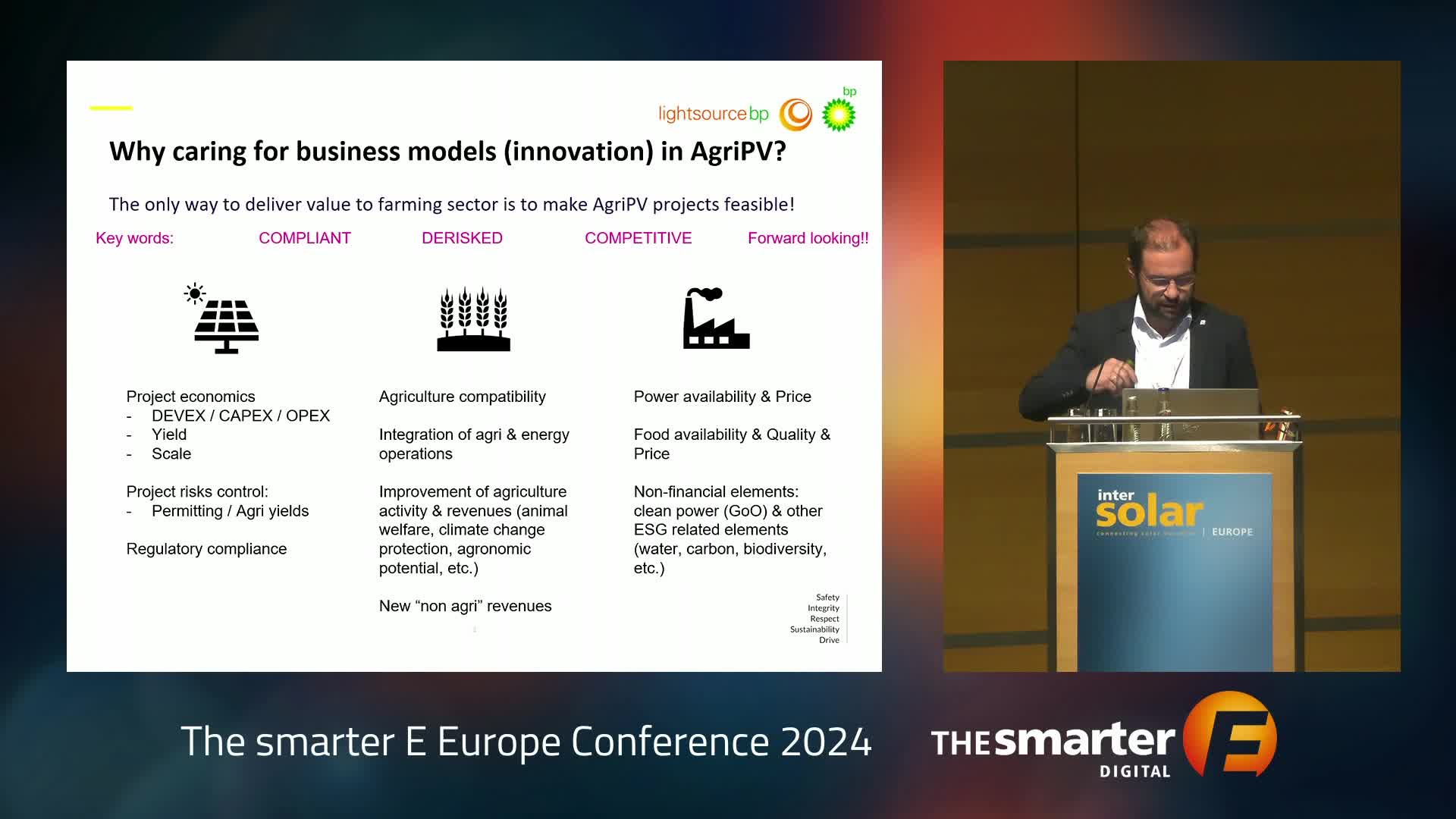
Business Models of Agri PV & How It Benefits Farmers Models

premium account

Recording of Tuesday, June 18, 2024 | The smarter E Europe 2024 | Conference Program | Language: English | Duration: 15:12 .

Agri-PV Business Model Innovations Essential for Scaling Sustainable Agricultural and Energy Solutions, Emphasizes Expert

AgriPV, a concept marrying agriculture and photovoltaic (PV) solar energy production, has been around for about 40 years. Despite significant hardware innovations in the past decade or so and upcoming software advancements, there is an essential need for business model innovation to ensure scalable solutions. This discussion emphasizes integrating agricultural activities into PV plants through diverse collaboration contracts with farmers across different countries. The presentation highlights that Agri-PV projects must consider various farming systems' diversity—farm sizes, production types, geographies—and how these factors influence both Agri-PV solutions and business models. Essential criteria include regulatory compliance, risk management for long-term viability, competitiveness, and forward-looking adaptability amidst climate change. Key elements of effective business models encompass economic risks on the PV side like permitting risk and agricultural yield regulations; compatibility issues from the agricultural perspective such as integration within existing farm operations; revenue stacking opportunities including non-agricultural revenues; crop performance considerations beyond simple metrics; adaptable integrated investments tailored to specific agri-PV systems; sharing development activities among stakeholders; involving farmers financially in projects’ success; and leveraging energy communities to enhance project competitiveness. A collaborative approach using diverse tools can help navigate this complex landscape effectively.

Automated summarization by AI Conver

Emilien Simonot
Head of Agrivoltaics EMEA and APAC
Lightsource bp
UK

Several European countries have implemented their first agricultural PV projects and policymakers are starting to recognize the benefits of this technology. Governments have been adopting regulatory frameworks that enable both food and power production. Agricultural PV has positive effects on biodiversity and nature, as well as revenues. But is the business case for agricultural PV really compelling enough for farmers to adopt it at a large scale? This session will discuss: Latest projects and regulatory changes in various European agricultural PV markets Business models integrating ‘Nature Based Solutions' from pilot projects to utility-scale agricultural PV power plants Why biodiversity is turning into a hot topic in agricultural PV Fireside chat: How to convince food farmers to adopt solar farming.

Speaker

Eva Vandest
Head of Public Affairs
Amarenco
Austria

To Talk

Speaker

Ignacio Asenjo
Policy Officer
European Commission
Belgium

To Talk

Speaker

Stephan Schindele
Head of Product Management Agri-PV
BayWa r.e. AG
Germany

To Talk

Speaker

Fabian Neu
Senior Expert Agri-PV
RWE Renewables Europe & Australia GmbH
Germany

To Talk

Speaker

Jiri Bim
Head of Agrivoltaic Section
Czech Solar Association
Czech Republic

To Talk

To Talk

Further Content
Webinar
Mixed Investment Solar Projects in Mexico: The 54% Model Explained

January 29, 2026

Mexico has introduced a new mixed investment scheme for renewable power generation, requiring a minimum 54% direct or indirect participation by CFE.

Anna Darmani, Principal Analyst from Wood Mackenzie
Big BESS Is Here to Save the Day

The smarter E Podcast Episode 246 | Language: English

January 8, 2026

Utility-scale batteries are booming in Europe. Discover key BESS trends, market impacts, and what to expect for large-scale storage in 2026.

The smarter E Europe Conferences 2025
Setting the Scene "Off-Grid"

Wednesday, May 07, 2025, 04:00 pm - 05:30 pm

The smarter E Europe Conferences 2025 | Conference Program

premium account

Photovoltaic prices have fallen continuously in recent years - a trend that should translate into a growing market for off-grid solutions. Declining costs are crucial for rural electrification in particular, making sustainable energy supply economically viable in remote regions. However, so far many of these price advantages have not yet reached the people that need them most. Do existing framework conditions to foster rural electrification still work in this new market reality? Which measures are needed to ensure that cost reductions reach our target group? This session discusses strategies for improving the availability of low-cost off-grid solutions, financing and innovative business models. A look at successful practical examples shows which political, economic and technological levers need to be pulled to make off-grid PV accessible on a large scale.

The smarter E Europe Conferences 2025
Factors That Influence the Success of a Minigrid Project

Wednesday, May 07, 2025, 11:00 am - 12:30 pm

The smarter E Europe Conferences 2025 | Conference Program

premium account

Off-grid solar systems are often the least expensive option for rural electrification. Solar home systems can power individual households, while mini-grids can supply entire villages. Each comes with its own advantages, disadvantages, and challenges. The aim of this session is to explore challenges as well as success stories. It takes well-functioning components such as battery systems, charge management and inverters to make projects successful. Proper system sizing, maintenance and repair management, as well as a robust financial concept are also necessary. If one of these elements is missing, the electrification will not be sustainable. This session will focus on the aspects mentioned above. The speakers will present successful and unsuccessful approaches and discuss what can be learned from them.

The smarter E Europe Conferences 2025
Q&A Session of of the Session Off-Grid: Rural Electrification Based on Solar Systems - Lessons Learned

Wednesday, May 07, 2025, 11:00 am - 12:30 pm

The smarter E Europe Conferences 2025 | Conference Program

premium account

Off-grid solar systems are often the least expensive option for rural electrification. Solar home systems can power individual households, while mini-grids can supply entire villages. Each comes with its own advantages, disadvantages, and challenges. The aim of this session is to explore challenges as well as success stories. It takes well-functioning components such as battery systems, charge management and inverters to make projects successful. Proper system sizing, maintenance and repair management, as well as a robust financial concept are also necessary. If one of these elements is missing, the electrification will not be sustainable. This session will focus on the aspects mentioned above. The speakers will present successful and unsuccessful approaches and discuss what can be learned from them.

You are using an outdated browser

The website cannot be viewed in this browser. Please open the website in an up-to-date browser such as Edge, Chrome, Firefox, or Safari.