Recording of Tuesday, June 18, 2024 | The smarter E Europe | Conference Program | Language: English | Duration: 17:04 .
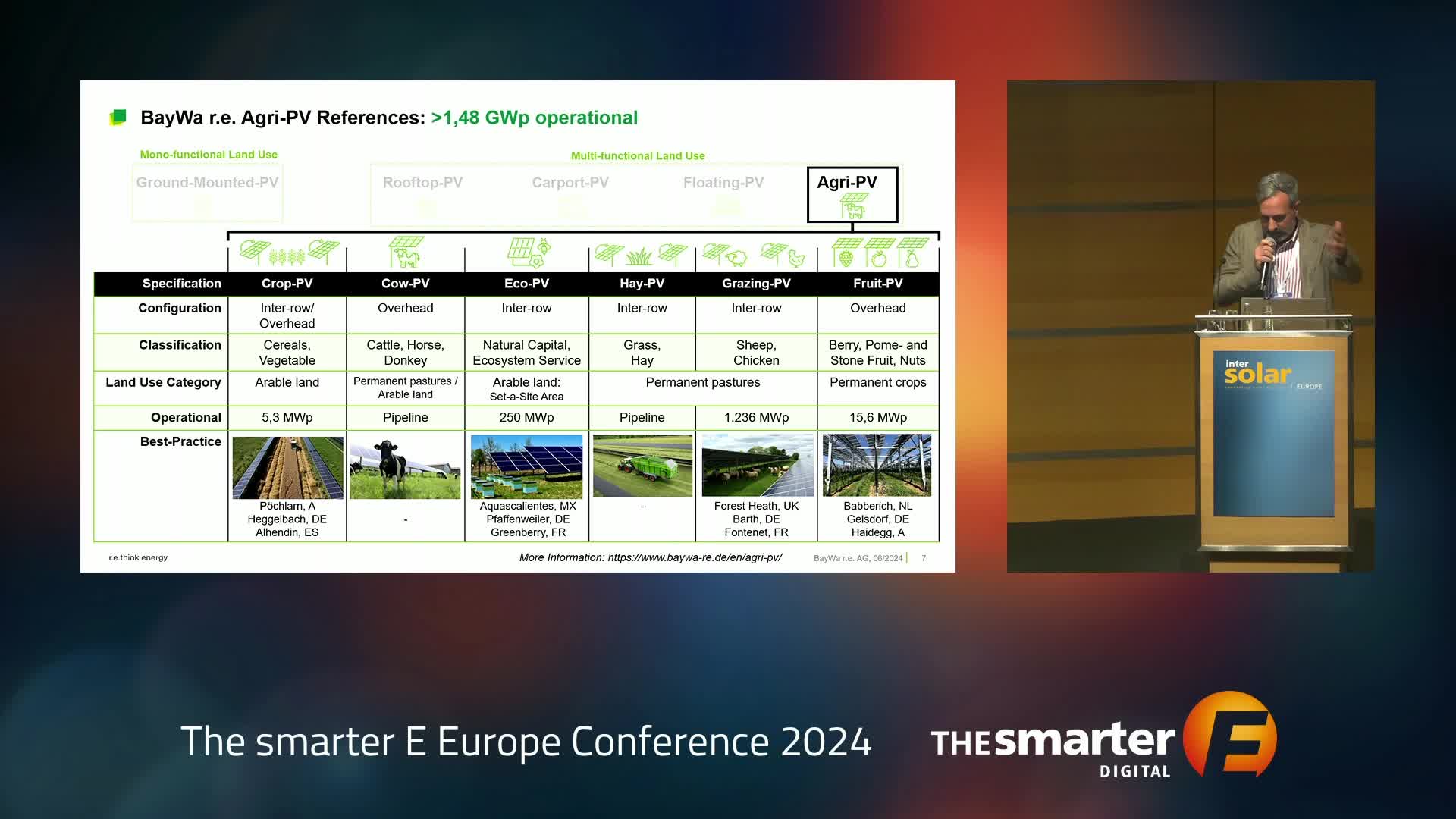
Eva, a recognized leader in the energy sector, leaves the session to attend an award ceremony where she is nominated. Her colleague praises her leadership and impactful statement that "energy alone is not enough," emphasizing the need for additional value beyond green electrons. The conversation shifts towards competitive markets and effective business cases in renewable energy projects like agro-photovoltaics (ACU-PV). It’s crucial for such ventures to provide financial benefits to farmers. The speaker discusses various challenges faced by the photovoltaic (PV) sector including technical, economic, social, and environmental issues. There is a significant growth rate in PV which necessitates better communication with rural areas to maintain social peace amid political threats from right-wing parties opposing renewables. Focusing on environmental aspects like biodiversity loss and ecovoltaics becomes essential. ACU-PV integrates agricultural activities with solar power generation; it can be productive (yielding food or fiber) or non-productive (enhancing natural capital). Effective implementation increases land use efficiency and techno-ecological synergies but always includes both farmers and agricultural activity unlike conventional systems.
Automated summarization by AI Conver
Stephan Schindele
Head of Product Management Agri-PV
BayWa r.e. AG
Germany
Several European countries have implemented their first agricultural PV projects and policymakers are starting to recognize the benefits of this technology. Governments have been adopting regulatory frameworks that enable both food and power production. Agricultural PV has positive effects on biodiversity and nature, as well as revenues. But is the business case for agricultural PV really compelling enough for farmers to adopt it at a large scale? This session will discuss: Latest projects and regulatory changes in various European agricultural PV markets Business models integrating ‘Nature Based Solutions' from pilot projects to utility-scale agricultural PV power plants Why biodiversity is turning into a hot topic in agricultural PV Fireside chat: How to convince food farmers to adopt solar farming.
Further Talks of this session:
Speaker
Eva Vandest
Head of Public Affairs
Amarenco
Austria
Speaker
Ignacio Asenjo
Policy Officer
European Commission
Belgium
Speaker
Emilien Simonot
Head of Agrivoltaics EMEA and APAC
Lightsource bp
UK
Speaker
Fabian Neu
Senior Expert Agri-PV
RWE Renewables Europe & Australia GmbH
Germany
Speaker
Jiri Bim
Head of Agrivoltaic Section
Czech Solar Association
Czech Republic