Why Eastern & Central Europe Governments Implement Supportive Policy Frameworks for Agri-PV Targets

premium account

Recording of Tuesday, June 18, 2024 | The smarter E Europe 2024 | Conference Program | Language: English | Duration: 9:44 .

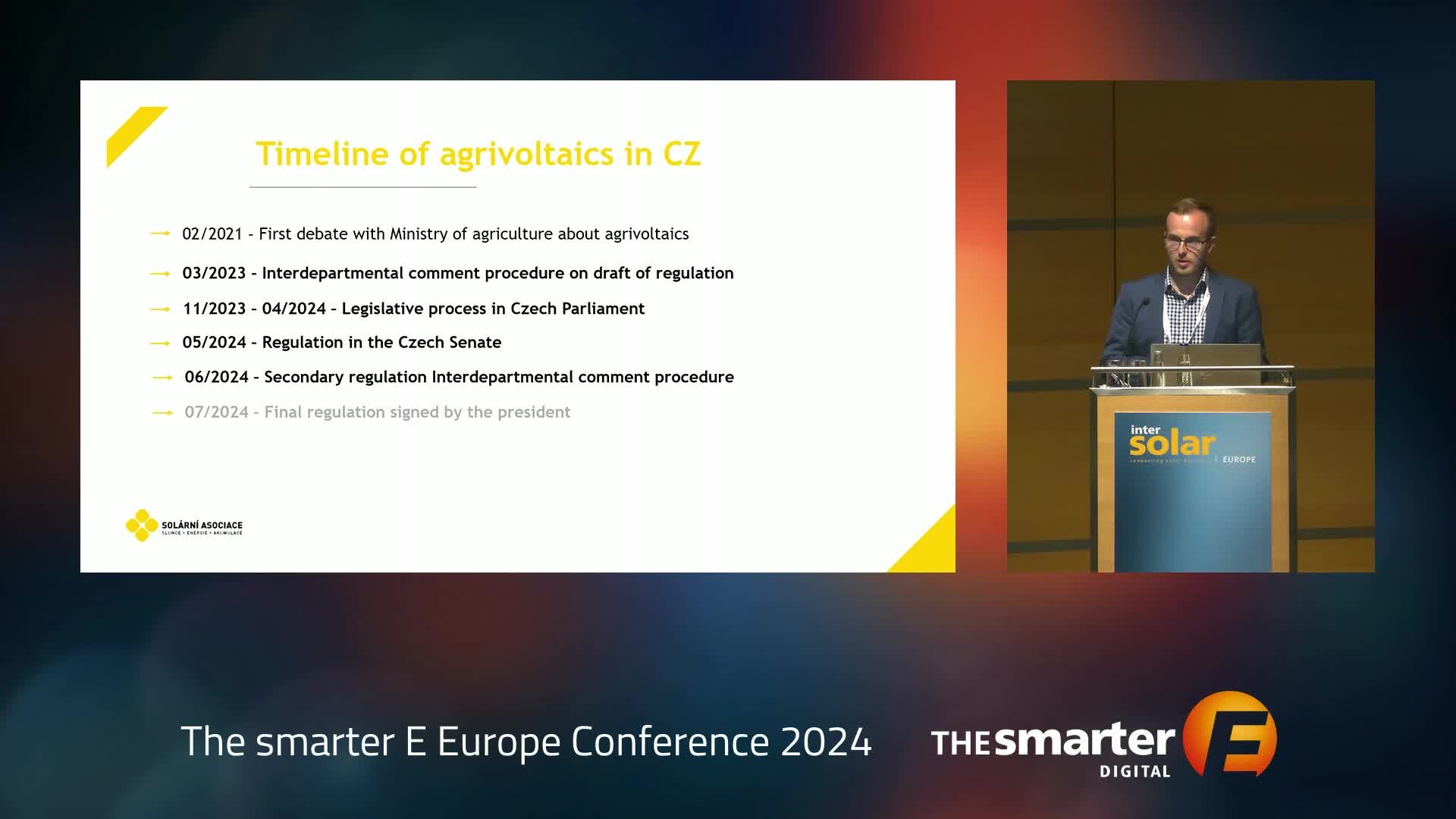
Czech Republic Introduces Groundbreaking Agrivoltaic Regulations to Boost Renewable Energy Sector

The context outlines the regulatory landscape and developments surrounding agrivoltaics in the Czech Republic, with reflections on similar efforts in Central and Eastern Europe. The need for decarbonization is driving these countries to explore renewable energy sources like solar power, integrating it into various settings including commercial rooftops and agricultural lands (agrivoltaics). In the Czech Republic, substantial progress has been made over three years of discussions involving key ministries. Agrivoltaic regulations have now been signed by the president but secondary regulations are still in development. Key points about these regulations include: 1. Land Use: Unlike conventional ground-mounted systems that require land removal from agricultural funds, agrivoltaics will not. 2. Zoning Adjustments: Agrivoltaic installations are considered as "buildings for agriculture," facilitating their placement within existing zoning plans. 3. Compliance with Rural Character: These installations must align with rural area aesthetics. Additional specifications pertain to technical parameters inspired by German DIN standards such as clear height requirements and row distances for crops under agrivoltaic setups. In financial terms, a special call for investment subsidies tailored towards agrivoltaics is anticipated by spring 2025 through modernization fund allocations. This initiative aims at mitigating higher CAPEX relative to traditional methods while promoting sustainable practices across fertile grounds and permanent grasslands in future expansions of regulation coverage.

Automated summarization by AI Conver

Jiri Bim
Head of Agrivoltaic Section
Czech Solar Association
Czech Republic

Several European countries have implemented their first agricultural PV projects and policymakers are starting to recognize the benefits of this technology. Governments have been adopting regulatory frameworks that enable both food and power production. Agricultural PV has positive effects on biodiversity and nature, as well as revenues. But is the business case for agricultural PV really compelling enough for farmers to adopt it at a large scale? This session will discuss: Latest projects and regulatory changes in various European agricultural PV markets Business models integrating ‘Nature Based Solutions' from pilot projects to utility-scale agricultural PV power plants Why biodiversity is turning into a hot topic in agricultural PV Fireside chat: How to convince food farmers to adopt solar farming.

Speaker

Eva Vandest
Head of Public Affairs
Amarenco
Austria

To Talk

Speaker

Ignacio Asenjo
Policy Officer
European Commission
Belgium

To Talk

Speaker

Emilien Simonot
Head of Agrivoltaics EMEA and APAC
Lightsource bp
UK

To Talk

Speaker

Stephan Schindele
Head of Product Management Agri-PV
BayWa r.e. AG
Germany

To Talk

Speaker

Fabian Neu
Senior Expert Agri-PV
RWE Renewables Europe & Australia GmbH
Germany

To Talk

To Talk

Further Content
Renate Egan, Executive Director of ACAP
What’s Next in PV Cell and Module Tech

The smarter E Podcast Episode 244 | Language: English

November 27, 2025

UNSW and ACAP drive advances in solar tech. Prof. Renate Egan shares new PV research and how innovation will shape the industry in 2026.

The smarter E Europe Conferences 2025
Digital Tools for Planning and Monitoring: Insights from Mozambique

Wednesday, May 07, 2025, 02:00 pm - 03:30 pm

The smarter E Europe Conferences 2025 | Conference Program

premium account

This session explores how digitalization is revolutionizing off-grid energy projects, enabling scalability and efficiency in underserved areas. Experts will discuss cutting-edge solutions based on the use and application of digital tools to support planning, development, and operations ultimately enhancing affordability. Attendees will gain insights into leveraging digital tools for optimized planning and project management, customer engagement, monitoring, and sustainable growth. Real-world case studies will highlight successful implementations, showcasing how technology bridges the gap between innovation and impact in energy access.

Webinar Collection
Kenya’s Solar Landscape 2025: Policy Shifts, Market Signals, and Opportunities for Scalable PV Deployment

December 2, 2025

free account

Join our free webinar on December 2 and learn about the current situation of the Kenyan solar industry, its opportunities, and challenges.

The smarter E Europe Conferences 2025
Factors That Influence the Success of a Minigrid Project

Wednesday, May 07, 2025, 11:00 am - 12:30 pm

The smarter E Europe Conferences 2025 | Conference Program

premium account

Off-grid solar systems are often the least expensive option for rural electrification. Solar home systems can power individual households, while mini-grids can supply entire villages. Each comes with its own advantages, disadvantages, and challenges. The aim of this session is to explore challenges as well as success stories. It takes well-functioning components such as battery systems, charge management and inverters to make projects successful. Proper system sizing, maintenance and repair management, as well as a robust financial concept are also necessary. If one of these elements is missing, the electrification will not be sustainable. This session will focus on the aspects mentioned above. The speakers will present successful and unsuccessful approaches and discuss what can be learned from them.

The smarter E Europe Conferences 2025
Panel Discussion of of the Session Off-Grid: When Will Off-Grid PV Follow the Affordability Trend?(BSW)

Wednesday, May 07, 2025, 04:00 pm - 05:30 pm

The smarter E Europe Conferences 2025 | Conference Program

premium account

Photovoltaic prices have fallen continuously in recent years - a trend that should translate into a growing market for off-grid solutions. Declining costs are crucial for rural electrification in particular, making sustainable energy supply economically viable in remote regions. However, so far many of these price advantages have not yet reached the people that need them most. Do existing framework conditions to foster rural electrification still work in this new market reality? Which measures are needed to ensure that cost reductions reach our target group? This session discusses strategies for improving the availability of low-cost off-grid solutions, financing and innovative business models. A look at successful practical examples shows which political, economic and technological levers need to be pulled to make off-grid PV accessible on a large scale.

You are using an outdated browser

The website cannot be viewed in this browser. Please open the website in an up-to-date browser such as Edge, Chrome, Firefox, or Safari.