Recording of Wednesday, May 07, 2025 | The smarter E Europe | Conference Program | Language: English | Duration: 14:41 .
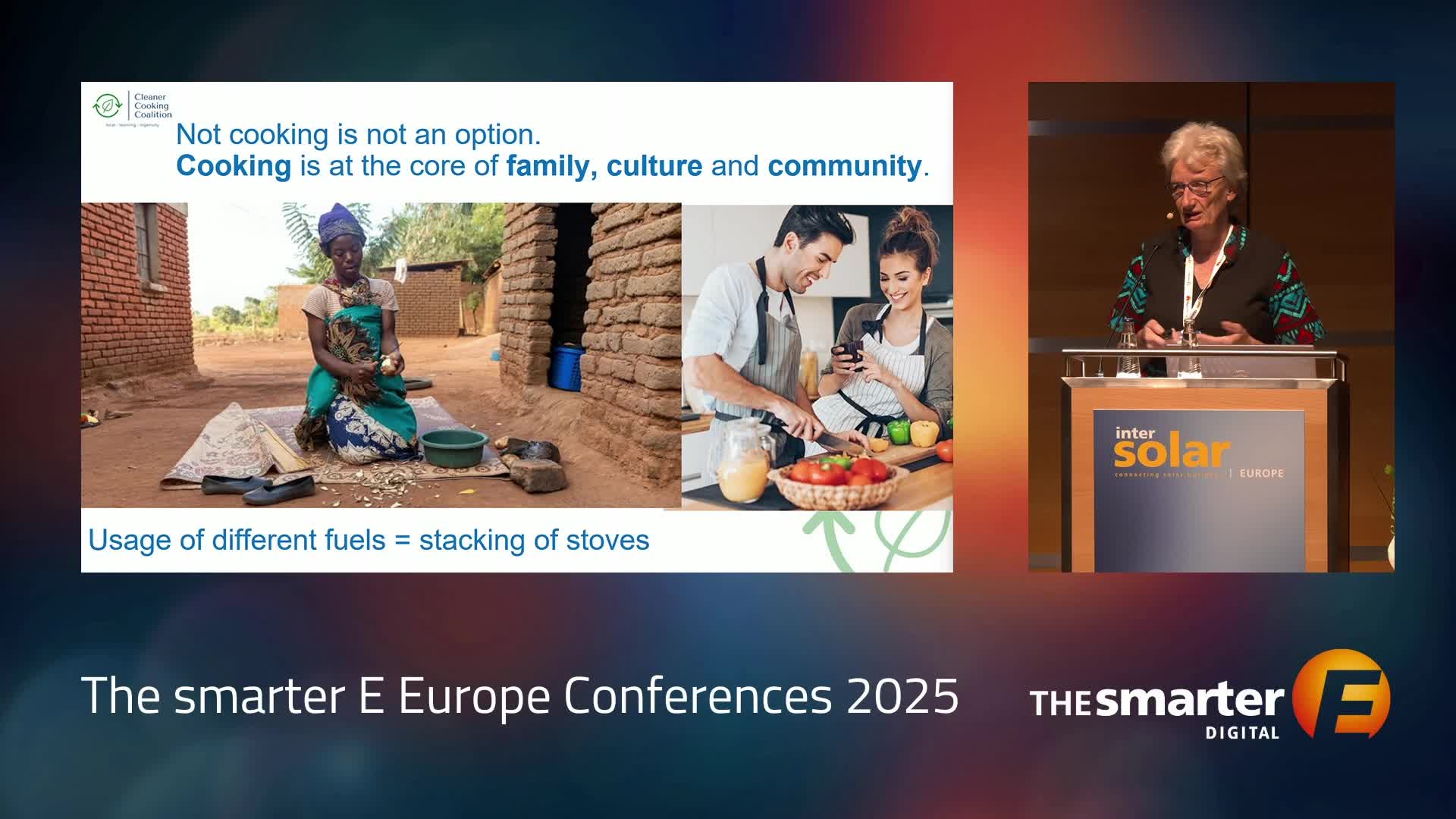
Christa Roth, representing Food and Fuel Consultants and the Cleaner Cooking Coalition, discusses integrating solar PV-based systems into cooking energy to promote cleaner cooking for people and the planet. She emphasizes that cooking is essential to humanity's survival, as it allows us to prepare energy-dense foods efficiently. Despite advancements in electricity access through solar PV enhancing quality of life globally, replicating this success for cooking remains challenging due to high power requirements compared to lighting or refrigeration. In developing countries, over 80% of household energy needs are dedicated to cooking; thus transitioning from traditional fuels towards cleaner alternatives is crucial for achieving net-zero emissions by 2050. Roth highlights various challenges: off-grid PV limitations like available power during non-sunny hours necessitating expensive storage solutions; cultural culinary preferences requiring specific appliances; financial viability issues including upfront investments and running costs hindering adoption rates among consumers who prioritize convenience alongside affordability when choosing their preferred fuel sources. She advocates intelligent management systems combining diverse technologies such as biomass with low-power electric devices tailored per region-specific demands while ensuring user-centered designs maximize efficiency without compromising comfort zones—ultimately accelerating sustainable transitions benefiting everyone equally worldwide today!
Automatisierte Zusammenfassung durch AI Conver
Christa Roth
Director
Food and Fuel Consultants
Germany
Electric cooking with solar energy is on the rise as both solar and battery technologies continue to improve, making it viable for off-grid homes. One of the main hurdles for solar-powered electric cooking has been energy storage. Cooking typically requires a large amount of energy for a short period, while solar generation is intermittent. However, advancements in lithium-ion and solid-state battery technology have made energy storage more efficient, allowing for cooking after sundown or on cloudy days. The efficiency of electric cooking appliances has also improved: In induction stoves, for example, most of the energy goes directly into heating the pot or pan. Appliances like electric pressure cookers and slow cookers are also energy-efficient. They can be ideal for solar-powered cooking setups, as they require a relatively low, steady energy input over a long period of time. With continuous advancements in solar PV and battery storage, solar electric cooking is likely to spread further in regions where grid access is limited or costly, such as parts of Africa, South Asia, and Latin America. In off-grid areas with limited access to electricity, PV systems are also key for powering refrigerators, freezers, refrigerated containers, and cold rooms. They are particularly valuable in rural or remote settings for storing perishable goods, medicines, and vaccines. New technological developments have significantly increased the efficiency of solar refrigeration systems, minimizing or even eliminating the need for battery power at night and during periods of low sunlight.Solar energy can also be used to purify or treat water to make it safe to drink or for agricultural or industrial use. This method leverages the power of sunlight, either directly or indirectly, to remove contaminants, pathogens, and impurities from water. There is a variety of methods for solar water treatment, ranging from using the sun's UV-A rays and heat to complex solar-powered water filtration systems where PV-generated electricity is used to pump water through advanced filtration systems such as ultrafiltration or RO (reverse osmosis). However, solar water treatment systems are still costly and require advanced technology and expertise.This session will provide an overview of current developments and insights into new applications for solar-powered cooking, cooling and water treatment.
Further Talks of this session:
Speaker
Deepak Mohapatra
Senior Officer - Business & Market Development
Alliance for Rural Electrification
Belgium
Recording of presentation not authorized for publication.
Speaker
Veit Goehringer
Advisor
GIZ - Deutsche Gesellschaft für Internationale Zusammenarbeit
India
Speaker
Géraldine Quelle
Project Manager
Phaesun GmbH
Germany
Speaker
Anna Shepelenko
COO
Boreal Light GmbH
Germany
Speaker
Christiane Kragh
CEO
Off-Grid Europe GmbH
Germany