Recording of Wednesday, May 07, 2025 | The smarter E Europe | Conference Program | Language: English | Duration: 12:29 .
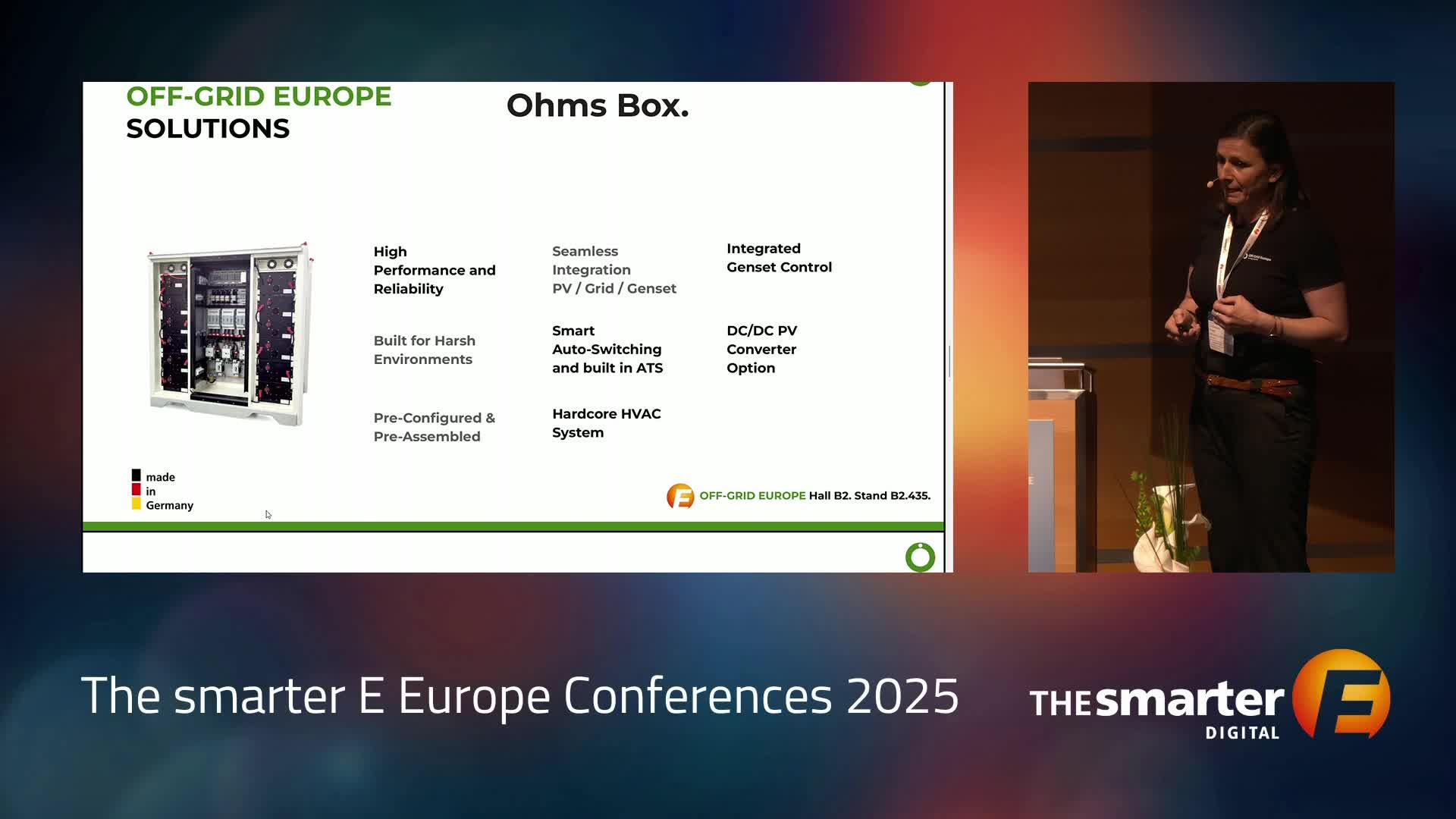
Christiane Kragh, CEO and founder of Off-Grid Europe, discusses the company's focus on off-grid energy solutions in Africa. Over the past 12 years, they have specialized in these systems with a significant presence in Senegal for eight years. They aim to address challenges such as high unemployment by creating local jobs through their projects. Their operations include production facilities both in Germany and Senegal where they assemble parts locally to support job creation. A key project involved electrifying over 200 villages across Senegal under ASEA 300 managed by GAUF Engineering Company, which inspired further innovations like cooling solutions to reduce post-harvest losses—estimated at around 40% per harvest due to inadequate cooling chains. The company offers end-to-end services from planning and logistics to maintenance while developing integrated monitoring systems like the "off-grid controller." Additionally, they've introduced compact containerized mini-grids suitable for rural electrification that are designed specifically for harsh African environments aiming at improving agricultural productivity and economic conditions through sustainable energy access.
Compactação automatizada pelo AI Conver
Christiane Kragh
CEO
Off-Grid Europe GmbH
Germany
Electric cooking with solar energy is on the rise as both solar and battery technologies continue to improve, making it viable for off-grid homes. One of the main hurdles for solar-powered electric cooking has been energy storage. Cooking typically requires a large amount of energy for a short period, while solar generation is intermittent. However, advancements in lithium-ion and solid-state battery technology have made energy storage more efficient, allowing for cooking after sundown or on cloudy days. The efficiency of electric cooking appliances has also improved: In induction stoves, for example, most of the energy goes directly into heating the pot or pan. Appliances like electric pressure cookers and slow cookers are also energy-efficient. They can be ideal for solar-powered cooking setups, as they require a relatively low, steady energy input over a long period of time. With continuous advancements in solar PV and battery storage, solar electric cooking is likely to spread further in regions where grid access is limited or costly, such as parts of Africa, South Asia, and Latin America. In off-grid areas with limited access to electricity, PV systems are also key for powering refrigerators, freezers, refrigerated containers, and cold rooms. They are particularly valuable in rural or remote settings for storing perishable goods, medicines, and vaccines. New technological developments have significantly increased the efficiency of solar refrigeration systems, minimizing or even eliminating the need for battery power at night and during periods of low sunlight.Solar energy can also be used to purify or treat water to make it safe to drink or for agricultural or industrial use. This method leverages the power of sunlight, either directly or indirectly, to remove contaminants, pathogens, and impurities from water. There is a variety of methods for solar water treatment, ranging from using the sun's UV-A rays and heat to complex solar-powered water filtration systems where PV-generated electricity is used to pump water through advanced filtration systems such as ultrafiltration or RO (reverse osmosis). However, solar water treatment systems are still costly and require advanced technology and expertise.This session will provide an overview of current developments and insights into new applications for solar-powered cooking, cooling and water treatment.
Further Talks of this session:
Speaker
Deepak Mohapatra
Senior Officer - Business & Market Development
Alliance for Rural Electrification
Belgium
Recording of presentation not authorized for publication.
Speaker
Veit Goehringer
Advisor
GIZ - Deutsche Gesellschaft für Internationale Zusammenarbeit
India
Speaker
Christa Roth
Director
Food and Fuel Consultants
Germany
Speaker
Géraldine Quelle
Project Manager
Phaesun GmbH
Germany
Speaker
Anna Shepelenko
COO
Boreal Light GmbH
Germany