DC Microgrids as the Next Frontier in Grid Modernization and DER Integration

premium account

Recording of Wednesday, May 07, 2025 | The smarter E Europe Exhibition Program 2025 | Exhibition Program | Language: English | Duration: 14:36 .

DC Microgrids and Battery Storage Set to Transform Energy Transition, According to ABB's Paolo Catapane

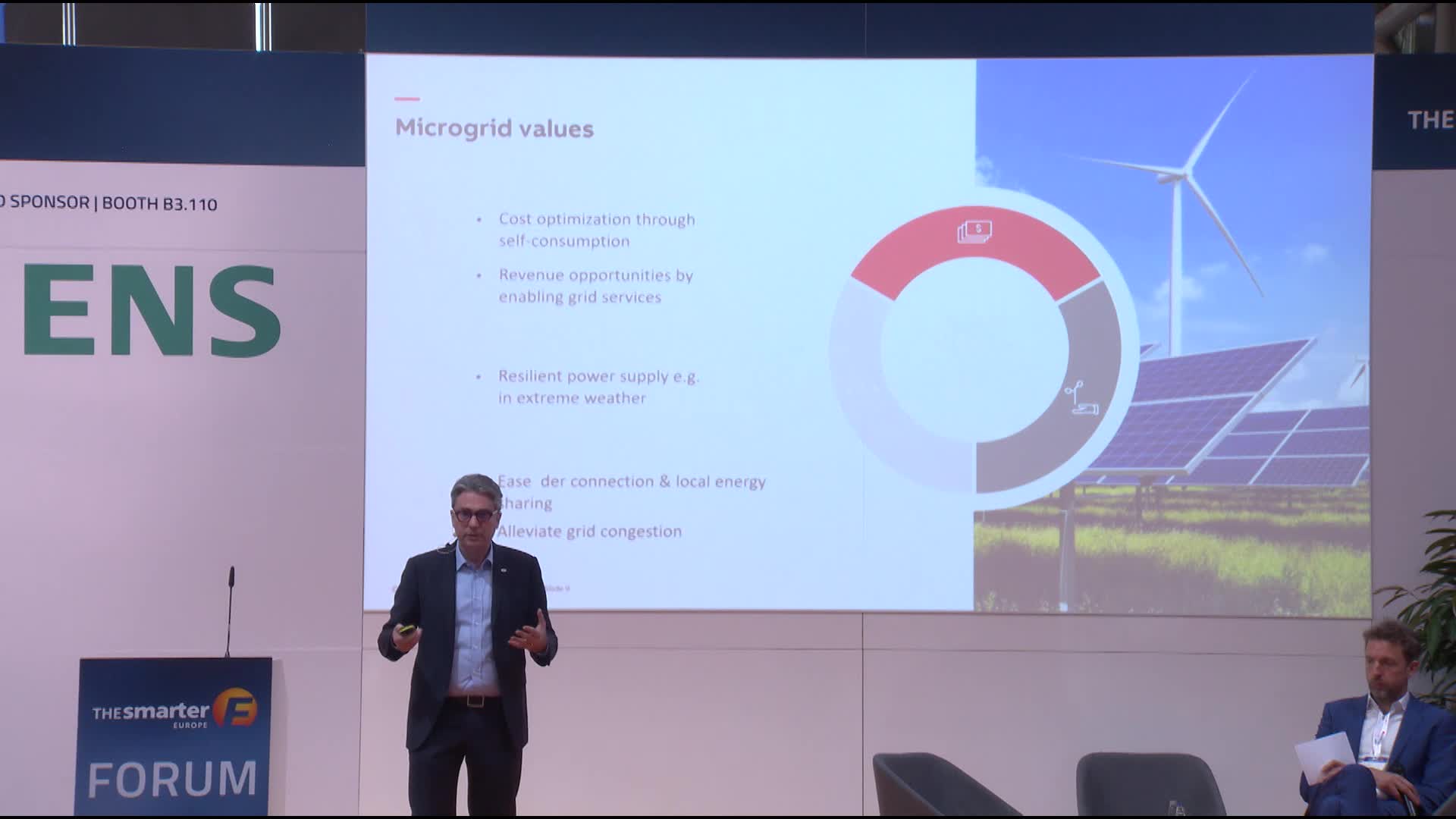
Paolo Catapane, a global product manager at ABB Electrification, explores the transformative role of DC Microgrids in modernizing grids and integrating distributed energy resources (DERs). As electrification advances with new loads like heat pumps and EV chargers primarily impacting low voltage sides of grids, traditional centralized generation models are shifting towards local contributions. This shift can cause congestion issues that DC Microgrids could alleviate by managing both loads and local generations as unified entities—enhancing user benefits while stabilizing the grid during challenges such as those experienced recently in Spain. Catapane emphasizes direct current's (DC) efficiency over alternating current (AC), citing reduced conversion losses and material usage advantages despite AC’s historical dominance due to transformer development. Modern power electronics now make DC more feasible; however, standardization gaps persist which industry alliances aim to address through interoperability advancements. He introduces ABB's solid-state circuit breaker for rapid fault response—a key component enabling efficient DC system adoption—and discusses battery energy storage systems' critical role owing to their native compatibility with DC setups for storing renewable energy efficiently. The conversation also considers charging stations within households using microgrid configurations to enhance electric vehicle charging efficiency directly from renewables without unnecessary conversions from AC.

Automated summarization by AI Conver

Paolo Catapane
Global Product Manager
ABB

Discover how next-gen distribution grid technologies are addressing the challenges of renewable integration and dynamic energy demands. This session offers insights into the latest developments in AI-driven data analytics and the transformative role of IoT in grid management. Explore how innovative digital solutions are used for efficient grid planning, expansion and modernization and provide more insights into the grid. Prepare for the future and learn how advanced grid automation is facilitating the seamless integration of Distributed Energy Resources (DERs) while enhancing grid stability, efficiency, and resilience.

Further Talks of this session:

Speaker

Dr. Thomas Hillig
CEO
THEnergy

To Talk

Speaker

Pascal Häfeli
Senior Technical Consulant
Hitachi Energy Germany AG

To Talk

Speaker

David Gomez
Maximo Renewables SME
IBM

To Talk

Speaker

Bastian Gierull
CEO
Octopus Energy Germany GmbH

To Talk

Speaker

Ben Gemsjäger
Director Business Development Europe
Siemens AG

To Talk

To Talk

Further Content
Webinar
Growth of the European Solar Market, Specifically, Romania

February 24, 2026

Webinar: EU Solar Market Overview with Focus on Romania

Irene Guerra Gil, Mark Bruno
Staying Home, with Smart Energy Management

The smarter E Podcast Episode 245 | Language: English

December 11, 2025

Irene Guerra Gil and Mark Bruno explain how smart home energy systems and building initiatives cut costs and emissions.

The smarter E Europe Conferences 2025
Factors That Influence the Success of a Minigrid Project

Wednesday, May 07, 2025, 11:00 am - 12:30 pm

The smarter E Europe Conferences 2025 | Conference Program

premium account

Off-grid solar systems are often the least expensive option for rural electrification. Solar home systems can power individual households, while mini-grids can supply entire villages. Each comes with its own advantages, disadvantages, and challenges. The aim of this session is to explore challenges as well as success stories. It takes well-functioning components such as battery systems, charge management and inverters to make projects successful. Proper system sizing, maintenance and repair management, as well as a robust financial concept are also necessary. If one of these elements is missing, the electrification will not be sustainable. This session will focus on the aspects mentioned above. The speakers will present successful and unsuccessful approaches and discuss what can be learned from them.

The smarter E Europe Conferences 2025
Q&A Session of of the Session Off-Grid: Rural Electrification Based on Solar Systems - Lessons Learned

Wednesday, May 07, 2025, 11:00 am - 12:30 pm

The smarter E Europe Conferences 2025 | Conference Program

premium account

Off-grid solar systems are often the least expensive option for rural electrification. Solar home systems can power individual households, while mini-grids can supply entire villages. Each comes with its own advantages, disadvantages, and challenges. The aim of this session is to explore challenges as well as success stories. It takes well-functioning components such as battery systems, charge management and inverters to make projects successful. Proper system sizing, maintenance and repair management, as well as a robust financial concept are also necessary. If one of these elements is missing, the electrification will not be sustainable. This session will focus on the aspects mentioned above. The speakers will present successful and unsuccessful approaches and discuss what can be learned from them.

The smarter E Europe Conferences 2025
Welcome of of the Session Off-Grid: When Will Off-Grid PV Follow the Affordability Trend?(BSW)

Wednesday, May 07, 2025, 04:00 pm - 05:30 pm

The smarter E Europe Conferences 2025 | Conference Program

premium account

Photovoltaic prices have fallen continuously in recent years - a trend that should translate into a growing market for off-grid solutions. Declining costs are crucial for rural electrification in particular, making sustainable energy supply economically viable in remote regions. However, so far many of these price advantages have not yet reached the people that need them most. Do existing framework conditions to foster rural electrification still work in this new market reality? Which measures are needed to ensure that cost reductions reach our target group? This session discusses strategies for improving the availability of low-cost off-grid solutions, financing and innovative business models. A look at successful practical examples shows which political, economic and technological levers need to be pulled to make off-grid PV accessible on a large scale.

You are using an outdated browser

The website cannot be viewed in this browser. Please open the website in an up-to-date browser such as Edge, Chrome, Firefox, or Safari.