Recording of Wednesday, May 07, 2025 | The smarter E Europe | Language: English | Duration: 11:15 .
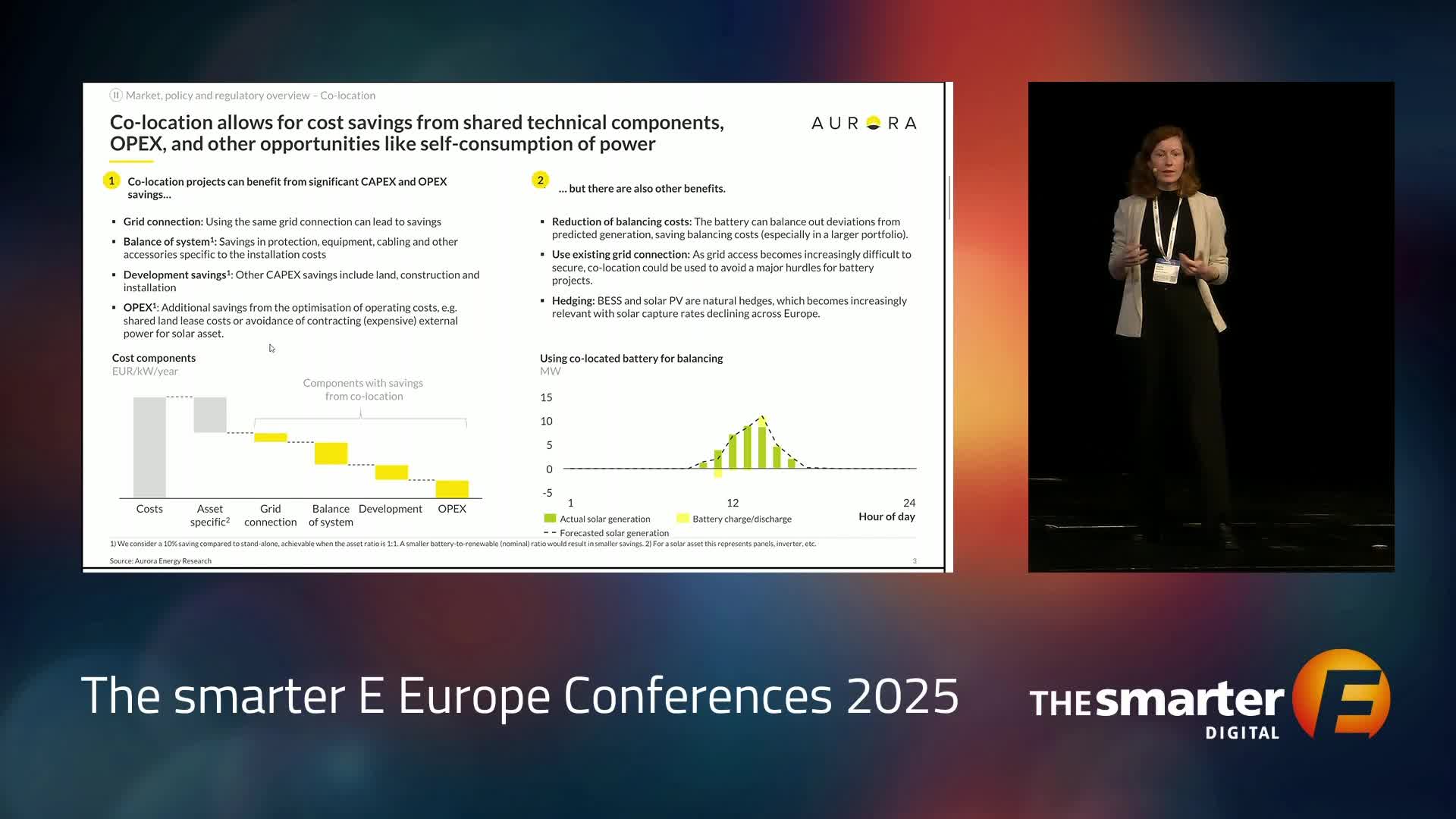
The presentation from Aurora Energy Research delves into the German energy market, focusing on hybrid solar and Battery Energy Storage Systems (BESS). It examines current financing models for these assets and anticipates positive policy changes favoring co-location. The annual build-out of ground-mounted solar reached a record six gigawatts last year, with standalone large-scale BESS adding half a gigawatt. Co-located hybrid assets are emerging due to innovation auction schemes but are also increasingly developed outside such frameworks. Hybrid systems offer cost savings in CAPEX and operational expenses like land lease costs while optimizing power procurement for solar assets. They mitigate high imbalance costs through battery optimization against forecast deviations, address grid connection scarcity by retrofitting existing installations with batteries, and hedge against decreasing capture prices during negative price hours. Three co-location business models were studied: merchant-based setups allowing full revenue stream access; subsidized innovation scheme projects limiting grid charging; EEG-subsidized hybrids optimized under evolving regulations promising increased returns once exclusivity principles change mid-next year across Europe’s favorable policies landscape.
Automated summarization by AI Conver
Claudia Günther
Research Lead Northwestern Europe
Aurora Energy Research
Germany
The profitability of hybrid PV power plants has improved significantly. In addition to steep cost declines in solar and storage solutions, evolving policy frameworks support a variety of business models for hybrid PV power plants to address flexibility needs. This includes merchant markets, PPAs, grid services and contracts for difference. In addition, some companies are requesting a 24/7 renewable energy supply that matches hourly supply and demand. This session will provide: Economic viability analysis of hybrid PV power plants Overview of viable business models for hybrid solar projects Case studies showcasing different technology combinations and market offerings Update on 24/7 renewable energy matching.
Further Talks of this session:
Speaker
Dr. Harry Wirth
Director, Division Power Solutions
Fraunhofer Institute for Solar Energy Systems ISE
Germany
Speaker
Eduard Foved Johe
Yield Assessment and Performance Manager
Engie
Spain
Speaker
Christian Folke
Head of Technology & Innovation
Uniper
Germany
Speaker
Claus Wattendrup
CEO
Vattenfall
Netherlands
Speaker
Kai Becker
Chief Development Officer
Energy2Market
Germany
Speaker
Claudia Günther
Research Lead Northwestern Europe
Aurora Energy Research
Germany