Lessons Learned With Hybrid Power Plants

premium account

Recording of Wednesday, May 07, 2025 | The smarter E Europe Conferences 2025 | Language: English | Duration: 8:27 .

Vattenfall's Claus Wattendrup Discusses Innovative Hybrid Energy Solutions and Revenue Challenges in Sweden and Germany

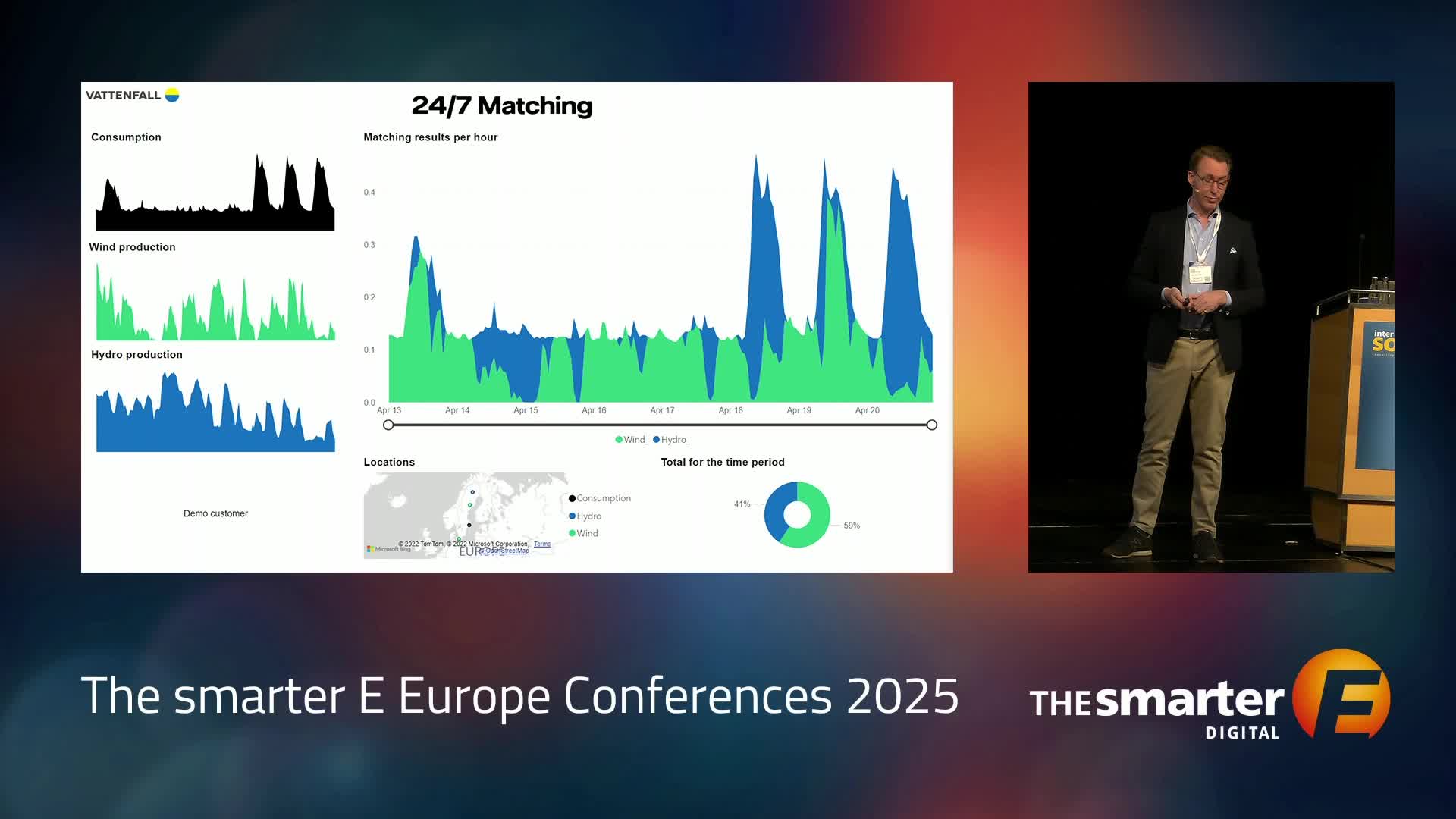
Claus Wattendrup from Vattenfall, a Swedish utility company known for its hydroelectric origins, discusses the complexities and innovations in hybrid energy projects. He highlights the integration of wind, solar, and battery systems to optimize energy production despite challenges posed by seasonal variations in Europe. In Sweden, where Vattenfall benefits from abundant hydropower resources alongside wind power, they have successfully created balanced energy solutions that fill gaps left by intermittent renewable sources like wind and solar. This approach has been particularly effective for data centers due to their specific consumption profiles. However, he notes difficulties replicating this model in Germany due to limited hydropower availability; instead relying on batteries to shift supply times slightly but not providing baseload capacity cost-effectively. While market optimization offers higher profits without fixed customer contracts—appealing especially when financing is challenging—it lacks revenue security needed for smaller companies seeking bank support. Claus invites further discussion on securing revenues across different markets while maintaining sustainable practices.

Automated summarization by AI Conver

Claus Wattendrup
CEO
Vattenfall
Netherlands

The profitability of hybrid PV power plants has improved significantly. In addition to steep cost declines in solar and storage solutions, evolving policy frameworks support a variety of business models for hybrid PV power plants to address flexibility needs. This includes merchant markets, PPAs, grid services and contracts for difference. In addition, some companies are requesting a 24/7 renewable energy supply that matches hourly supply and demand. This session will provide: Economic viability analysis of hybrid PV power plants Overview of viable business models for hybrid solar projects Case studies showcasing different technology combinations and market offerings Update on 24/7 renewable energy matching.

Further Talks of this session:

Speaker

Dr. Harry Wirth
Director, Division Power Solutions
Fraunhofer Institute for Solar Energy Systems ISE
Germany

To Talk

Speaker

Claudia Günther
Research Lead Northwestern Europe
Aurora Energy Research
Germany

To Talk

Speaker

Eduard Foved Johe
Yield Assessment and Performance Manager
Engie
Spain

To Talk

Speaker

Christian Folke
Head of Technology & Innovation
Uniper
Germany

To Talk

Speaker

Kai Becker
Chief Development Officer
Energy2Market
Germany

To Talk

Speaker

Claudia Günther
Research Lead Northwestern Europe
Aurora Energy Research
Germany

Eduard Foved Johe
Yield Assessment and Performance Manager
Engie
Spain

Christian Folke
Head of Technology & Innovation
Uniper
Germany

Kai Becker
Chief Development Officer
Energy2Market
Germany

To Talk

Further Content
Renate Egan, Executive Director of ACAP
What’s Next in PV Cell and Module Tech

The smarter E Podcast Episode 244 | Language: English

November 27, 2025

UNSW and ACAP drive advances in solar tech. Prof. Renate Egan shares new PV research and how innovation will shape the industry in 2026.

The smarter E Europe Conferences 2025
Digital Tools for Planning and Monitoring: Insights from Mozambique

Wednesday, May 07, 2025, 02:00 pm - 03:30 pm

The smarter E Europe Conferences 2025 | Conference Program

premium account

This session explores how digitalization is revolutionizing off-grid energy projects, enabling scalability and efficiency in underserved areas. Experts will discuss cutting-edge solutions based on the use and application of digital tools to support planning, development, and operations ultimately enhancing affordability. Attendees will gain insights into leveraging digital tools for optimized planning and project management, customer engagement, monitoring, and sustainable growth. Real-world case studies will highlight successful implementations, showcasing how technology bridges the gap between innovation and impact in energy access.

Webinar Collection
Kenya’s Solar Landscape 2025: Policy Shifts, Market Signals, and Opportunities for Scalable PV Deployment

December 2, 2025

free account

Join our free webinar on December 2 and learn about the current situation of the Kenyan solar industry, its opportunities, and challenges.

The smarter E Europe Conferences 2025
Factors That Influence the Success of a Minigrid Project

Wednesday, May 07, 2025, 11:00 am - 12:30 pm

The smarter E Europe Conferences 2025 | Conference Program

premium account

Off-grid solar systems are often the least expensive option for rural electrification. Solar home systems can power individual households, while mini-grids can supply entire villages. Each comes with its own advantages, disadvantages, and challenges. The aim of this session is to explore challenges as well as success stories. It takes well-functioning components such as battery systems, charge management and inverters to make projects successful. Proper system sizing, maintenance and repair management, as well as a robust financial concept are also necessary. If one of these elements is missing, the electrification will not be sustainable. This session will focus on the aspects mentioned above. The speakers will present successful and unsuccessful approaches and discuss what can be learned from them.

The smarter E Europe Conferences 2025
Panel Discussion of of the Session Off-Grid: When Will Off-Grid PV Follow the Affordability Trend?(BSW)

Wednesday, May 07, 2025, 04:00 pm - 05:30 pm

The smarter E Europe Conferences 2025 | Conference Program

premium account

Photovoltaic prices have fallen continuously in recent years - a trend that should translate into a growing market for off-grid solutions. Declining costs are crucial for rural electrification in particular, making sustainable energy supply economically viable in remote regions. However, so far many of these price advantages have not yet reached the people that need them most. Do existing framework conditions to foster rural electrification still work in this new market reality? Which measures are needed to ensure that cost reductions reach our target group? This session discusses strategies for improving the availability of low-cost off-grid solutions, financing and innovative business models. A look at successful practical examples shows which political, economic and technological levers need to be pulled to make off-grid PV accessible on a large scale.

You are using an outdated browser

The website cannot be viewed in this browser. Please open the website in an up-to-date browser such as Edge, Chrome, Firefox, or Safari.