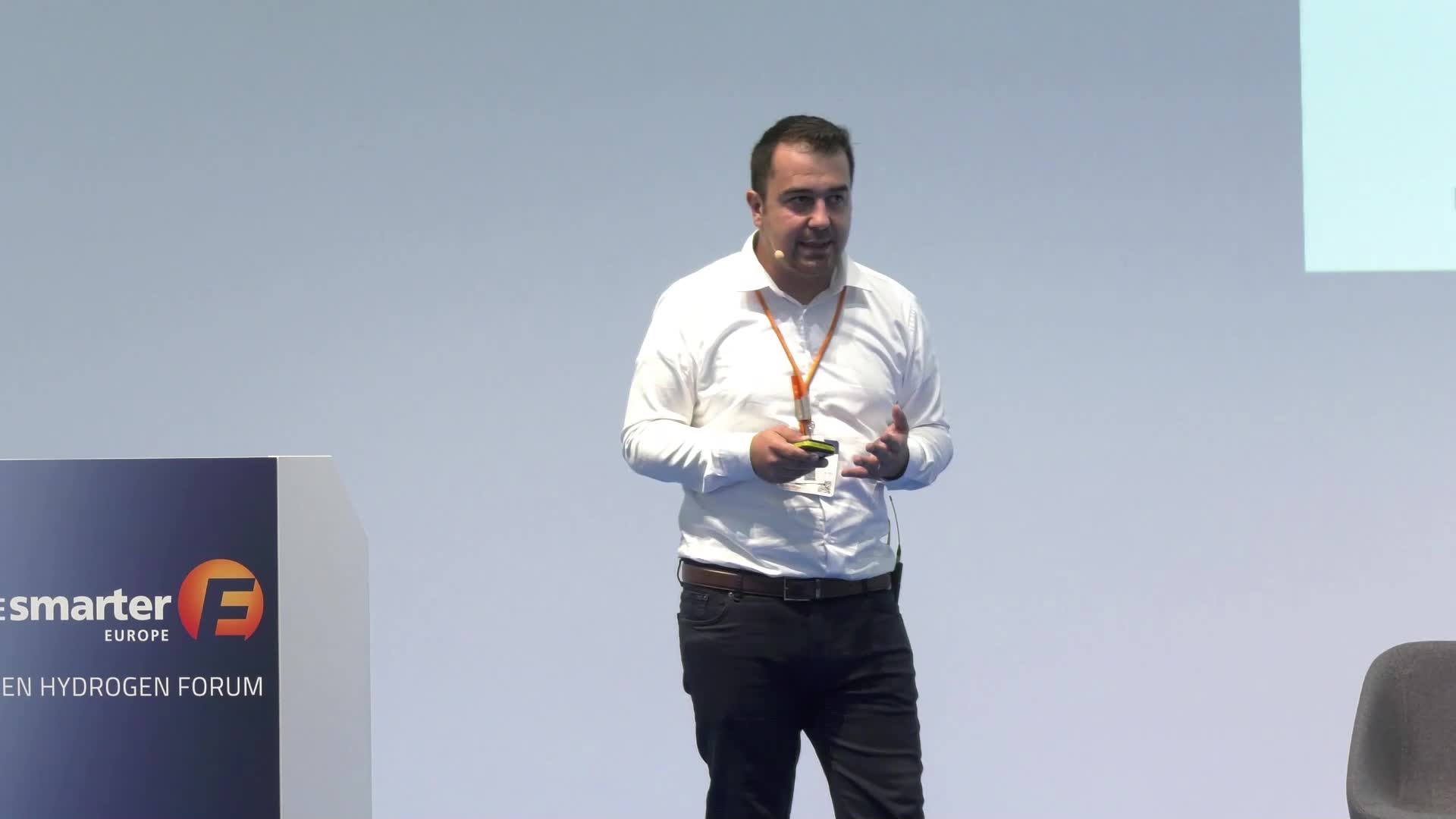
Elevating Renewable Energy Efficiency: The Advancements in Stack Condition Monitoring

premium account

Recording of Thursday, June 20, 2024 | The smarter E Europe 2024 | Exhibition Program | Language: English | Duration: 12:31 .

Weidmüller Interface Advanced Stack Condition Monitoring Enhances Efficiency in Fuel Cells and Electrolyzers with Data-Driven Solutions

Cengiz Oguzoglu from Weidmüller Interface discusses improving stack condition monitoring for hydrogen plants, fuel cells, and electrolyzers. He outlines the process by explaining three key topics: understanding current operations, highlighting unique aspects of their approach in this field (including machine learning), and making data more efficient and meaningful. Weidmüller employs over 6,000 people across 65 countries with a turnover of approximately 1.2 billion euros annually. They invest significantly in new factories and logistics centers while bringing around 120 new products to market each year. Their primary markets include machinery, wheat industry equipment, PV systems, wind energy solutions, and process industries. Their expertise lies in power signal data transmission—from connectivity to cloud technology—across various industries like wind power and photovoltaics. The company's mission emphasizes seamless data handling from sensor acquisition to cloud integration using preprocessing layers followed by analysis through visualization tools or machine learning techniques. In addressing customer issues such as cell degradation or gas crossover in fuel cells/electrolyzers; they focus on collecting vital parameters like voltage levels/temperature/compression/vibration/pressure quality metrics before feeding these into customizable Lego-like modular setups that transfer insights directly onto SCADA systems/local servers/cloud networks ensuring both operator independence & satisfaction alike ultimately leading towards enhanced operational efficiency overall!

Automated summarization by AI Conver

Cengiz Oguzoglu
Global Business Development Manager - Hydrogen
Weidmüller Interface GmbH & Co. KG
Germany

Industrial/Product Live Pitches

Further Talks of this session:

Speaker

Michael Spirig
CEO & Founder
EFCF (European Electrolyser & Fuel Cell Forum)
Switzerland

To Talk

Speaker

Thomas Therkild Petersen
Product Line Manager, Marine & Large Stationary
Ballard Power Systems Europe A/S
U.S.

To Talk

Speaker

Dr. Joey Disch
Senior Scientist Electrolysis
ionysis GmbH
Germany

To Talk

Speaker

Moritz Holzmüller
Business Development Manager
Reverion GmbH
Germany

To Talk

Speaker

Alexander Cordes
Vice President Customer Success
Robert Bosch GmbH
Germany

To Talk

Speaker

Björn Ledergerber
Senior Vice President Hydrogen & Corporate Development
SFC Energy AG
Germany

To Talk

Further Content
Business Visibility
Sponsoring & Marketing Overview

All sponsorship and marketing opportunities at a glance: Find the ideal marketing mix for your company.

Webinar
Growth of the European Solar Market, Specifically, Romania

February 24, 2026

Webinar: EU Solar Market Overview with Focus on Romania

The smarter E Europe Conferences 2025
Factors That Influence the Success of a Minigrid Project

Wednesday, May 07, 2025, 11:00 am - 12:30 pm

The smarter E Europe Conferences 2025 | Conference Program

premium account

Off-grid solar systems are often the least expensive option for rural electrification. Solar home systems can power individual households, while mini-grids can supply entire villages. Each comes with its own advantages, disadvantages, and challenges. The aim of this session is to explore challenges as well as success stories. It takes well-functioning components such as battery systems, charge management and inverters to make projects successful. Proper system sizing, maintenance and repair management, as well as a robust financial concept are also necessary. If one of these elements is missing, the electrification will not be sustainable. This session will focus on the aspects mentioned above. The speakers will present successful and unsuccessful approaches and discuss what can be learned from them.

The smarter E Europe Conferences 2025
Q&A Session of of the Session Off-Grid: Rural Electrification Based on Solar Systems - Lessons Learned

Wednesday, May 07, 2025, 11:00 am - 12:30 pm

The smarter E Europe Conferences 2025 | Conference Program

premium account

Off-grid solar systems are often the least expensive option for rural electrification. Solar home systems can power individual households, while mini-grids can supply entire villages. Each comes with its own advantages, disadvantages, and challenges. The aim of this session is to explore challenges as well as success stories. It takes well-functioning components such as battery systems, charge management and inverters to make projects successful. Proper system sizing, maintenance and repair management, as well as a robust financial concept are also necessary. If one of these elements is missing, the electrification will not be sustainable. This session will focus on the aspects mentioned above. The speakers will present successful and unsuccessful approaches and discuss what can be learned from them.

The smarter E Europe Conferences 2025
Setting the Scene "Affodability"

Wednesday, May 07, 2025, 04:00 pm - 05:30 pm

The smarter E Europe Conferences 2025 | Conference Program

premium account

Photovoltaic prices have fallen continuously in recent years - a trend that should translate into a growing market for off-grid solutions. Declining costs are crucial for rural electrification in particular, making sustainable energy supply economically viable in remote regions. However, so far many of these price advantages have not yet reached the people that need them most. Do existing framework conditions to foster rural electrification still work in this new market reality? Which measures are needed to ensure that cost reductions reach our target group? This session discusses strategies for improving the availability of low-cost off-grid solutions, financing and innovative business models. A look at successful practical examples shows which political, economic and technological levers need to be pulled to make off-grid PV accessible on a large scale.

You are using an outdated browser

The website cannot be viewed in this browser. Please open the website in an up-to-date browser such as Edge, Chrome, Firefox, or Safari.