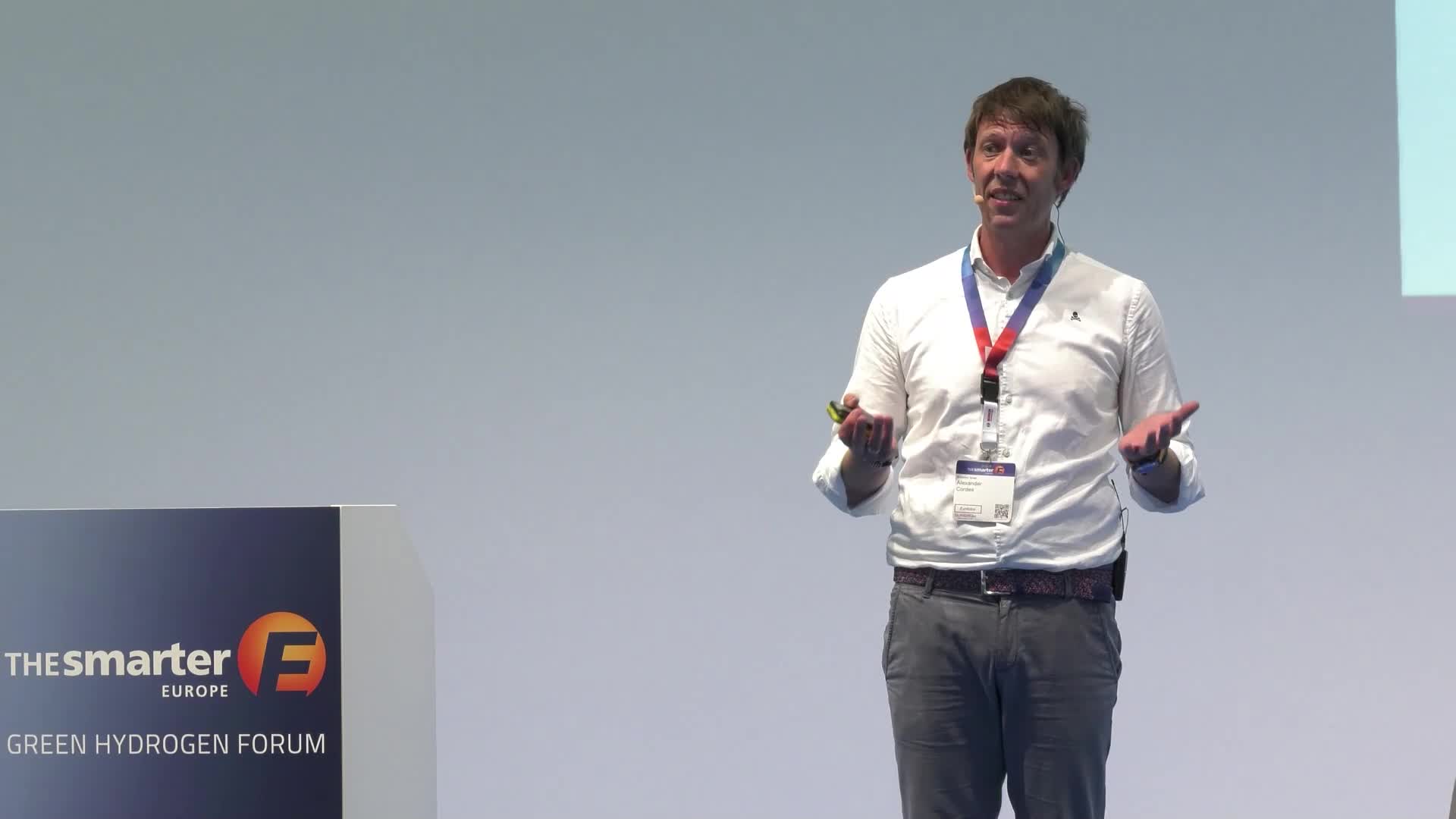
POWERFUL SYNERGY: SOFC, Renewable Energy Technologies, and Demand Response

premium account

Recording of Thursday, June 20, 2024 | The smarter E Europe 2024 | Exhibition Program | Language: English | Duration: 12:20 .

Bosch Unveils Scalable Solid Oxide Fuel Cell Systems for Green Hydrogen Economy, Targeting Data Centers and Industrial Applications

Alexander Cordes from Bosch discusses the company's movement towards a green hydrogen economy, focusing on solid oxide fuel cell (SOFC) systems. Bosch, traditionally known for household and automotive products, is heavily investing in hydrogen technology across production, storage, distribution, and usage. The company is developing electrolysis stacks for H2 generation and equipment for H2 gas stations while working on PEM fuel cells for automobiles and SOFCs as part of their €500 million annual investment. The SOFC system presented boasts an electrical efficiency of around 60%, reaching up to 90% with heat utilization. These scalable plug-and-play units are robust with low maintenance costs due to no moving parts. Initially using natural gas but adaptable to hydrogen when available, these systems cater mainly to data centers requiring reliable power solutions that scale with demand. Bosch's current focus includes building urban quarters and industrial applications where electricity needs are high. Despite not starting full-scale production yet—expected soon—the company has over a hundred operational units in various sectors demonstrating practicality and feasibility. In terms of cost-competitiveness against existing grid rates today’s development ensures future mass scaling will maintain economic viability. In response to inquiries about downsizing technology for residential use within the next decade or two amidst widespread natural gas heating reliance Alexander Cordes confirmed long-term plans include smaller kilowatt-range solutions already explored by other market players.

Automated summarization by AI Conver

Alexander Cordes
Vice President Customer Success
Robert Bosch GmbH
Germany

Industrial/Product Live Pitches

Further Talks of this session:

Speaker

Michael Spirig
CEO & Founder
EFCF (European Electrolyser & Fuel Cell Forum)
Switzerland

To Talk

Speaker

Thomas Therkild Petersen
Product Line Manager, Marine & Large Stationary
Ballard Power Systems Europe A/S
U.S.

To Talk

Speaker

Cengiz Oguzoglu
Global Business Development Manager - Hydrogen
Weidmüller Interface GmbH & Co. KG
Germany

To Talk

Speaker

Dr. Joey Disch
Senior Scientist Electrolysis
ionysis GmbH
Germany

To Talk

Speaker

Moritz Holzmüller
Business Development Manager
Reverion GmbH
Germany

To Talk

Speaker

Björn Ledergerber
Senior Vice President Hydrogen & Corporate Development
SFC Energy AG
Germany

To Talk

Further Content
Webinar
Mixed Investment Solar Projects in Mexico: The 54% Model Explained

January 29, 2026

Mexico has introduced a new mixed investment scheme for renewable power generation, requiring a minimum 54% direct or indirect participation by CFE.

Anna Darmani, Principal Analyst from Wood Mackenzie
Big BESS Is Here to Save the Day

The smarter E Podcast Episode 246 | Language: English

January 8, 2026

Utility-scale batteries are booming in Europe. Discover key BESS trends, market impacts, and what to expect for large-scale storage in 2026.

Business Visibility
Sponsoring & Marketing Overview

All sponsorship and marketing opportunities at a glance: Find the ideal marketing mix for your company.

Alex Barrows, Molly Morgan, Sonia Dunlop
Inside 2026’s PV Pricing Reset

The smarter E Podcast Episode 247 | Language: English

January 22, 2026

Solar PV prices shift after years of oversupply. This episode covers supply-chain pressures, tech competition, and 2026 market impacts.

The smarter E Europe Conferences 2025
Factors That Influence the Success of a Minigrid Project

Wednesday, May 07, 2025, 11:00 am - 12:30 pm

The smarter E Europe Conferences 2025 | Conference Program

premium account

Off-grid solar systems are often the least expensive option for rural electrification. Solar home systems can power individual households, while mini-grids can supply entire villages. Each comes with its own advantages, disadvantages, and challenges. The aim of this session is to explore challenges as well as success stories. It takes well-functioning components such as battery systems, charge management and inverters to make projects successful. Proper system sizing, maintenance and repair management, as well as a robust financial concept are also necessary. If one of these elements is missing, the electrification will not be sustainable. This session will focus on the aspects mentioned above. The speakers will present successful and unsuccessful approaches and discuss what can be learned from them.

You are using an outdated browser

The website cannot be viewed in this browser. Please open the website in an up-to-date browser such as Edge, Chrome, Firefox, or Safari.