Recording of Tuesday, June 23, 2026 | The smarter E Europe Conferences 2026 | Language: English | Duration: 7:17 .
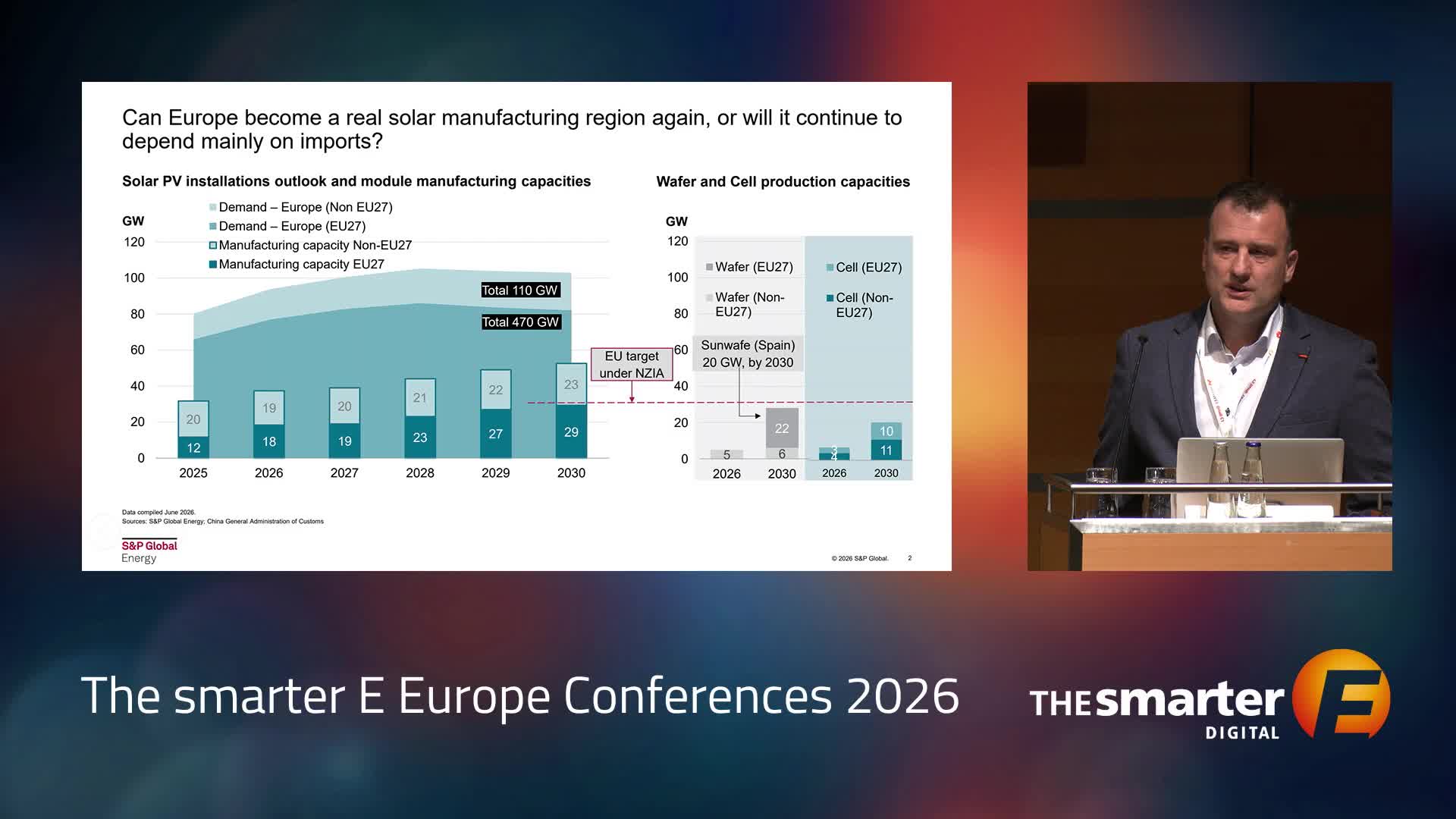
Europe is set to install around 580 gigawatts of solar capacity over the next five years but faces significant production challenges, with local manufacturing only fulfilling 30 to 40 percent of current demand. The EU's reliance on imports, particularly from China, remains high, even as expectations for additional imports in the coming year signal a potential excess inventory of around 60 gigawatts. This oversupply dampens local sourcing urgency, putting pressure on domestic manufacturers who struggle with price competitiveness, exacerbated by higher production costs compared to China—40 to 50 percent more. Factors influencing production costs include labor, materials, and regulatory compliance, with Western Europe incurring higher expenses than Eastern Europe. Efforts to innovate and optimize operations are crucial as local manufacturers contend with ongoing market challenges. Although the EU is implementing measures like the Industry Accelerator and Net Zero Industry Act, more robust support is needed for sustainable success in the solar sector. By 2030, selective growth in manufacturing rather than full reshoring of the value chain is anticipated, as companies prioritize advanced technologies while managing financial constraints.
Automatisierte Zusammenfassung durch AI Conver
Speaker
Karl Melkonyan
Principal Analyst
S&P Global
Despite strong research capabilities and the presence of leading production equipment suppliers, Europe has been struggling to rebuild competitive wafer-to-module manufacturing, while the USA and India have enabled a local renaissance in solar manufacturing. In Europe, even long-established inverter manufacturers have been losing considerable ground. With the EU's Net Zero Industry Act yet to deliver momentum, attention is turning to the upcoming Industry Accelerator Act. This session examines how policy, investment and value-chain strategies can strengthen domestic manufacturing and increase internal value creation.
Key topics:
Further Talks of this session:
Speaker
Dries Acke
Deputy CEO
SolarPower Europe
Belgium
Speaker
Marius Mordal Bakke
VP, Head of solar and storage research
Rystad Energy AS
Norway
Speaker
Prof. Dr. Peter Fath
CEO
RCT Solutions GmbH
Germany
Speaker