First Experience Report on Dealing With the Requirements of the New EU Battery Regulation

premium account

Recording of Wednesday, May 07, 2025 | The smarter E Europe 2025 | Exhibition Program | Language: English | Duration: 15:36 .

Navigating the Challenges and Obligations of the EU Battery Regulation: Insights from TÜV SÜD's First Year Experience

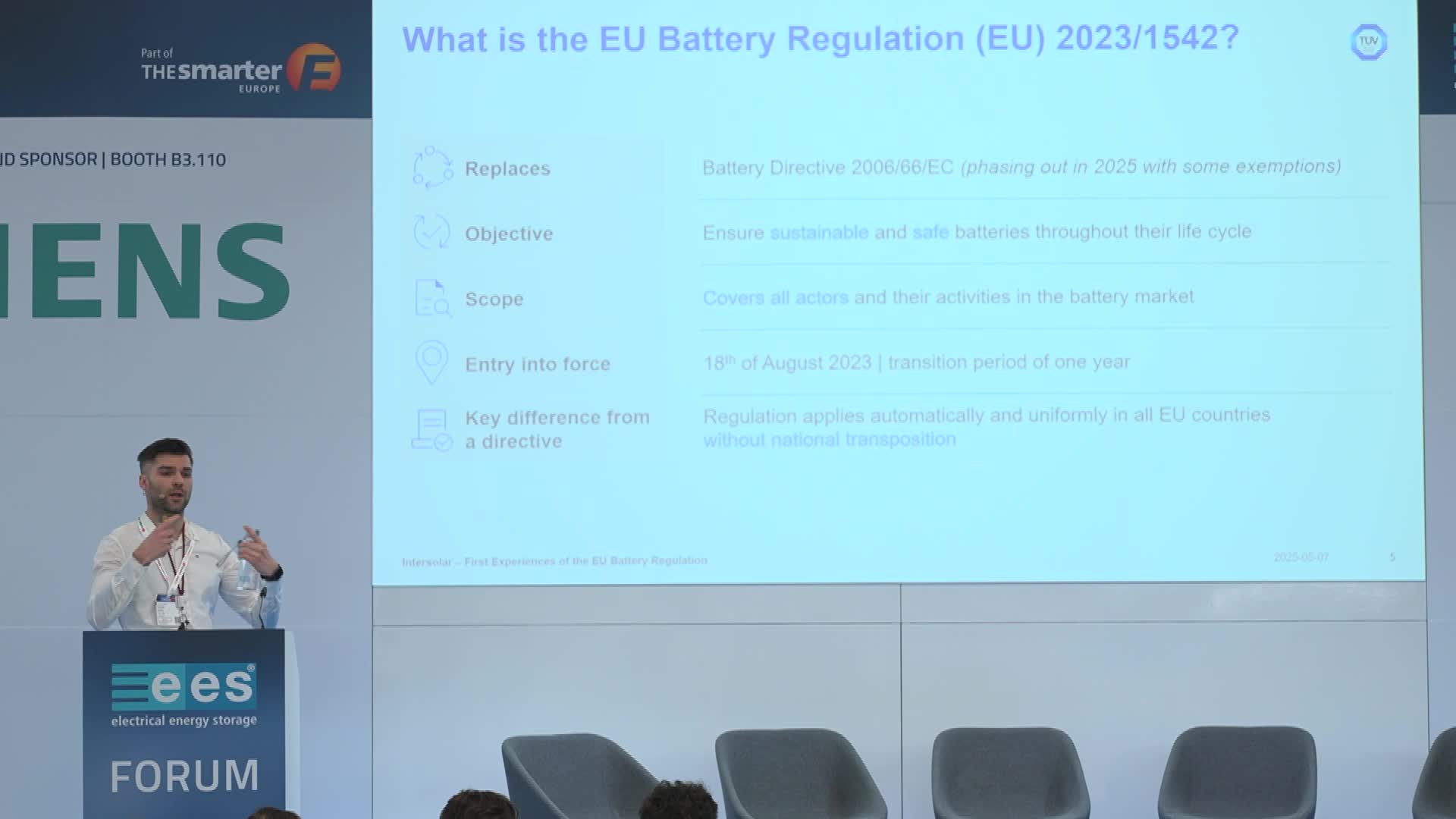
The discussion focuses on the EU Battery Regulation, which replaced the 2006 battery directive to ensure sustainable and safer batteries throughout their lifecycle. This regulation applies uniformly across all EU countries without national transposition, marking a significant shift from directives. It covers nearly all types of batteries except those used in defense, space, and some nuclear applications. The regulation categorizes batteries into five main groups: portable; starting lighting and ignition; light transport means; vehicle propulsion; and industrial stationary storage. Economic operators such as manufacturers, importers, distributors have specific obligations under this regulation including CE conformity assessment for manufacturers. A key challenge is understanding one's role within these regulations due to varying responsibilities like producer responsibility differing by country. Technical documentation demonstrating compliance with articles affecting different battery categories is crucial but complex due to ambiguous terminology and overlapping regulations. Additionally, calculating carbon footprints for lifecycle emissions poses resource-intensive challenges requiring notified bodies' involvement when mandatory provisions come into force in future dates specified by delegated acts yet pending implementation.

Automated summarization by AI Conver

Speaker

Nicholas Bellino
Business Development Manager
TÜV SÜD

The energy storage market is developing dynamically. What are the trends in the European and German storage market? Where are the best opportunities for development? Trade associations and industry representatives will provide valuable insights into the latest market trends, framework and emerging technologies.

Further Talks of this session:

Speaker

Sangetha Suresh
Partner UAE
EUPD Research/ IBESA

To Talk

Speaker

Saif Islam
Senior Consultant
EUPD Research

Ali Arfa
Data Manager
EUPD Research

To Talk

Speaker

Antonio Arruebo
Market Analyst
SolarPower Europe

To Talk

Speaker

Thomas Seltmann
PV Expert
BSW

To Talk

Speaker

Barbara Adamska
President
Polish Energy Storage Association (PESA)

To Talk

Speaker

Dr. Nam Truong
CEO & Co-Founder
STABL Energy GmbH

To Talk

Video is not available.

Further Content
Webinar
Mixed Investment Solar Projects in Mexico: The 54% Model Explained

January 29, 2026

Mexico has introduced a new mixed investment scheme for renewable power generation, requiring a minimum 54% direct or indirect participation by CFE.

Anna Darmani, Principal Analyst from Wood Mackenzie
Big BESS Is Here to Save the Day

The smarter E Podcast Episode 246 | Language: English

January 8, 2026

Utility-scale batteries are booming in Europe. Discover key BESS trends, market impacts, and what to expect for large-scale storage in 2026.

Publications
European Market Outlook for Battery Storage 2025–2029

Comprehensive analysis of Europe’s battery storage market – now available for download

The smarter E Europe Exhibition Program 2025
DC Microgrids as the Next Frontier in Grid Modernization and DER Integration

Wednesday, May 07, 2025, 11:00 am - 12:25 pm

The smarter E Europe Exhibition Program 2025 | Exhibition Program

premium account

Discover how next-gen distribution grid technologies are addressing the challenges of renewable integration and dynamic energy demands. This session offers insights into the latest developments in AI-driven data analytics and the transformative role of IoT in grid management.

The smarter E Europe Conferences 2025
Factors That Influence the Success of a Minigrid Project

Wednesday, May 07, 2025, 11:00 am - 12:30 pm

The smarter E Europe Conferences 2025 | Conference Program

premium account

Off-grid solar systems are often the least expensive option for rural electrification. Solar home systems can power individual households, while mini-grids can supply entire villages. Each comes with its own advantages, disadvantages, and challenges. The aim of this session is to explore challenges as well as success stories. It takes well-functioning components such as battery systems, charge management and inverters to make projects successful. Proper system sizing, maintenance and repair management, as well as a robust financial concept are also necessary. If one of these elements is missing, the electrification will not be sustainable. This session will focus on the aspects mentioned above. The speakers will present successful and unsuccessful approaches and discuss what can be learned from them.

You are using an outdated browser

The website cannot be viewed in this browser. Please open the website in an up-to-date browser such as Edge, Chrome, Firefox, or Safari.