Recording of Monday, June 22, 2026 | The smarter E Europe Conferences 2026 | Language: English | Duration: 9:18 .
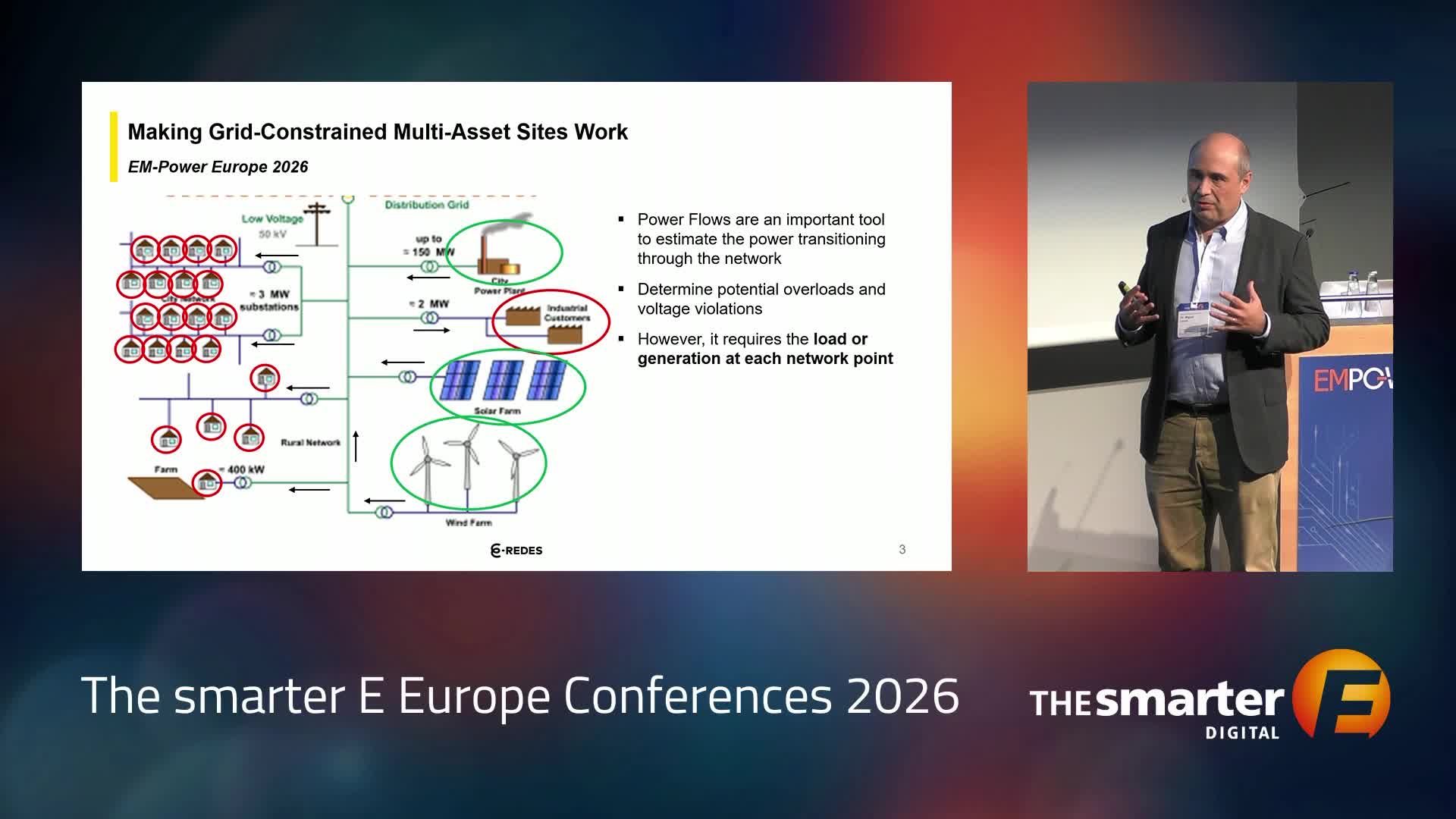
The presentation discusses the significant challenges facing Distribution System Operators (DSOs) in Portugal, specifically E-REDES, due to increased demand and generation connection requests. The network is notably stressed, illustrated by incidents such as a data center exhausting its capacity. Similar pressures are observed across Europe, as highlighted by the complex interactions between urban areas, wind farms, solar farms, industrial clients, and agricultural zones feeding into the same system. Balancing generation and load becomes particularly challenging due to fluctuating consumption and generation. Additionally, the necessity of a sophisticated forecasting system for energy networks is emphasized, which includes around 71,000 secondary substations and 750 generation stations. This system now generates forecasts for about 100,000 points every 15 minutes over a three-day period, calculating nearly 58 million data points daily using historical data and weather forecasts. Utilizing Microsoft Azure and specialized algorithms enhances accuracy, while dynamic line rating helps assess real-time grid capacity, reflecting the fluctuating nature of overhead lines. Overall, the integration of advanced forecasting tools is crucial for improving network management and power delivery capabilities.
Automated summarization by AI Conver
Speaker
Dr. Miguel Louro
Director for System Management
E-REDES
Portugal
Across Europe, there are ports, logistics hubs, industrial parks and campuses electrifying faster than grid capacity can be expanded. Shared connections, hybrid assets and active energy management are no longer optional -they are essential tools needed to stay connected, compliant and competitive. Well-designed industrial hubs and clusters can also strengthen Europe's resilience and competitiveness, but only if they are organized in a way that preserves a company's operational autonomy and avoids new system vulnerabilities or unnecessary complexity. This session explores how grid-constrained multi-asset sites are designed and operated in practice. Speakers will show how solar systems, battery storage systems, EV charging and flexible loads can be coordinated despite limited connections. They will also explain how DSOs interact with these sites and how energy hubs can deliver measurable grid relief while maintaining smooth operation.
Further Talks of this session:
Speaker
Helena Gerard
Senior Researcher
VITO/EnergyVille
Speaker
Dr. Andreas Braun
Product Area Manager HV Systems
AVL Deutschland
Germany
Speaker
Speaker
Philip Hahn
Head of Flexibility
CyberGrid GmbH
Austria