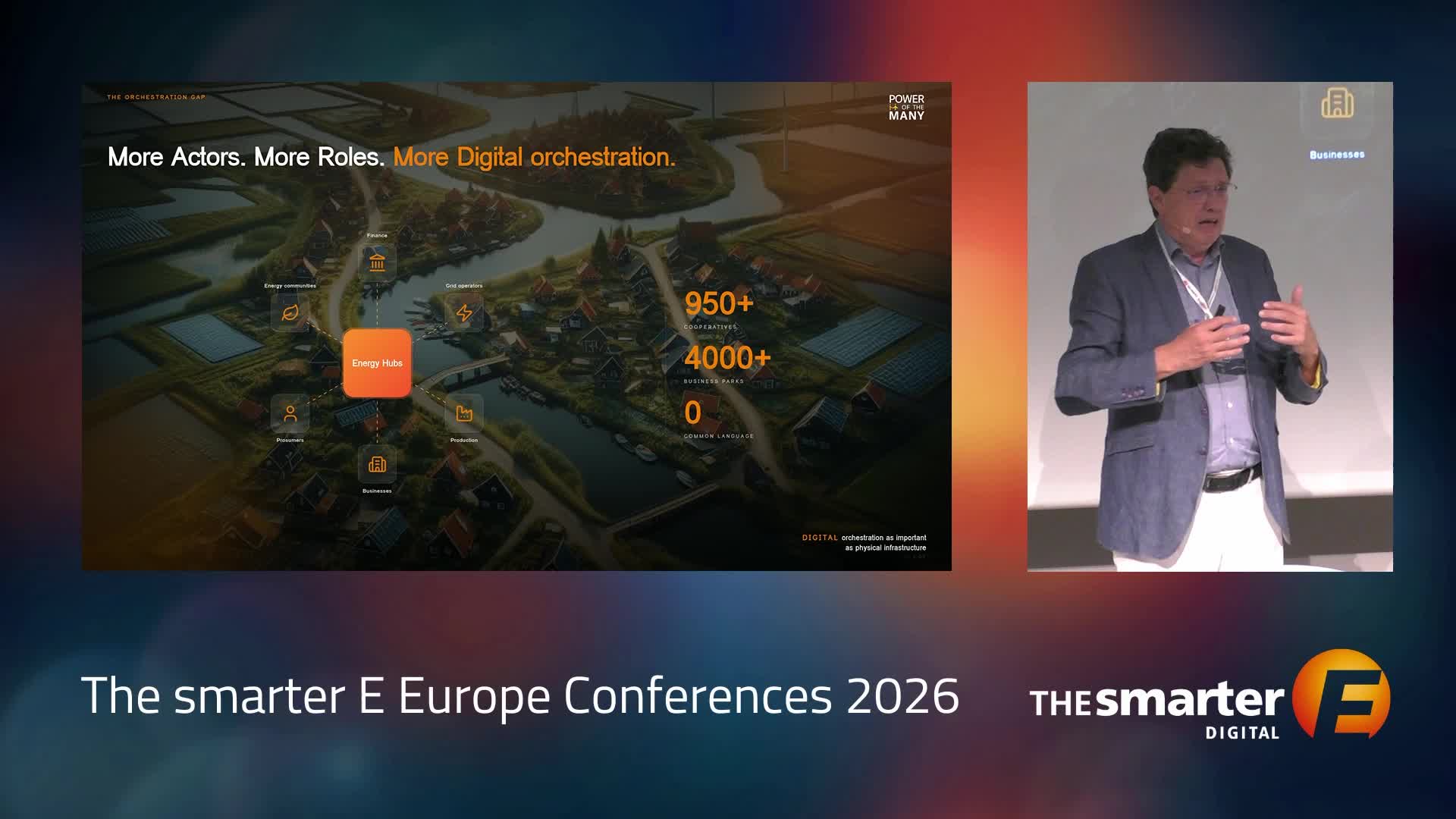
Recording of Monday, June 22, 2026 | The smarter E Europe Conferences 2026 | Language: English | Duration: 14:29 .
The talk explores the urgent need for digital transformation and collaborative efforts among various stakeholders to address energy sharing and grid congestion in the Netherlands. Power of the Many, a non-profit organization, emphasizes the challenges posed by the grid nearing capacity, with significant investments required to expand infrastructure. However, merely adding cables is insufficient; a focus on enhancing orchestration in energy distribution is crucial. The document highlights the importance of integrating local production, consumption, and storage of energy resources, necessitating new policies to bridge knowledge gaps in decentralized systems. It advocates for the development of a real-time energy management platform that enhances transparency and flexibility, integrating diverse energy sources like solar power, electric vehicles, and heat pumps. Additionally, initiatives such as those by Distro Energy and the Port of Rotterdam aim to create cohesive energy networks, demonstrating the need for collaboration between engineers, policymakers, and market players. Overall, the presentation underscores the potential of digital tools to unlock hidden grid capacity and foster innovative energy management solutions.
Automated summarization by AI Conver
Speaker
Kennard Brandenburgh
CCO
Distro Energy
The Netherlands
Alex Bausch
Chairman
2Tokens Foundation / Power of the Many
Across Europe, there are ports, logistics hubs, industrial parks and campuses electrifying faster than grid capacity can be expanded. Shared connections, hybrid assets and active energy management are no longer optional -they are essential tools needed to stay connected, compliant and competitive. Well-designed industrial hubs and clusters can also strengthen Europe's resilience and competitiveness, but only if they are organized in a way that preserves a company's operational autonomy and avoids new system vulnerabilities or unnecessary complexity. This session explores how grid-constrained multi-asset sites are designed and operated in practice. Speakers will show how solar systems, battery storage systems, EV charging and flexible loads can be coordinated despite limited connections. They will also explain how DSOs interact with these sites and how energy hubs can deliver measurable grid relief while maintaining smooth operation.
Further Talks of this session:
Speaker
Helena Gerard
Senior Researcher
VITO/EnergyVille
Speaker
Dr. Andreas Braun
Product Area Manager HV Systems
AVL Deutschland
Germany
Speaker
Dr. Miguel Louro
Director for System Management
E-REDES
Portugal
Speaker
Philip Hahn
Head of Flexibility
CyberGrid GmbH
Austria