Recording of Monday, June 22, 2026 | The smarter E Europe Conferences 2026 | Language: English | Duration: 9:20 .
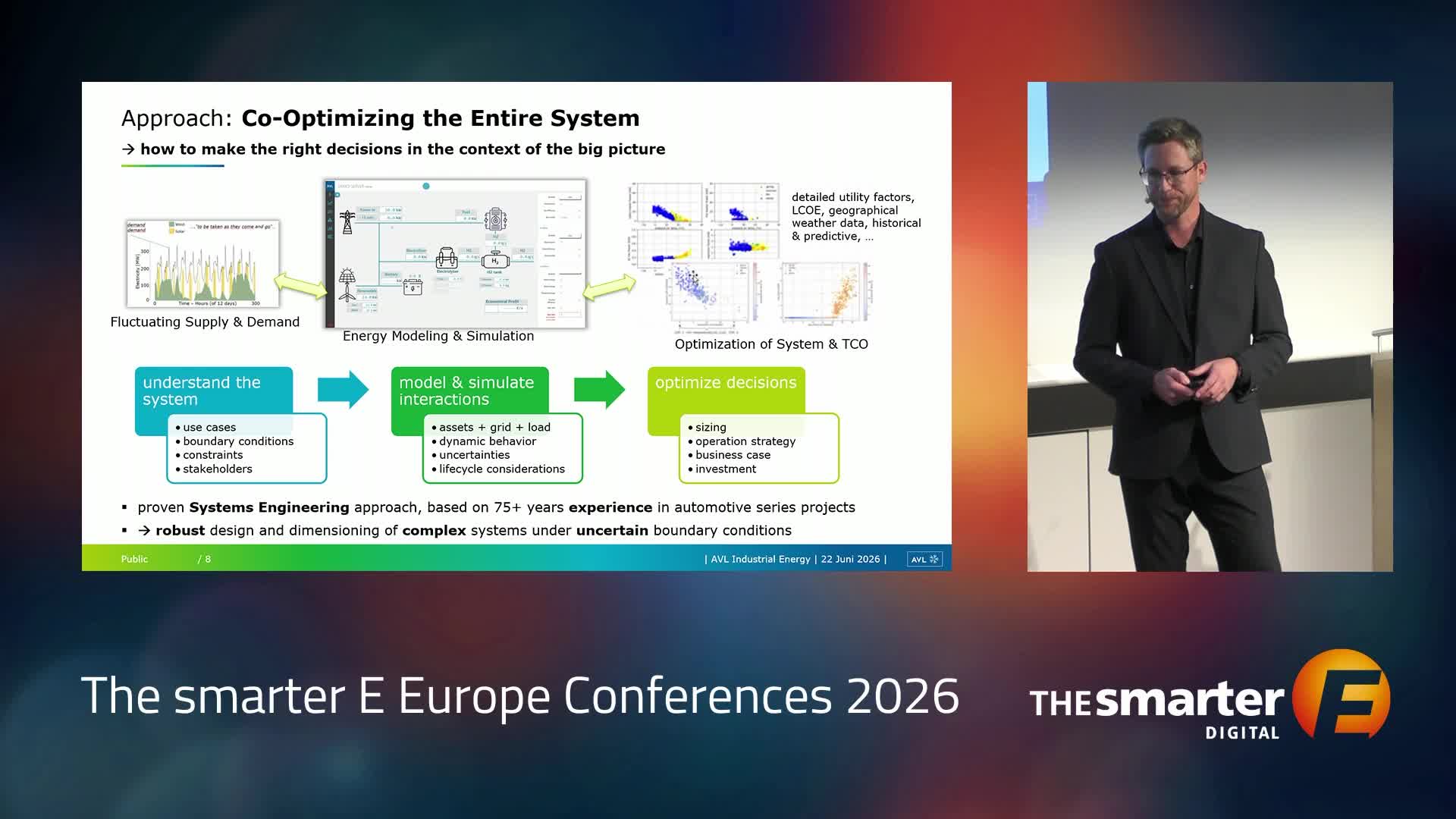
The speaker from AVL, a well-established independent engineering service provider with a global presence, elaborates on their approach to tackling microgrid challenges in the automotive industry. Highlighting the significance of a systematic decision-making framework, the presentation discusses critical aspects such as electricity yield, regulatory constraints, and financial considerations from investors. The emphasis is placed on leveraging database prediction models and Total Cost of Ownership (TCO) assessments to enhance decision-making efficiency. The text also points out that a fragmented view of assets can lead to challenges in asset sizing and grid constraints, necessitating a comprehensive understanding of technology implications for effective projectability. Furthermore, the integration of technological, legal, and financial dimensions is essential for developing robust business models amidst changing conditions like weather and tariffs. A co-optimization approach is suggested, stressing the importance of modeling dynamic interactions among system components to optimize operations. Practical examples, such as a German logistics hub's transition to electric solutions, further illustrate the complexities of implementing integrated energy systems. Overall, the presentation advocates for innovative strategies to navigate regulatory landscapes while ensuring that energy systems are not only technologically sound but also aligned with business objectives.
Automated summarization by AI Conver
Speaker
Dr. Andreas Braun
Product Area Manager HV Systems
AVL Deutschland
Germany
Across Europe, there are ports, logistics hubs, industrial parks and campuses electrifying faster than grid capacity can be expanded. Shared connections, hybrid assets and active energy management are no longer optional -they are essential tools needed to stay connected, compliant and competitive. Well-designed industrial hubs and clusters can also strengthen Europe's resilience and competitiveness, but only if they are organized in a way that preserves a company's operational autonomy and avoids new system vulnerabilities or unnecessary complexity. This session explores how grid-constrained multi-asset sites are designed and operated in practice. Speakers will show how solar systems, battery storage systems, EV charging and flexible loads can be coordinated despite limited connections. They will also explain how DSOs interact with these sites and how energy hubs can deliver measurable grid relief while maintaining smooth operation.
Further Talks of this session:
Speaker
Helena Gerard
Senior Researcher
VITO/EnergyVille
Speaker
Speaker
Dr. Miguel Louro
Director for System Management
E-REDES
Portugal
Speaker
Philip Hahn
Head of Flexibility
CyberGrid GmbH
Austria