Grids & Benefits - Pioneering Grid- and Marketfriendly Charging

premium account

Recording of Tuesday, May 06, 2025 | The smarter E Europe | Conference Program | Language: English | Duration: 13:16 .

Germany's New Dynamic Grid Tariffs Leverage EV Flexibility for Enhanced Energy Efficiency

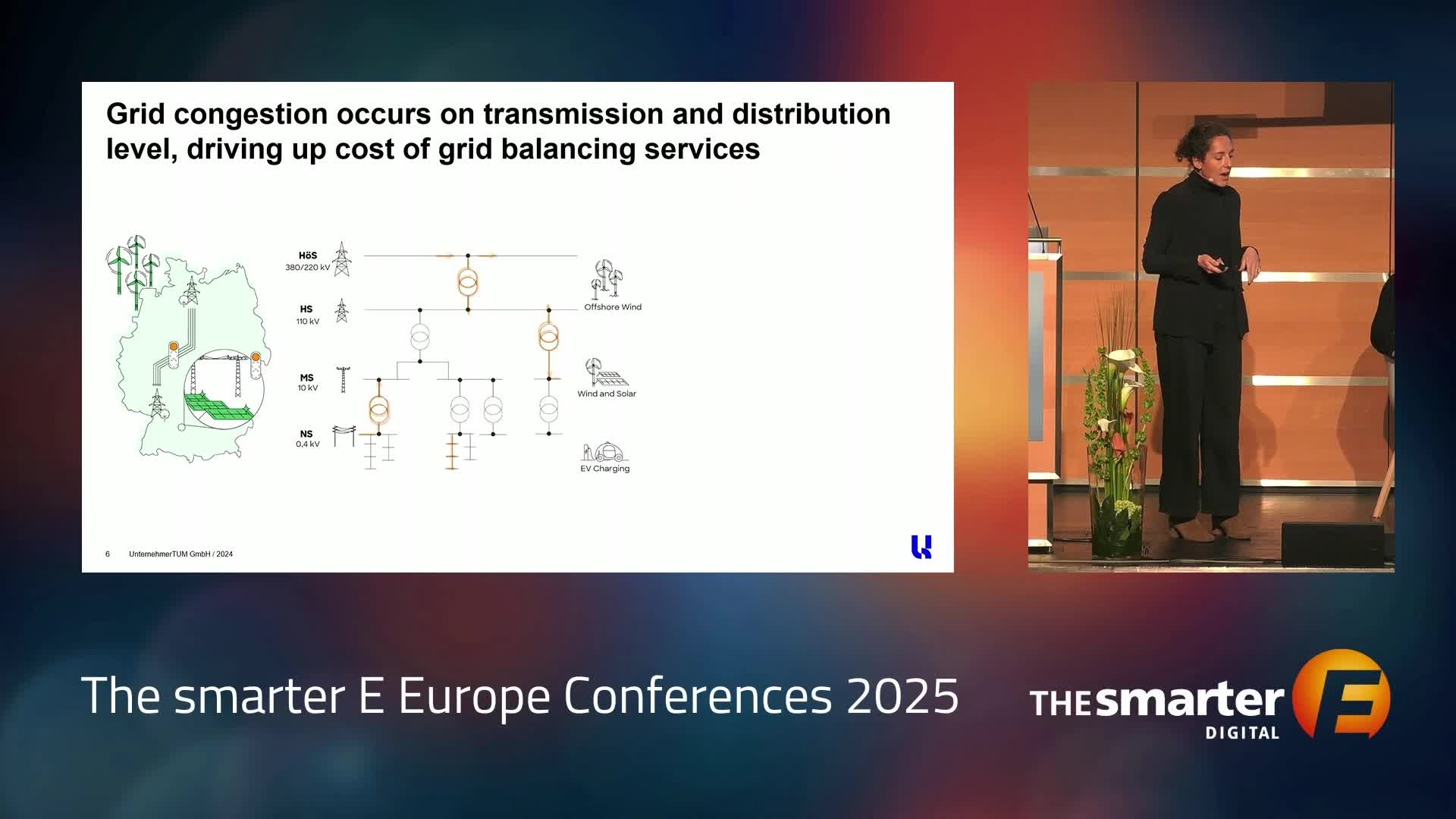
Johanna from UnternehmerTUM discusses the "Grids and Benefits" project, which aims to address the strain on Germany's electricity grid due to increasing electric vehicle (EV) usage. The current flat tariff system does not incentivize efficient energy use or reflect actual load demands. By implementing dynamic grid fees and leveraging EV flexibility through smart charging, this project seeks to manage demand peaks and renewable feed-in pressures effectively. It proposes cost-reflective network tariffs that are spatially and temporally granular, considering weather patterns for accurate load projections at medium-to-low voltage levels in specific regions known as "Entlastungsregionen." A 15-minute time resolution model is suggested with tariffs set a day ahead of market closure using a traffic light system initially for signaling grid conditions—green indicates surplus capacity while red signals congestion—which will evolve into complex price signaling linked to redispatch processes. An aggregator optimizes these price signals without consumer intervention during inconvenient hours like nighttime. Testing involves IT infrastructure by Transnet BW with components such as 500 EVs and home chargers aimed at enhancing public charging capabilities through partnerships like MeinGau’s involvement based on real-world data analysis focusing on congestion points within high-level coalitions promoting bidirectional charging initiatives supported collaboratively towards successful deployment outcomes.

Automated summarization by AI Conver

Dr. Johanna Bronisch
Head of Energy Innovation
UnternehmerTUM
Germany

This session will explore how smart and bidirectional charging can improve grid integration and sustainability within EV infrastructure. We will also discuss how to make smart charging a mainstream solution, focusing on intuitive design, seamless integration with the grid and other sectors, energy management, and key legal considerations to create a more accessible and efficient charging ecosystem.

Further Talks of this session:

Speaker

Andreas Jahn
Senior Associate
Regulatory Assistance Project (RAP)
Belgium

Video is not available.

Speaker

Dr. Julia Hildermeier
Team Lead E-Transport
Regulatory Assistance Project (RAP)
Belgium

Speaker

Michael von Bonin
Expert Scientist - EV Integration & Flexibility
Fraunhofer IEE
Germany

To Talk

Speaker

Bernhard Schowe-von der Brelie
Managing Director
FGH Research Association (FGH e.V.)
Germany

To Talk

Speaker

Dr. Matti Sprengeler
Strategy and Business Development Manager
The Mobility House GmbH
Germany

To Talk

To Talk

Further Content
James Allston, Marko Topič
Keep Calm and Deploy Solar (and Batteries)

The smarter E Podcast Episode 254 | Language: English

April 30, 2026

How European businesses use solar, batteries and EV fleets to manage volatile power prices and explore the future of perovskite solar.

Gautham Ram Chandra Mouli, Ruben Valiente
Beating the Blockade with EVs and Batteries

The smarter E Podcast Episode 253 | Language: English

April 16, 2026

Flexibility as a hedge: How V2G and battery storage reduce fossil fuel reliance and turn electric transport into a strategic asset for grid stability.

The smarter E Europe Conferences 2026
Panel Discussion of the Session: User Success Stories and Best Cases

Tuesday, June 23, 2026, 02:30 pm

The smarter E Europe Conferences 2026 | Conference Program

premium account

For more than two decades, Norway has been steadily building a marketplace for electric transport. Having started out with inexpensive short-range electric cars and household charging sockets, Norway has now moved to mass-market solutions where fast charging (DC) and grid balancing (AC) plays an ever more vital role. With more than 1,000,000 electric cars and over 10,000 fast chargers in a relatively small market, Norway offers a rare early view of large-scale electrification. Over the past decade, electric cars have seen substantial improvements, which is now making it easier for new markets to advance electrification. At the same time, Norway has to deal with challenges years before other markets do. Yet despite different starting points, we can see that most markets are facing the same core challenges. From grid-smart charging strategies to innovative business models, there are excellent examples of best practices emerging elsewhere in Europe. What will the next thing in electrification be, both in mature and in emerging markets? And what will be possible when the right people and companies come together, sharing knowledge, solving common problems and accelerating the shift to cleaner mobility?

Marcel Rümenapf
Will Soaring Fuel Costs Make eMobility Mass Market? – With Marcel Rümenapf

The smarter E Podcast Episode 256 | Language: English

May 28, 2026

Siemens’ Marcel Rümenapf explains why eMobility is becoming a strategic advantage for European logistics fleets.

Thomas Raffeiner and Petrouschka Werther
What EV Acceleration Means for the Grid

The smarter E Podcast Episode 260 | Language: English

July 9, 2026

Cars as batteries on wheels: Thomas Raffeiner and Petrouschka Werther discuss how V2G and smart charging turn EVs into critical grid assets.

You are using an outdated browser

The website cannot be viewed in this browser. Please open the website in an up-to-date browser such as Edge, Chrome, Firefox, or Safari.