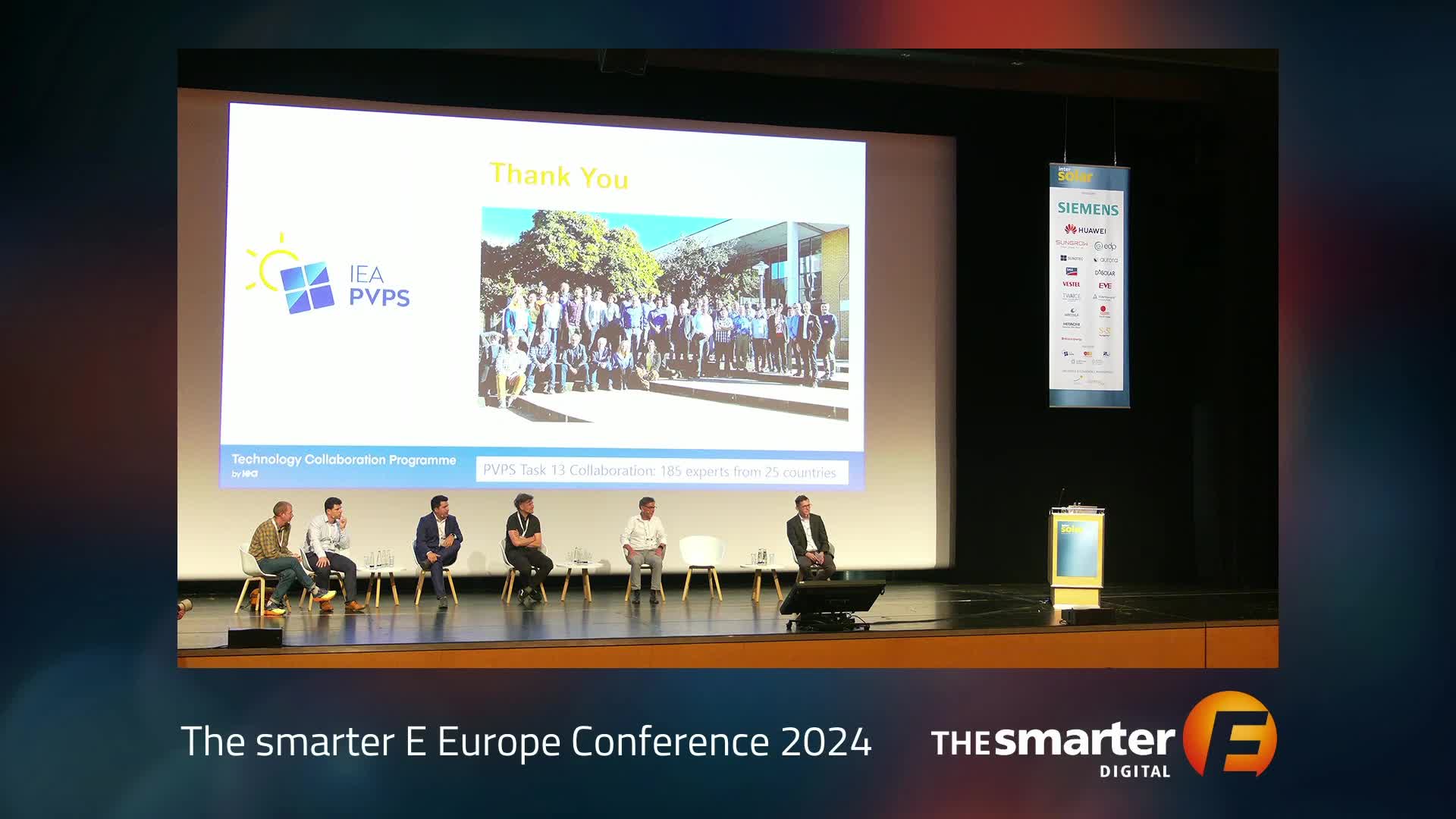
Recording of Tuesday, June 18, 2024 | The smarter E Europe | Conference Program | Language: English | Duration: 19:23 .
The panel discussion began with the moderator taking over and inviting questions from participants. Joyce, from Eleta in Brazil, raised a query about whether integrated software uses operational data to recalibrate short-term generation forecasts more accurately due to resource variability not captured in feasibility studies. Julián responded by explaining that their platform integrates with design companies like PlanPredict in the U.S., utilizing bi-directional APIs for various business processes. This integration helps retrain models using operational data to predict power output better. Clément Boussard from ILF Consulting asked Mr. Ascencio-Vásquez about defining baselines for budget production against actual production and identifying loss causes. Ascencio-Vásquez described their approach of running simulations twice: once using 30-year average weather (TMY) and again with current actual data, comparing both outputs to adjust predictions accordingly. Lastly, Jonathan addressed misconceptions about AI replacing natural intelligence or expertise within industries like PV plant operations or development. He emphasized that while AI is valuable when understood correctly alongside physical systems' basics, it cannot wholly replace expert knowledge at this stage.
Automated summarization by AI Conver
David Daßler
Team Leader for PV System Assessment & Diagnostics
Fraunhofer Center for Silicon-Photovoltaics CSP
Germany
The utility-scale segment is being digitized at a rapid pace. New digital tools make workflows along the PV power plant value chain more cost-effective: from development to operations and maintenance. A key concept in PV digitalization is the so-called digital twin, a digital representation of the physical PV plant that accurately simulates the performance of a solar system. A digital twin enables better failure detection and support of the O&M decision-making process. This session will discuss: The role of digitalization and digital twins in the solar power plant sector How digitalization can enhance O&M activities Need for full integration of data along the value chain of PV power plants Benefits, drawbacks and hurdles for digitalization in the utility-scale segment (panel debate).
Further Talks of this session:
Speaker
Ulrike Jahn
Senior Scientist
Fraunhofer Center for Silicon-Photovoltaics CSP
Germany
Speaker
Jonathan Leloux
Managing Director
LuciSun
Belgium
Speaker
Dr. Julián Ascencio-Vásquez
Head of Solar Advanced Analytics
Univers
France
Speaker
Dr. Björn Müller
CEO
Enmova GmbH
Speaker
Christian Schill
Group Manager "PV Power Plants"
Fraunhofer Institute for Solar Energy Systems ISE
Germany
Speaker
Ulrike Jahn
Senior Scientist
Fraunhofer Center for Silicon-Photovoltaics CSP
Germany