IEA PVPS Task 13 Activity 2.4: Digitalisation in the PV Sector

premium account

Recording of Tuesday, June 18, 2024 | The smarter E Europe 2024 | Conference Program | Language: English | Duration: 14:34 .

Digitalization in the PV Sector: Integrating Data Across the Value Chain and Defining Digital Twins for Improved Efficiency

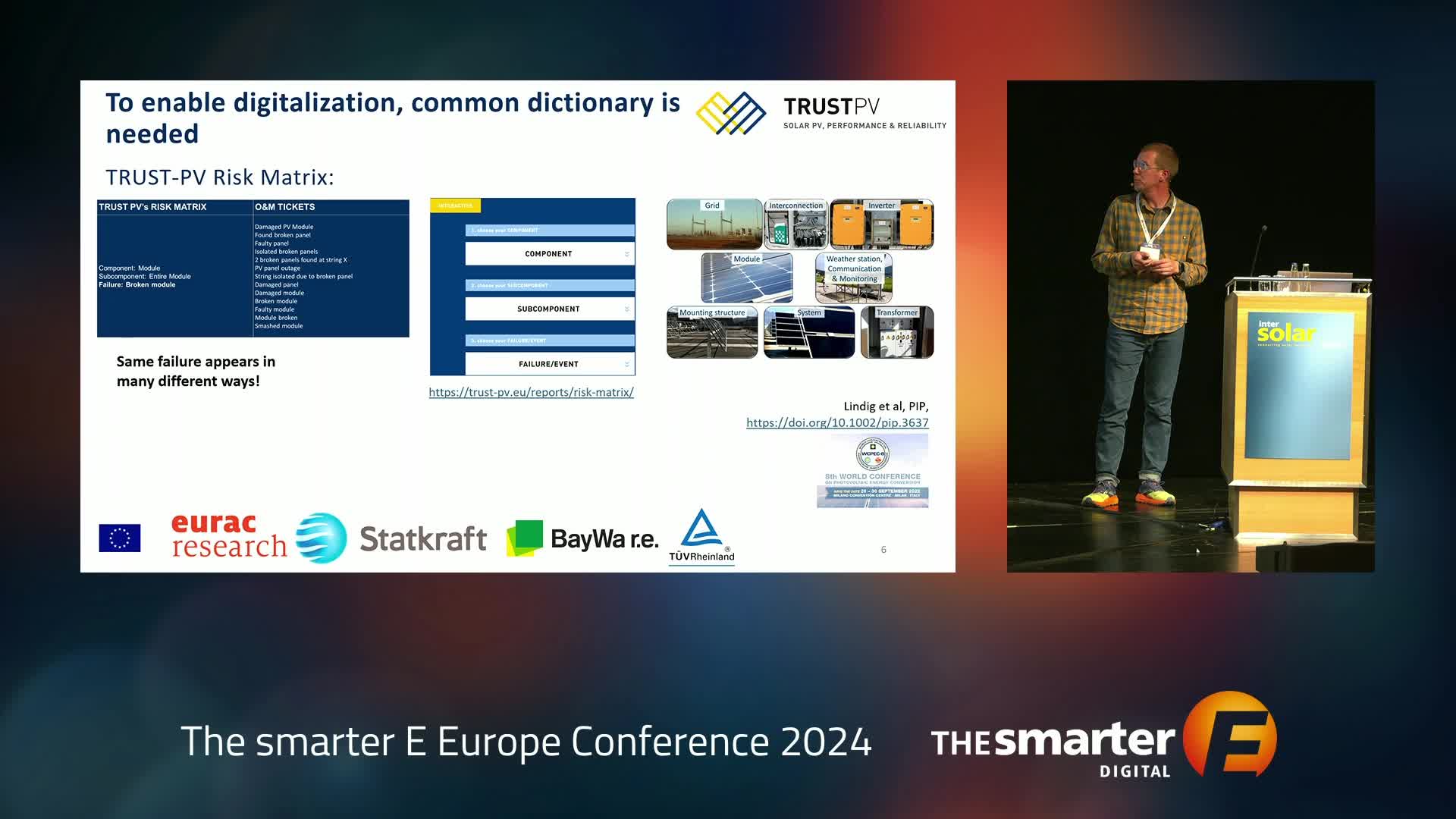
In this presentation, the speaker discusses Activity 2.4 of Task 13, focusing on digitalization within the photovoltaic (PV) sector alongside colleague Christian. The activity examines topics such as digital twinning of PV systems and addresses definitions, ontologies, and data models while covering the entire PV system value chain—from design through operation and maintenance to end-of-life. Two comprehensive reports are being prepared: one centered on defining "digital twins" in PV for researchers by discussing their data flows, open data practices, strengths, weaknesses; another aimed at industry stakeholders like EPCs and asset managers that evaluates how digital twins are integrated into current practices across all phases. The Trust PV project is also highlighted for its efforts in standardizing nomenclature related to failure analysis via a risk matrix based on extensive O&M tickets review. This initiative aims to break down existing silos between different stages of the value chain by fostering better integrated machine-readable and human-readable data models along with standardized terms called ontologies or dictionaries from early design through operations.

Automated summarization by AI Conver

Christian Schill
Group Manager "PV Power Plants"
Fraunhofer Institute for Solar Energy Systems ISE
Germany

Dr. Atse Louwen
Senior Researcher
EURAC Research Institute
Italy

The utility-scale segment is being digitized at a rapid pace. New digital tools make workflows along the PV power plant value chain more cost-effective: from development to operations and maintenance. A key concept in PV digitalization is the so-called digital twin, a digital representation of the physical PV plant that accurately simulates the performance of a solar system. A digital twin enables better failure detection and support of the O&M decision-making process. This session will discuss: The role of digitalization and digital twins in the solar power plant sector How digitalization can enhance O&M activities Need for full integration of data along the value chain of PV power plants Benefits, drawbacks and hurdles for digitalization in the utility-scale segment (panel debate).

Speaker

Ulrike Jahn
Senior Scientist
Fraunhofer Center for Silicon-Photovoltaics CSP
Germany

To Talk

Speaker

Jonathan Leloux
Managing Director
LuciSun
Belgium

To Talk

Speaker

Dr. Julián Ascencio-Vásquez
Head of Solar Advanced Analytics
Univers
France

To Talk

Speaker

Dr. Björn Müller
CEO
Enmova GmbH

To Talk

Speaker

David Daßler
Team Leader for PV System Assessment & Diagnostics
Fraunhofer Center for Silicon-Photovoltaics CSP
Germany

To Talk

Speaker

Ulrike Jahn
Senior Scientist
Fraunhofer Center for Silicon-Photovoltaics CSP
Germany

To Talk

Further Content
Webinar
Mixed Investment Solar Projects in Mexico: The 54% Model Explained

January 29, 2026

Mexico has introduced a new mixed investment scheme for renewable power generation, requiring a minimum 54% direct or indirect participation by CFE.

Anna Darmani, Principal Analyst from Wood Mackenzie
Big BESS Is Here to Save the Day

The smarter E Podcast Episode 246 | Language: English

January 8, 2026

Utility-scale batteries are booming in Europe. Discover key BESS trends, market impacts, and what to expect for large-scale storage in 2026.

The smarter E Europe Conferences 2025
Setting the Scene "Off-Grid"

Wednesday, May 07, 2025, 04:00 pm - 05:30 pm

The smarter E Europe Conferences 2025 | Conference Program

premium account

Photovoltaic prices have fallen continuously in recent years - a trend that should translate into a growing market for off-grid solutions. Declining costs are crucial for rural electrification in particular, making sustainable energy supply economically viable in remote regions. However, so far many of these price advantages have not yet reached the people that need them most. Do existing framework conditions to foster rural electrification still work in this new market reality? Which measures are needed to ensure that cost reductions reach our target group? This session discusses strategies for improving the availability of low-cost off-grid solutions, financing and innovative business models. A look at successful practical examples shows which political, economic and technological levers need to be pulled to make off-grid PV accessible on a large scale.

The smarter E Europe Conferences 2025
Factors That Influence the Success of a Minigrid Project

Wednesday, May 07, 2025, 11:00 am - 12:30 pm

The smarter E Europe Conferences 2025 | Conference Program

premium account

Off-grid solar systems are often the least expensive option for rural electrification. Solar home systems can power individual households, while mini-grids can supply entire villages. Each comes with its own advantages, disadvantages, and challenges. The aim of this session is to explore challenges as well as success stories. It takes well-functioning components such as battery systems, charge management and inverters to make projects successful. Proper system sizing, maintenance and repair management, as well as a robust financial concept are also necessary. If one of these elements is missing, the electrification will not be sustainable. This session will focus on the aspects mentioned above. The speakers will present successful and unsuccessful approaches and discuss what can be learned from them.

The smarter E Europe Conferences 2025
Q&A Session of of the Session Off-Grid: Rural Electrification Based on Solar Systems - Lessons Learned

Wednesday, May 07, 2025, 11:00 am - 12:30 pm

The smarter E Europe Conferences 2025 | Conference Program

premium account

Off-grid solar systems are often the least expensive option for rural electrification. Solar home systems can power individual households, while mini-grids can supply entire villages. Each comes with its own advantages, disadvantages, and challenges. The aim of this session is to explore challenges as well as success stories. It takes well-functioning components such as battery systems, charge management and inverters to make projects successful. Proper system sizing, maintenance and repair management, as well as a robust financial concept are also necessary. If one of these elements is missing, the electrification will not be sustainable. This session will focus on the aspects mentioned above. The speakers will present successful and unsuccessful approaches and discuss what can be learned from them.

You are using an outdated browser

The website cannot be viewed in this browser. Please open the website in an up-to-date browser such as Edge, Chrome, Firefox, or Safari.