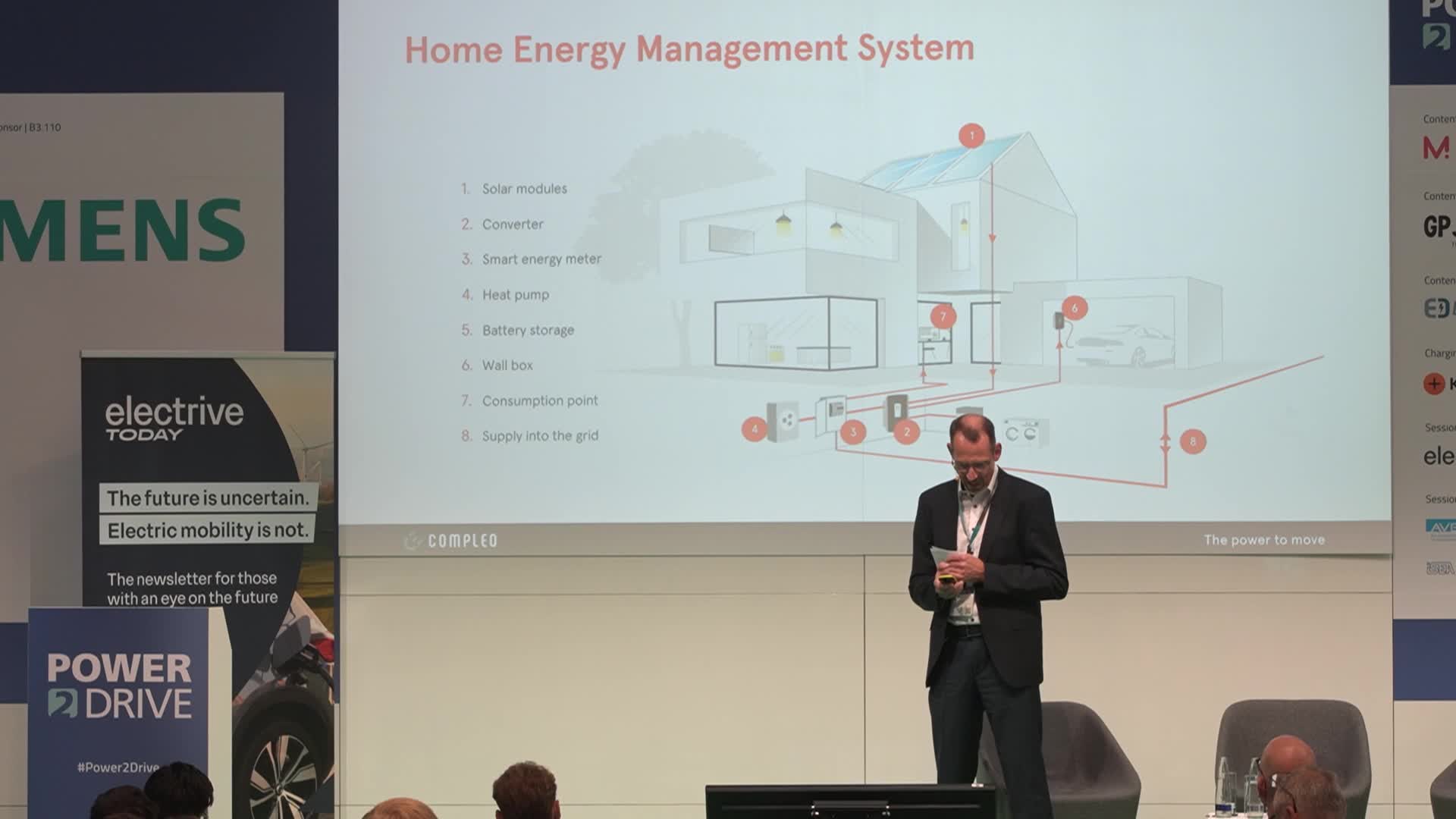
The Future of Energy Management - Experiences with Bidirectional Charging

premium account

Recording of Thursday, June 20, 2024 | The smarter E Europe | Exhibition Program | Language: English | Duration: 13:12 .

KOSTAL-Group's Holger Hasselmann Discusses Future of Energy Management Through Bidirectional Charging Systems

Holger Hasselmann, a long-time employee of the KOSTAL-Group since 1989, currently oversees the development of bidirectional charging wall boxes at Compleo. His discussion centers on future energy management systems focusing on bidirectional charging capabilities. In this context, a wall box connects vehicles to both household and grid systems, facilitating various functionalities like vehicle-to-home (V2H) integration with photovoltaic inverters for smart home energy management. This setup involves standards such as ISO 1511820 for car connections and EE bus for interactions with household devices. Use cases include optimized tariff-based charging/discharging, emergency power supply solutions especially relevant in Germany's changing energy landscape, peak load shaving, fleet management in large parking spaces like airports, and network stabilization through local grid serviceability and provision of reactive power. Addressing system compatibility issues is crucial; many cars are expected to adhere to specified standards soon despite some proprietary exceptions from certain brands. The practical rollout focuses on affordable 11-kilowatt systems suitable for overnight home use without restrictions from electricity providers compared to more expensive 22-kilowatt alternatives. Publicly funded projects have driven their experience and ongoing developments within this domain.

Automated summarization by AI Conver

This session will explore the future of electromobility with a focus on innovative applications of vehicle-to-home (V2H) and vehicle-to-load (V2L) technologies. Moderated by electrive, experts will discuss how battery electric vehicles will be used not only as a means of transportation, but also as mobile energy storage to power homes and manage loads. Attendees will learn how these technologies could revolutionize energy management at home and on the road by providing a flexible energy source that will help stabilize the power grid and increase energy efficiency. This session is designed for technology developers, energy consultants, decision makers in the energy and automotive industries and for homeowners interested in integrating e-vehicles into their domestic energy management.

Further Talks of this session:

To Talk

To Talk

To Talk

Further Content
The smarter E Europe Conferences 2026
Panel Discussion of the Session: User Success Stories and Best Cases

Tuesday, June 23, 2026, 02:30 pm

The smarter E Europe Conferences 2026 | Conference Program

premium account

For more than two decades, Norway has been steadily building a marketplace for electric transport. Having started out with inexpensive short-range electric cars and household charging sockets, Norway has now moved to mass-market solutions where fast charging (DC) and grid balancing (AC) plays an ever more vital role. With more than 1,000,000 electric cars and over 10,000 fast chargers in a relatively small market, Norway offers a rare early view of large-scale electrification. Over the past decade, electric cars have seen substantial improvements, which is now making it easier for new markets to advance electrification. At the same time, Norway has to deal with challenges years before other markets do. Yet despite different starting points, we can see that most markets are facing the same core challenges. From grid-smart charging strategies to innovative business models, there are excellent examples of best practices emerging elsewhere in Europe. What will the next thing in electrification be, both in mature and in emerging markets? And what will be possible when the right people and companies come together, sharing knowledge, solving common problems and accelerating the shift to cleaner mobility?

The smarter E Europe Conferences 2026
Integrated Truck Charging: Challenges & Solutions Towards Zero-Emission Freight

Tuesday, June 23, 2026, 11:30 am

The smarter E Europe Conferences 2026 | Conference Program

premium account

The electrification of heavy-duty transport is more than just a goal - the transformation is already underway. But scaling up also means having to solve the big challenges: How can we build charging networks that keep pace with fleet electrification without overburdening grids or budgets? What innovations in AI, energy storage and smart infrastructure can turn today's pilot projects into tomorrow's industry standard? And how can OEMs, logistics operators and energy providers align their strategies to make zero-emission freight profitable rather than just possible? From truck manufacturers and charge point operators to logistics innovators and energy experts, this dynamic panel brings together the leaders driving change. We will dive into the real-world solutions making an impact now, like modular charging hubs that grow with demand, fleets and energy optimization solutions powered by AI and smart grid integration that cuts costs and boosts reliability. We will also ask the hard questions: Where are the gaps in collaboration, technology or policy that could slow progress, and how do we close these gaps?

Marcel Rümenapf
Will Soaring Fuel Costs Make eMobility Mass Market? – With Marcel Rümenapf

The smarter E Podcast Episode 256 | Language: English

May 28, 2026

Siemens’ Marcel Rümenapf explains why eMobility is becoming a strategic advantage for European logistics fleets.

James Allston, Marko Topič
Keep Calm and Deploy Solar (and Batteries)

The smarter E Podcast Episode 254 | Language: English

April 30, 2026

How European businesses use solar, batteries and EV fleets to manage volatile power prices and explore the future of perovskite solar.

Gautham Ram Chandra Mouli, Ruben Valiente
Beating the Blockade with EVs and Batteries

The smarter E Podcast Episode 253 | Language: English

April 16, 2026

Flexibility as a hedge: How V2G and battery storage reduce fossil fuel reliance and turn electric transport into a strategic asset for grid stability.

You are using an outdated browser

The website cannot be viewed in this browser. Please open the website in an up-to-date browser such as Edge, Chrome, Firefox, or Safari.