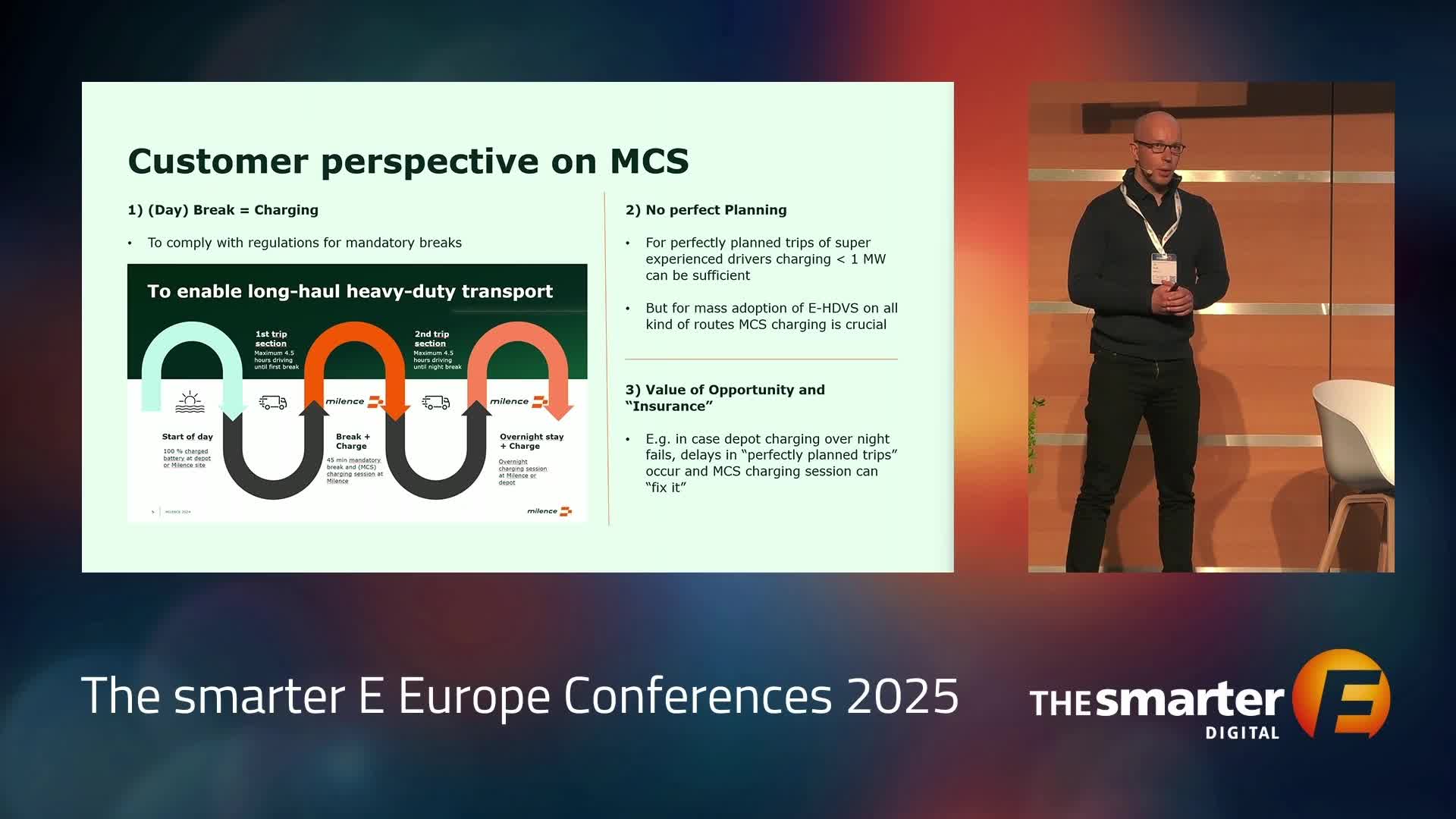
Truck Charging: Key Business Case Elements and Differences from Car Charging

premium account

Recording of Tuesday, May 06, 2025 | The smarter E Europe | Conference Program | Language: Français | Duration: 15:18 .

Milence Aims to Establish 1,700 Electric Truck Charging Points in Europe by 2027.

Milence, established in 2022 by major European OEMs like Daimler Truck, Volvo, and Traton (Volkswagen Group), aims to create a network of 1,700 public charging points for heavy electric vehicles by 2027. With an initial funding of nearly €500 million, the company focuses on rapid charging solutions essential for professional drivers who must adhere to strict driving regulations requiring breaks between shifts. The "megawatt charging" technology is crucial here as it allows quick recharges—between 800 kW and 1 MW—to deliver around five to six hundred kWh within just forty-five minutes. Unlike passenger cars with varied routes needing less intensive infrastructure support, commercial clients frequently require multiple daily charges along stable routes year-round; thus Milence's targeted deployment in strategic European areas is critical. The integration challenges include technological advancements such as megawatt chargers that enable efficient energy delivery comparable to several car charges quickly. However, grid connectivity poses significant hurdles due to high costs linked with long-distance connections necessitating strategic site placements near key intersections and collaboration among stakeholders for effective large-scale E-truck site deployments while ensuring cost-efficiency.

Automated summarization by AI Conver

Dr. Till Kreft
Manager Public Affairs
Milence
Germany

This session will explore financial business models for Charge Point Operators (CPOs) and e-Mobility Service Providers (eMSPs), addressing regional differences. Key topics will include charging point utilization rates and the need for alternative funding mechanisms to accelerate the expansion of charging infrastructure across Europe. The session will also cover business model differences for truck and passenger car charging, including customer interface design and reservation challenges.

Further Talks of this session:

Speaker

Marie Rajon Bernard
Senior Researcher
ICCT (International Council on Clean Transportation)
Germany

To Talk

Speaker

Christian Adolph
Senior Innovation Manager
E.ON Group Innovation GmbH
Germany

To Talk

Speaker

Oliver Peter Kaul
General Manager & Inventor
KWiQ GmbH
Germany

To Talk

To Talk

Further Content
Adriana Fricke, Robin Berg
Has Vehicle-to-Grid Reached the Tipping Point?

The smarter E Podcast Episode 248 | Language: English

February 5, 2026

Why 2026 could be a turning point for bidirectional EV charging – from regulation to large V2G fleets in Europe.

Webinar Collection
Mixed Investment Solar Projects in Mexico: The 54% Model Explained

January 29, 2026

Mexico has introduced a new mixed investment scheme for renewable power generation, requiring a minimum 54% direct or indirect participation by CFE.

Irene Guerra Gil, Mark Bruno
Staying Home, with Smart Energy Management

The smarter E Podcast Episode 245 | Language: English

December 11, 2025

Irene Guerra Gil and Mark Bruno explain how smart home energy systems and building initiatives cut costs and emissions.

The smarter E Europe Exhibition Program 2025
DC Microgrids as the Next Frontier in Grid Modernization and DER Integration

Wednesday, May 07, 2025, 11:00 am - 12:25 pm

The smarter E Europe Exhibition Program 2025 | Exhibition Program

premium account

Discover how next-gen distribution grid technologies are addressing the challenges of renewable integration and dynamic energy demands. This session offers insights into the latest developments in AI-driven data analytics and the transformative role of IoT in grid management.

The smarter E Europe Conferences 2025
Factors That Influence the Success of a Minigrid Project

Wednesday, May 07, 2025, 11:00 am - 12:30 pm

The smarter E Europe Conferences 2025 | Conference Program

premium account

Off-grid solar systems are often the least expensive option for rural electrification. Solar home systems can power individual households, while mini-grids can supply entire villages. Each comes with its own advantages, disadvantages, and challenges. The aim of this session is to explore challenges as well as success stories. It takes well-functioning components such as battery systems, charge management and inverters to make projects successful. Proper system sizing, maintenance and repair management, as well as a robust financial concept are also necessary. If one of these elements is missing, the electrification will not be sustainable. This session will focus on the aspects mentioned above. The speakers will present successful and unsuccessful approaches and discuss what can be learned from them.

You are using an outdated browser

The website cannot be viewed in this browser. Please open the website in an up-to-date browser such as Edge, Chrome, Firefox, or Safari.