The smart grid depends on a permanent flow of information between millions of decentralized installations in order to keep the balance between power generation, storage and consumption. Routers are responsible for sending the necessary data on its way. However, every once in a while, a router may “crash” and the data flow is cut off. The only remedy is to reboot it. Start-up keeconn has developed a simple and secure solution for this.

For most people, the WIFI router isn’t far from their sofa or desk and it’s easy to reach if it crashes. But even having to take those few steps to your router can be annoying. Now imagine how much effort it takes when the cellular router of a remote PV system fails. “Just getting there can take up to two hours,” Jan-Rewert Rulfs reports.
The founder and managing director of keeconn GmbH knows this from experience. Rulfs also works for a photovoltaic company in Großbeeren, where he is responsible for the configuration of PV system monitoring and technical service. If a router breaks down, so does the data transmission, and he has to drive over to the affected system and reboot it manually. This is vital, because large-scale systems with more than 100 kW output are obligated to take part in the direct marketing of renewable electricity and Redispatch 2.0. However, this can only be achieved when data is continuously read, transmitted and received.
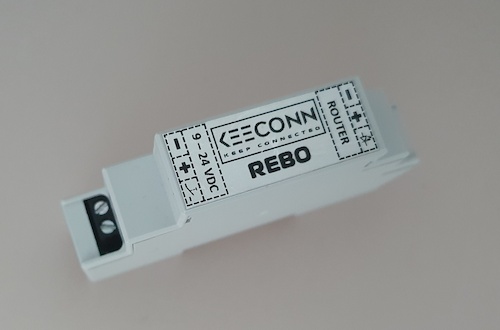
The systems that Rulfs looks after are spread all across Germany. One day, he came up with the idea to develop a device that can tell whether a router has “frozen” or crashed, and can reboot it immediately. The result: a small device with a big impact that can be easily installed in a switching cabinet. About three years ago, Rulfs first installed his “REBO”, the intelligent router reboot, in the system of one of his customers to test it. “This customer runs several ground-mounted systems with up to 750 kWp and a few roof-mounted systems, which need to be adjustable at all times due to their size. They kept complaining about router failures,” recounts Rulfs. Since Rulfs installed his devices, there have been no more issues.
Depending on the system and type of router, it may break down multiple times a day. To detect the “crash”, the REBO’s algorithm monitors the power consumption of the router. “For example, a router with an active internet connection has a much higher power consumption compared to when it’s frozen,” explains Rulfs. “When you record the power consumption for a certain period of time, you can tell what state the router is in based on that.”
Simply secure
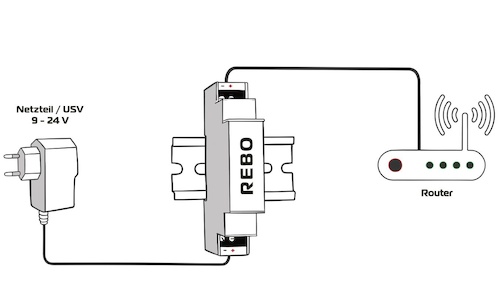
What’s special about the REBO is its simplicity. “There are other devices with a similar function – but they’re connected to the router via WIFI, which makes the system vulnerable, because someone could theoretically access the installations from outside via the WIFI network,” Rulfs says. His device, on the other hand, is only connected to the router’s power supply and does not tap into any data.
It is universal and can be used with all types of cellular routers. During the installation process, it becomes familiar with the respective router and learns how much power it normally consumes. This process takes around 20 minutes and can be repeated at any time in a different location with a different network constellation.
How many different applications can the REBO be used for? The answer never ceases to amaze Rulfs. While most of the requests come from the PV sector – his professional focus – his system is also becoming popular for charging stations and storage systems. He has even received requests for elevators, toll stations and digital billboards – applications that use cellular routers to send data.
As it is installed in switching cabinets, REBO is first and foremost designed for industrial applications. But Rulfs is already looking ahead: “This device could be modified in a way that, for example, end customers could use it at home in form of a ready-to-use plug-in wall wart” He also intends to improve the REBO’s temporal resolution, because at the moment it takes fifteen minutes to detect a failure in a router and to reboot it. Of course, the inventor has more product ideas in store to add to the portfolio of keeconn, which he manages together with a business partner. “I constantly come up with all kinds of practical little solutions that could be realized.”