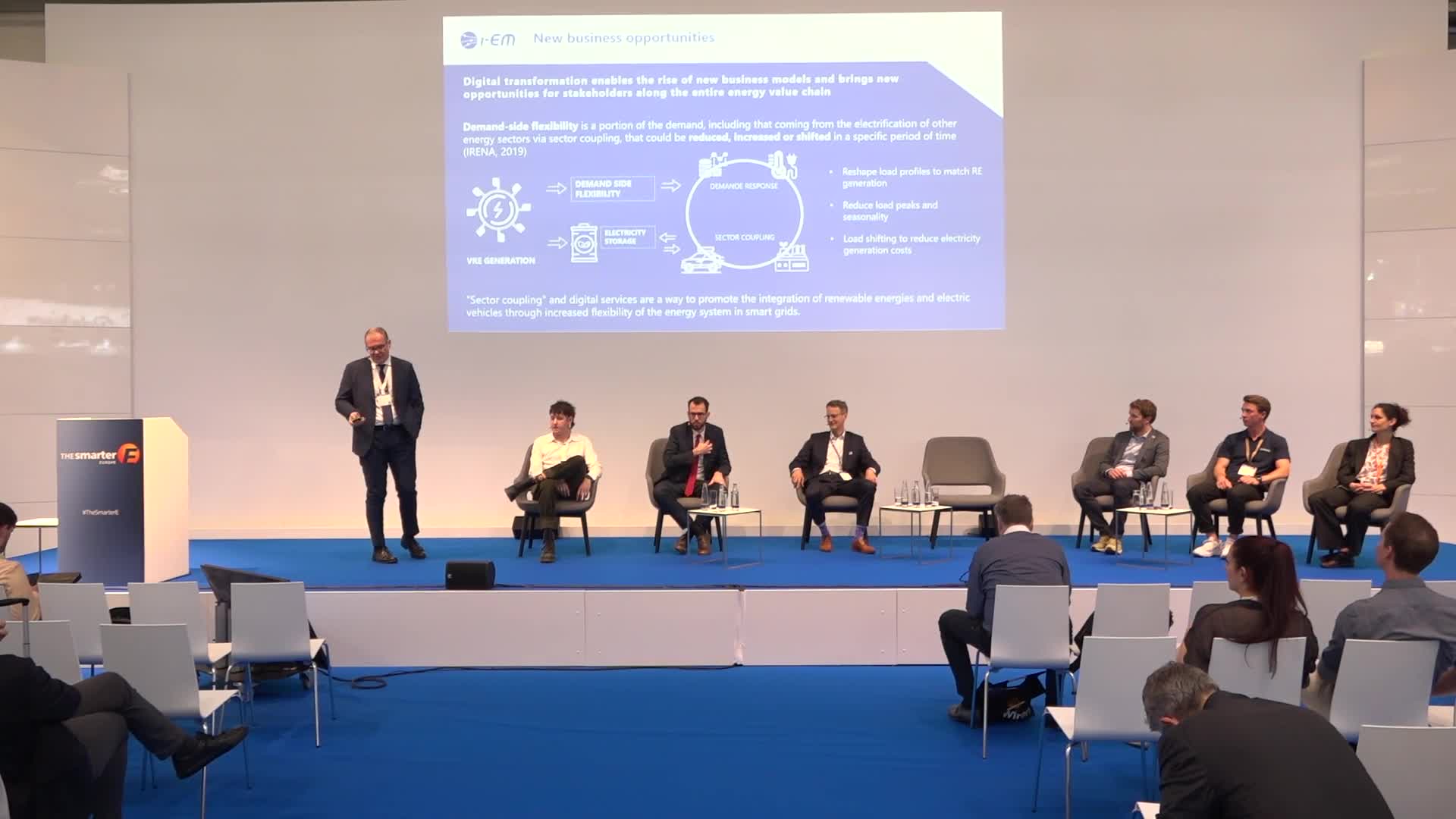
Digital Services as a Way to Foster REs Sources (and EVs) Integration and the Development of New Local Energy Communities

premium account

Recording of Thursday, June 20, 2024 | The smarter E Europe 2024 | Exhibition Program | Language: English | Duration: 9:43 .

Ciro Lanzetta from i-em Discusses Digital Solutions for Integrating Renewables and Enhancing Energy Ecosystems at Conference

Ciro Lanzetta from i-em discusses the role of digital services in enhancing renewable energy integration into the grid. I-em is a global company providing digital solutions for managing renewables—solar, wind, and hydro—in more than 20 countries with around 5 gigawatts of total power installed. The focus includes smart grids, microgrids, and local energy communities. The current shift towards using renewables like solar energy creates substantial real-time data that necessitates effective data management to optimize their usage. European regulations are pushing citizens to be both producers and consumers (prosumers) of energy, fostering local initiatives such as Italy's new renewable energy communities aimed at optimizing generation and consumption. Digital transformation offers new business opportunities by enabling flexible demand-side management. For instance, i-em’s platform XM supports coordination in using various types of stored or generated energy efficiently. A notable project in Northern Italy demonstrated significant savings through awareness without automation. I-em also developed simulation tools for designing optimal microgrids tailored to user-defined scenarios incorporating electric vehicles and battery storage systems for better utilization of rooftop solar installations in commercial centers like one in Tuscany. Lanzetta concludes emphasizing that digital platforms can significantly boost sustainable energy use by making it easier to manage data effectively while promoting a cultural shift towards proactive data utilization within the renewable sector.

Automated summarization by AI Conver

A decentralised, flexible energy system puts energy consumers at the fore-front of the clean energy transition. Through demand-side flexibility, consumers are able to adjust their consumption, store energy, and inject energy into the grid during peak moments, contributing to a more efficient and sustainable decarbonisation pathway. smartEn has calculated that, with help from flexible consumers, in 2030 the EU energy system could avoid 15.5 TWh in renewable energy curtailment, a 61% improvement compared to if no action is taken, and avoid investments in 60 GW of peak generation capacity, equivalent to 137 gas peaking plants, resulting in €2.7 billion saved annually. This session aims to deep-dive into how decentralised assets such as PV, Stationary and Mobile storage, amongst others, are key to reducing costs for consumers, increasing the uptake of renewables and solving grid congestion issues.

Further Talks of this session:

To Talk

To Talk

To Talk

To Talk

To Talk

To Talk

To Talk

Further Content
Webinar
Mixed Investment Solar Projects in Mexico: The 54% Model Explained

January 29, 2026

Mexico has introduced a new mixed investment scheme for renewable power generation, requiring a minimum 54% direct or indirect participation by CFE.

The smarter E Europe Exhibition Program 2025
DC Microgrids as the Next Frontier in Grid Modernization and DER Integration

Wednesday, May 07, 2025, 11:00 am - 12:25 pm

The smarter E Europe Exhibition Program 2025 | Exhibition Program

premium account

Discover how next-gen distribution grid technologies are addressing the challenges of renewable integration and dynamic energy demands. This session offers insights into the latest developments in AI-driven data analytics and the transformative role of IoT in grid management.

Irene Guerra Gil, Mark Bruno
Staying Home, with Smart Energy Management

The smarter E Podcast Episode 245 | Language: English

December 11, 2025

Irene Guerra Gil and Mark Bruno explain how smart home energy systems and building initiatives cut costs and emissions.

The smarter E Europe Conferences 2025
Panel Discussion of of the Session Off-Grid: When Will Off-Grid PV Follow the Affordability Trend?(BSW)

Wednesday, May 07, 2025, 04:00 pm - 05:30 pm

The smarter E Europe Conferences 2025 | Conference Program

premium account

Photovoltaic prices have fallen continuously in recent years - a trend that should translate into a growing market for off-grid solutions. Declining costs are crucial for rural electrification in particular, making sustainable energy supply economically viable in remote regions. However, so far many of these price advantages have not yet reached the people that need them most. Do existing framework conditions to foster rural electrification still work in this new market reality? Which measures are needed to ensure that cost reductions reach our target group? This session discusses strategies for improving the availability of low-cost off-grid solutions, financing and innovative business models. A look at successful practical examples shows which political, economic and technological levers need to be pulled to make off-grid PV accessible on a large scale.

The smarter E Europe Conferences 2025
Setting the Scene "Affodability"

Wednesday, May 07, 2025, 04:00 pm - 05:30 pm

The smarter E Europe Conferences 2025 | Conference Program

premium account

Photovoltaic prices have fallen continuously in recent years - a trend that should translate into a growing market for off-grid solutions. Declining costs are crucial for rural electrification in particular, making sustainable energy supply economically viable in remote regions. However, so far many of these price advantages have not yet reached the people that need them most. Do existing framework conditions to foster rural electrification still work in this new market reality? Which measures are needed to ensure that cost reductions reach our target group? This session discusses strategies for improving the availability of low-cost off-grid solutions, financing and innovative business models. A look at successful practical examples shows which political, economic and technological levers need to be pulled to make off-grid PV accessible on a large scale.

You are using an outdated browser

The website cannot be viewed in this browser. Please open the website in an up-to-date browser such as Edge, Chrome, Firefox, or Safari.