Empowering Consumers Through Demand Side Flexibility

premium account

Recording of Thursday, June 20, 2024 | The smarter E Europe 2024 | Exhibition Program | Language: English | Duration: 8:08 .

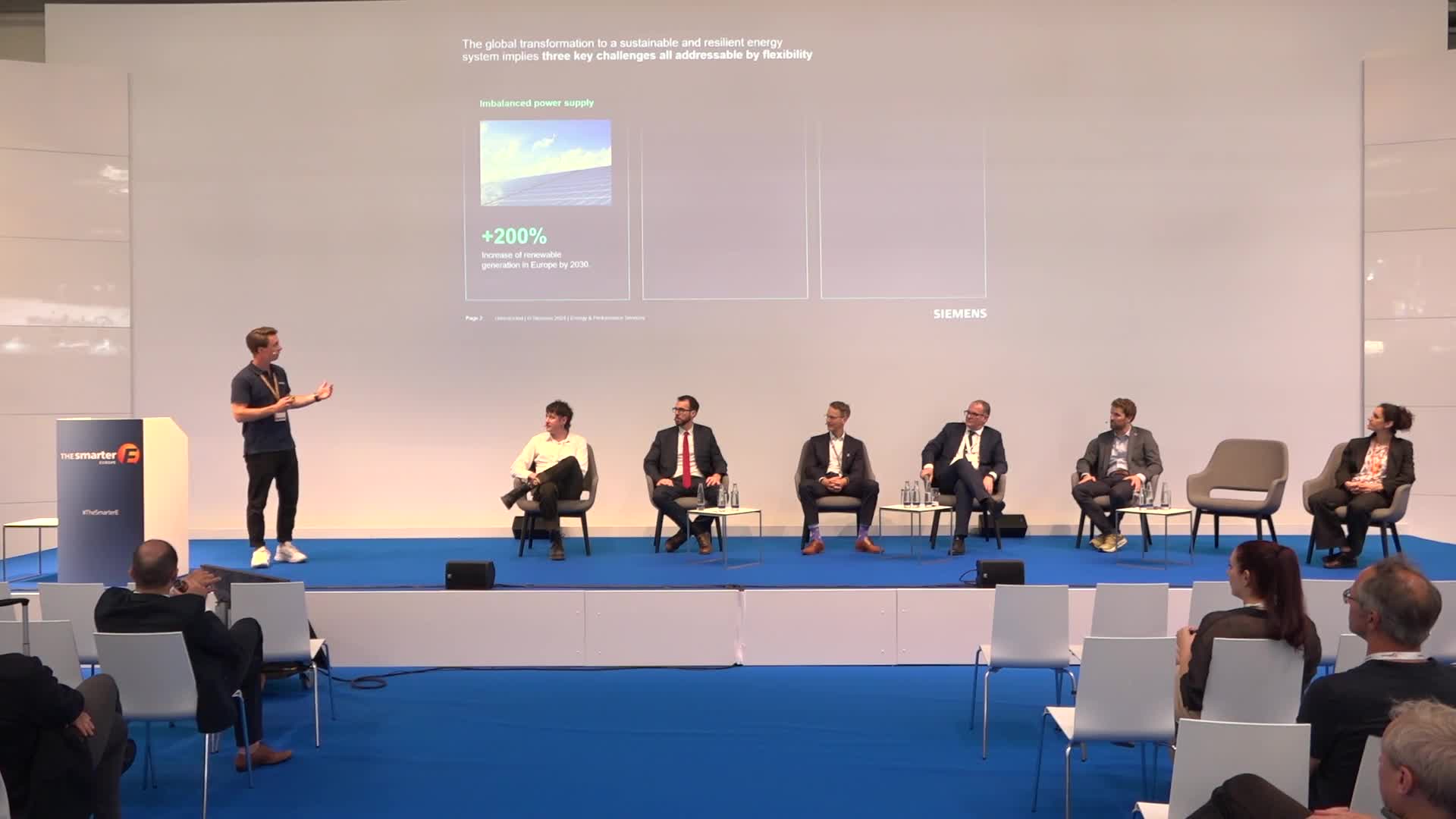
Siemens' Viktor Persson Discusses Innovative Flexibility Solutions to Address Energy System Challenges Without Relying on Batteries

Viktor Persson, a strategy and business developer at Siemens, discusses the importance of flexibility in energy systems, particularly in light of Europe's transition to a CO2-neutral society. The focus is on finding solutions for energy storage and management beyond traditional batteries. Despite significant growth in renewable sources like wind and solar power, Europe faces substantial grid constraints that hinder both consumption capacity expansion and new renewable installations due to lengthy permitting processes. Flexibility services are highlighted as crucial for optimizing these challenges. Flexibility isn't limited to battery use; it involves managing various assets such as natural gas, biogas, hydrogen, and even adjusting consumer behavior. A digital twin model representing each asset's operation cost-effectively forecasts energy prices and load demands. A case study from Belgium demonstrates this approach’s efficacy: a medium-sized hospital achieved 6-7% annual cost savings by implementing software-driven optimization without using batteries—showing quicker payback compared to traditional battery investments. Viktor emphasizes contacting him for more information on these innovative strategies.

Automated summarization by AI Conver

A decentralised, flexible energy system puts energy consumers at the fore-front of the clean energy transition. Through demand-side flexibility, consumers are able to adjust their consumption, store energy, and inject energy into the grid during peak moments, contributing to a more efficient and sustainable decarbonisation pathway. smartEn has calculated that, with help from flexible consumers, in 2030 the EU energy system could avoid 15.5 TWh in renewable energy curtailment, a 61% improvement compared to if no action is taken, and avoid investments in 60 GW of peak generation capacity, equivalent to 137 gas peaking plants, resulting in €2.7 billion saved annually. This session aims to deep-dive into how decentralised assets such as PV, Stationary and Mobile storage, amongst others, are key to reducing costs for consumers, increasing the uptake of renewables and solving grid congestion issues.

Further Talks of this session:

To Talk

To Talk

To Talk

To Talk

To Talk

To Talk

To Talk

Further Content
Webinar
Growth of the European Solar Market, Specifically, Romania

February 24, 2026

Webinar: EU Solar Market Overview with Focus on Romania

The smarter E Europe Exhibition Program 2025
DC Microgrids as the Next Frontier in Grid Modernization and DER Integration

Wednesday, May 07, 2025, 11:00 am - 12:25 pm

The smarter E Europe Exhibition Program 2025 | Exhibition Program

premium account

Discover how next-gen distribution grid technologies are addressing the challenges of renewable integration and dynamic energy demands. This session offers insights into the latest developments in AI-driven data analytics and the transformative role of IoT in grid management.

Irene Guerra Gil, Mark Bruno
Staying Home, with Smart Energy Management

The smarter E Podcast Episode 245 | Language: English

December 11, 2025

Irene Guerra Gil and Mark Bruno explain how smart home energy systems and building initiatives cut costs and emissions.

Webinar Collection
Mixed Investment Solar Projects in Mexico: The 54% Model Explained

January 29, 2026

Mexico has introduced a new mixed investment scheme for renewable power generation, requiring a minimum 54% direct or indirect participation by CFE.

The smarter E Europe Conferences 2025
Factors That Influence the Success of a Minigrid Project

Wednesday, May 07, 2025, 11:00 am - 12:30 pm

The smarter E Europe Conferences 2025 | Conference Program

premium account

Off-grid solar systems are often the least expensive option for rural electrification. Solar home systems can power individual households, while mini-grids can supply entire villages. Each comes with its own advantages, disadvantages, and challenges. The aim of this session is to explore challenges as well as success stories. It takes well-functioning components such as battery systems, charge management and inverters to make projects successful. Proper system sizing, maintenance and repair management, as well as a robust financial concept are also necessary. If one of these elements is missing, the electrification will not be sustainable. This session will focus on the aspects mentioned above. The speakers will present successful and unsuccessful approaches and discuss what can be learned from them.

You are using an outdated browser

The website cannot be viewed in this browser. Please open the website in an up-to-date browser such as Edge, Chrome, Firefox, or Safari.