Finding the Right Inverters for Any Purpose

premium account

Recording of Tuesday, June 18, 2024 | The smarter E Europe Conferences 2024 | Conference Program | Language: English | Duration: 13:04 .

Arvid Bürkle of KACO new energy GmbH Presents on Selecting the Right PV Inverters Amid Evolving Customer, Project, and Sustainability Requirements at Industry Event

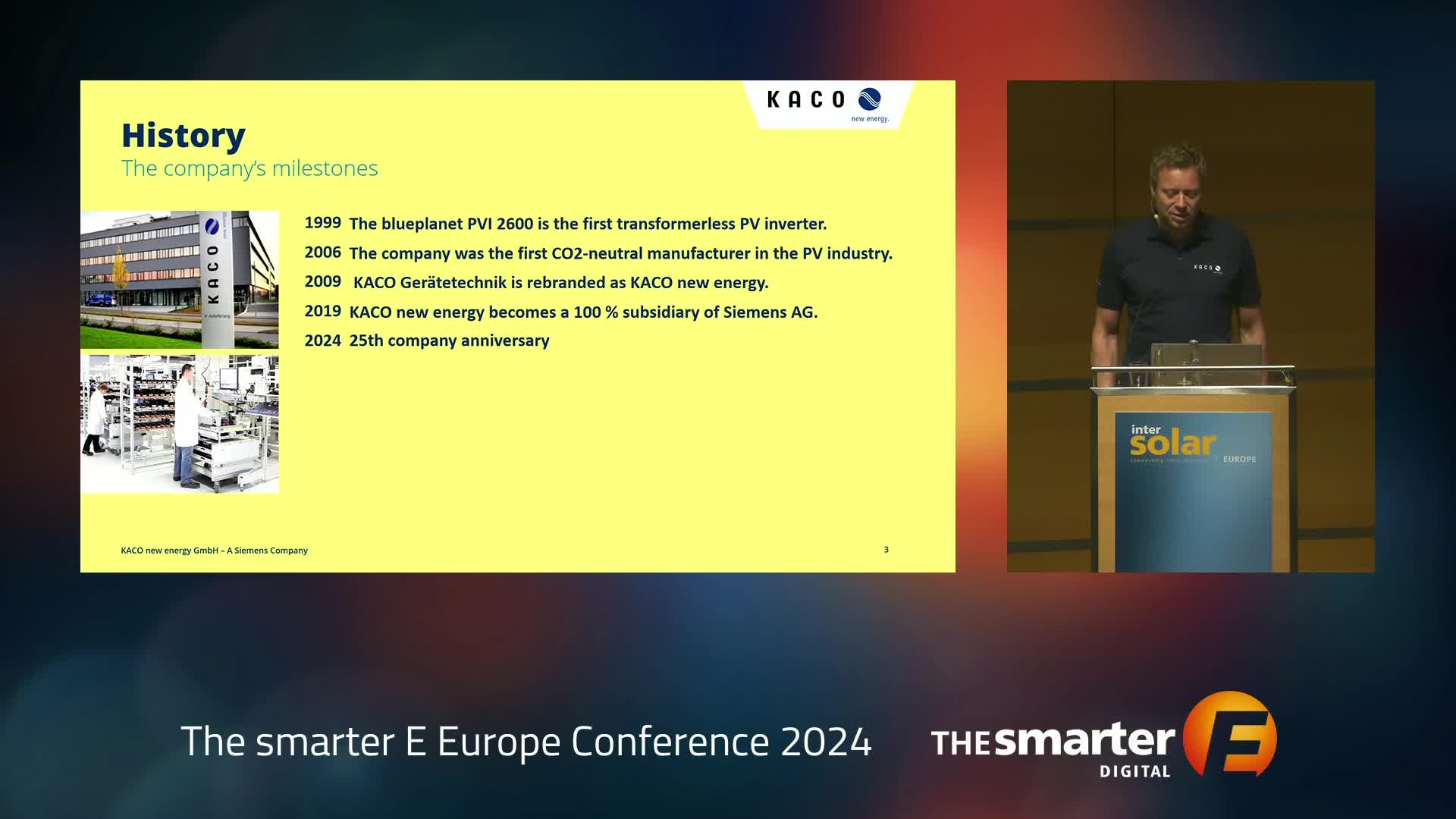
Arvid Bürkle from KACO new energy GmbH discusses selecting the right inverters for various purposes, underlining customer and project requirements alongside sustainability trends. KACO new energy is a German PV inverter manufacturer with notable achievements: introducing the first transformerless PV inverter in 1999, becoming carbon neutral by 2006, rebranding in 2009, and celebrating its 25th anniversary recently. The company has seen significant advancements in efficiency and power density while reducing costs over time. When choosing an inverter, understanding whether it's for a new or repowering project is crucial. New projects can set specifications anew whereas repowering requires compatibility with existing systems. Project specifics like type (roof-mounted vs ground-mounted), special applications (storage or high altitude), and size are important factors. Country-specific regulations also play a key role; CE conformity applies to Europe while UL listings are necessary for U.S markets. Each country may have unique codes such as zero feed-in mandates in Spain or rapid shutdown devices required on U.S roofs due to fire safety laws. Project-specific needs also include module types, DC voltage levels, MPPT configurations, and AC voltage requirements. Environmental conditions like temperature thresholds may necessitate specialized inverters that delay derating at higher temperatures. Additionally, features like surge protection ensure system integrity. These considerations help optimize operational outcomes and enhance the total cost of ownership, aligning with the diverse demands of the global market.

Automated summarization by AI Conver

Arvid Bürkle
Head of Product Lifecycle Management
KACO new energy GmbH - A Siemens Company
Germany

The advances in technology along the solar value chain in recent years have been breathtaking: Innovations have included considerably larger wafers, new cell technologies, much higher-efficiency solar modules, smarter inverters with management systems that can control fully electrified high-tech homes and less material-intensive fixed or tracking mounting systems that can be installed faster and boost system yields. This session will provide an overview of the latest technologies.

Further Talks of this session:

Speaker

Dr. Harry Wirth
Director, Division Power Solutions
Fraunhofer Institute for Solar Energy Systems ISE
Germany

To Talk

Speaker

Molly Morgan
Senior Research Analyst
Exawatt
United Kingdom

To Talk

Speaker

Joe Steveni
Research Analyst - Clean Energy Technology
S&P Global

Liam Coman
Solar Research Analyst
S&P Global

To Talk

Speaker

Dr. Peter Fath
CEO
RCT Solutions GmbH
Germany

To Talk

Speaker

Helena Li
Executive President
Trina Solar
Singapore

To Talk

Further Content
Webinar
Mixed Investment Solar Projects in Mexico: The 54% Model Explained

January 29, 2026

Mexico has introduced a new mixed investment scheme for renewable power generation, requiring a minimum 54% direct or indirect participation by CFE.

Anna Darmani, Principal Analyst from Wood Mackenzie
Big BESS Is Here to Save the Day

The smarter E Podcast Episode 246 | Language: English

January 8, 2026

Utility-scale batteries are booming in Europe. Discover key BESS trends, market impacts, and what to expect for large-scale storage in 2026.

The smarter E Europe Conferences 2025
Setting the Scene "Affodability"

Wednesday, May 07, 2025, 04:00 pm - 05:30 pm

The smarter E Europe Conferences 2025 | Conference Program

premium account

Photovoltaic prices have fallen continuously in recent years - a trend that should translate into a growing market for off-grid solutions. Declining costs are crucial for rural electrification in particular, making sustainable energy supply economically viable in remote regions. However, so far many of these price advantages have not yet reached the people that need them most. Do existing framework conditions to foster rural electrification still work in this new market reality? Which measures are needed to ensure that cost reductions reach our target group? This session discusses strategies for improving the availability of low-cost off-grid solutions, financing and innovative business models. A look at successful practical examples shows which political, economic and technological levers need to be pulled to make off-grid PV accessible on a large scale.

The smarter E Europe Conferences 2025
Setting the Scene "Off-Grid"

Wednesday, May 07, 2025, 04:00 pm - 05:30 pm

The smarter E Europe Conferences 2025 | Conference Program

premium account

Photovoltaic prices have fallen continuously in recent years - a trend that should translate into a growing market for off-grid solutions. Declining costs are crucial for rural electrification in particular, making sustainable energy supply economically viable in remote regions. However, so far many of these price advantages have not yet reached the people that need them most. Do existing framework conditions to foster rural electrification still work in this new market reality? Which measures are needed to ensure that cost reductions reach our target group? This session discusses strategies for improving the availability of low-cost off-grid solutions, financing and innovative business models. A look at successful practical examples shows which political, economic and technological levers need to be pulled to make off-grid PV accessible on a large scale.

The smarter E Europe Conferences 2025
Welcome of of the Session Off-Grid: When Will Off-Grid PV Follow the Affordability Trend?(BSW)

Wednesday, May 07, 2025, 04:00 pm - 05:30 pm

The smarter E Europe Conferences 2025 | Conference Program

premium account

Photovoltaic prices have fallen continuously in recent years - a trend that should translate into a growing market for off-grid solutions. Declining costs are crucial for rural electrification in particular, making sustainable energy supply economically viable in remote regions. However, so far many of these price advantages have not yet reached the people that need them most. Do existing framework conditions to foster rural electrification still work in this new market reality? Which measures are needed to ensure that cost reductions reach our target group? This session discusses strategies for improving the availability of low-cost off-grid solutions, financing and innovative business models. A look at successful practical examples shows which political, economic and technological levers need to be pulled to make off-grid PV accessible on a large scale.

You are using an outdated browser

The website cannot be viewed in this browser. Please open the website in an up-to-date browser such as Edge, Chrome, Firefox, or Safari.