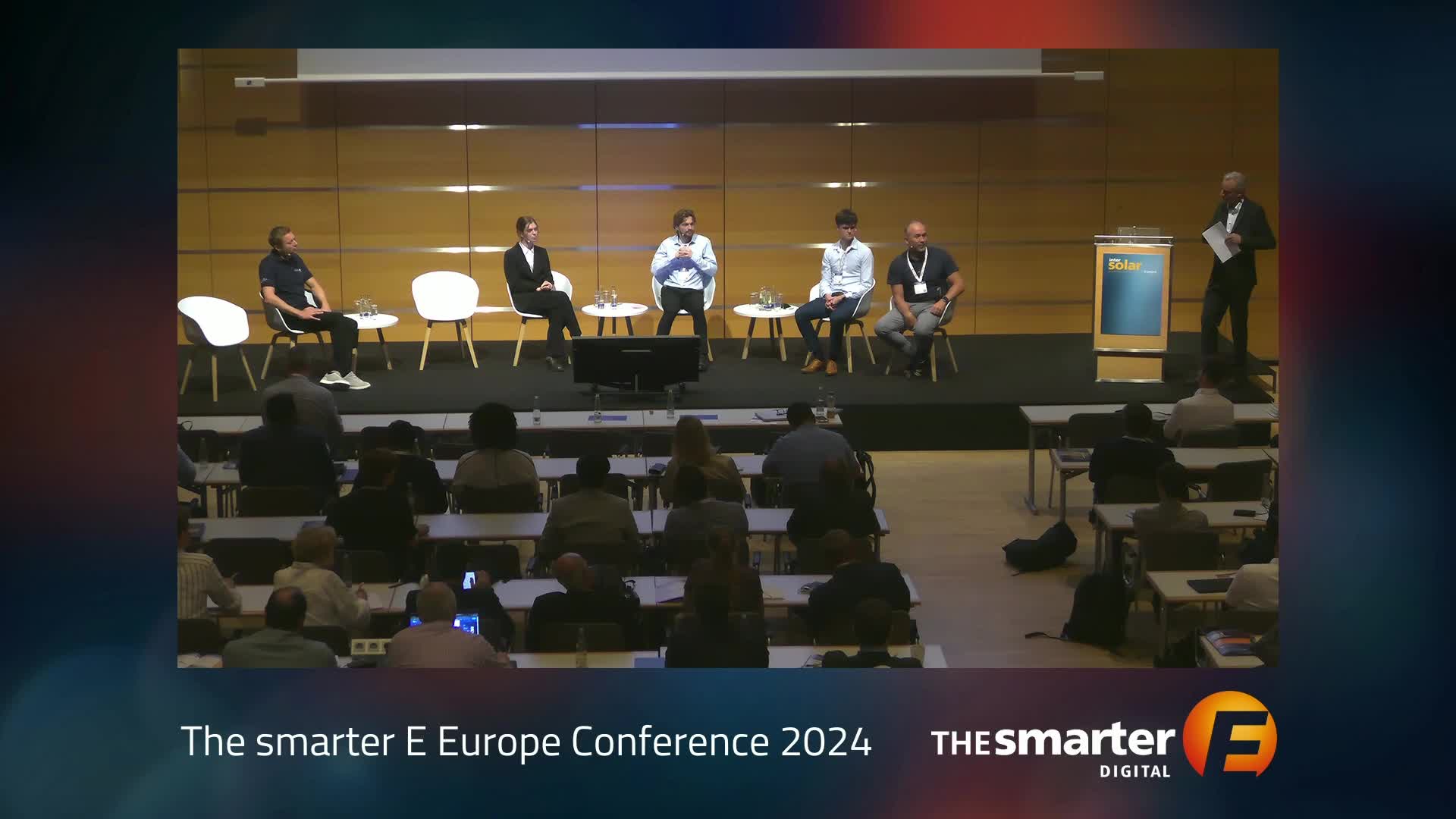
Fire Chat: What's Needed in Solar to Bring the Technology to the Next Level?

premium account

Recording of Tuesday, June 18, 2024 | The smarter E Europe | Conference Program | Language: English | Duration: 17:15 .

Experts Debate Cost Drivers and Efficiency of Back Contact Solar Technologies, Challenges for Floating Solar Inverters, and Impact of Incentives on Manufacturing Distribution at Industry Panel

In a recent discussion about solar technologies, Johannes Müller inquired about the cost drivers for back contact technologies and whether these costs might diminish over time. The response highlighted that back contact technology currently comes with a price premium due to less established manufacturing processes compared to other technologies like Mono PERC and Topcon. These established methods benefit from upgradable equipment which is not yet available for back contact technology. Despite this, there are indications that streamlining production could eventually reduce costs. Additionally, it was pointed out that there isn't much difference between Topcon-based back contact cells and traditional front-to-rear connection cells concerning efficiency gains versus investment required. However, challenges remain in making TBC (Tunnel Oxide Passivated Contact) cells bifacially efficient, predicting only around 60% bifaciality as feasible. Further on inverter technology for floating or offshore solar applications was discussed briefly by Benjamin Lena from DMACC who raised concerns regarding higher corrosion rates near the sea affecting longevity and warranty commitments of such devices. Paul Lewis from the World Bank Group asked about incentives' role in manufacturing distribution outside specific acts like IRA and supply chain resilience premiums. It was noted that market players often demand diversification away from single-country dependencies despite potential cost increases; however, rational customers may absorb minor cost uplifts if incentivized properly. Finally, questions were raised about Europe's capacity to support solar manufacturing infrastructure amidst global competition—a recurring theme emphasizing the need for strategizing competitive frameworks both with and without direct incentives.

Automated summarization by AI Conver

Helena Li
Executive President
Trina Solar
Singapore

The advances in technology along the solar value chain in recent years have been breathtaking: Innovations have included considerably larger wafers, new cell technologies, much higher-efficiency solar modules, smarter inverters with management systems that can control fully electrified high-tech homes and less material-intensive fixed or tracking mounting systems that can be installed faster and boost system yields. This session will provide an overview of the latest technologies.

Further Talks of this session:

Speaker

Dr. Harry Wirth
Director, Division Power Solutions
Fraunhofer Institute for Solar Energy Systems ISE
Germany

To Talk

Speaker

Molly Morgan
Senior Research Analyst
Exawatt
United Kingdom

To Talk

Speaker

Joe Steveni
Research Analyst - Clean Energy Technology
S&P Global

Liam Coman
Solar Research Analyst
S&P Global

To Talk

Speaker

Arvid Bürkle
Head of Product Lifecycle Management
KACO new energy GmbH - A Siemens Company
Germany

To Talk

Speaker

Dr. Peter Fath
CEO
RCT Solutions GmbH
Germany

To Talk

Further Content
Webinar
Growth of the European Solar Market, Specifically, Romania

February 24, 2026

Webinar: EU Solar Market Overview with Focus on Romania

Webinar Collection
Mixed Investment Solar Projects in Mexico: The 54% Model Explained

January 29, 2026

Mexico has introduced a new mixed investment scheme for renewable power generation, requiring a minimum 54% direct or indirect participation by CFE.

The smarter E Europe Conferences 2025
Factors That Influence the Success of a Minigrid Project

Wednesday, May 07, 2025, 11:00 am - 12:30 pm

The smarter E Europe Conferences 2025 | Conference Program

premium account

Off-grid solar systems are often the least expensive option for rural electrification. Solar home systems can power individual households, while mini-grids can supply entire villages. Each comes with its own advantages, disadvantages, and challenges. The aim of this session is to explore challenges as well as success stories. It takes well-functioning components such as battery systems, charge management and inverters to make projects successful. Proper system sizing, maintenance and repair management, as well as a robust financial concept are also necessary. If one of these elements is missing, the electrification will not be sustainable. This session will focus on the aspects mentioned above. The speakers will present successful and unsuccessful approaches and discuss what can be learned from them.

The smarter E Europe Conferences 2025
Q&A Session of of the Session Off-Grid: Rural Electrification Based on Solar Systems - Lessons Learned

Wednesday, May 07, 2025, 11:00 am - 12:30 pm

The smarter E Europe Conferences 2025 | Conference Program

premium account

Off-grid solar systems are often the least expensive option for rural electrification. Solar home systems can power individual households, while mini-grids can supply entire villages. Each comes with its own advantages, disadvantages, and challenges. The aim of this session is to explore challenges as well as success stories. It takes well-functioning components such as battery systems, charge management and inverters to make projects successful. Proper system sizing, maintenance and repair management, as well as a robust financial concept are also necessary. If one of these elements is missing, the electrification will not be sustainable. This session will focus on the aspects mentioned above. The speakers will present successful and unsuccessful approaches and discuss what can be learned from them.

The smarter E Europe Conferences 2025
Panel Discussion of of the Session Off-Grid: When Will Off-Grid PV Follow the Affordability Trend?(BSW)

Wednesday, May 07, 2025, 04:00 pm - 05:30 pm

The smarter E Europe Conferences 2025 | Conference Program

premium account

Photovoltaic prices have fallen continuously in recent years - a trend that should translate into a growing market for off-grid solutions. Declining costs are crucial for rural electrification in particular, making sustainable energy supply economically viable in remote regions. However, so far many of these price advantages have not yet reached the people that need them most. Do existing framework conditions to foster rural electrification still work in this new market reality? Which measures are needed to ensure that cost reductions reach our target group? This session discusses strategies for improving the availability of low-cost off-grid solutions, financing and innovative business models. A look at successful practical examples shows which political, economic and technological levers need to be pulled to make off-grid PV accessible on a large scale.

You are using an outdated browser

The website cannot be viewed in this browser. Please open the website in an up-to-date browser such as Edge, Chrome, Firefox, or Safari.