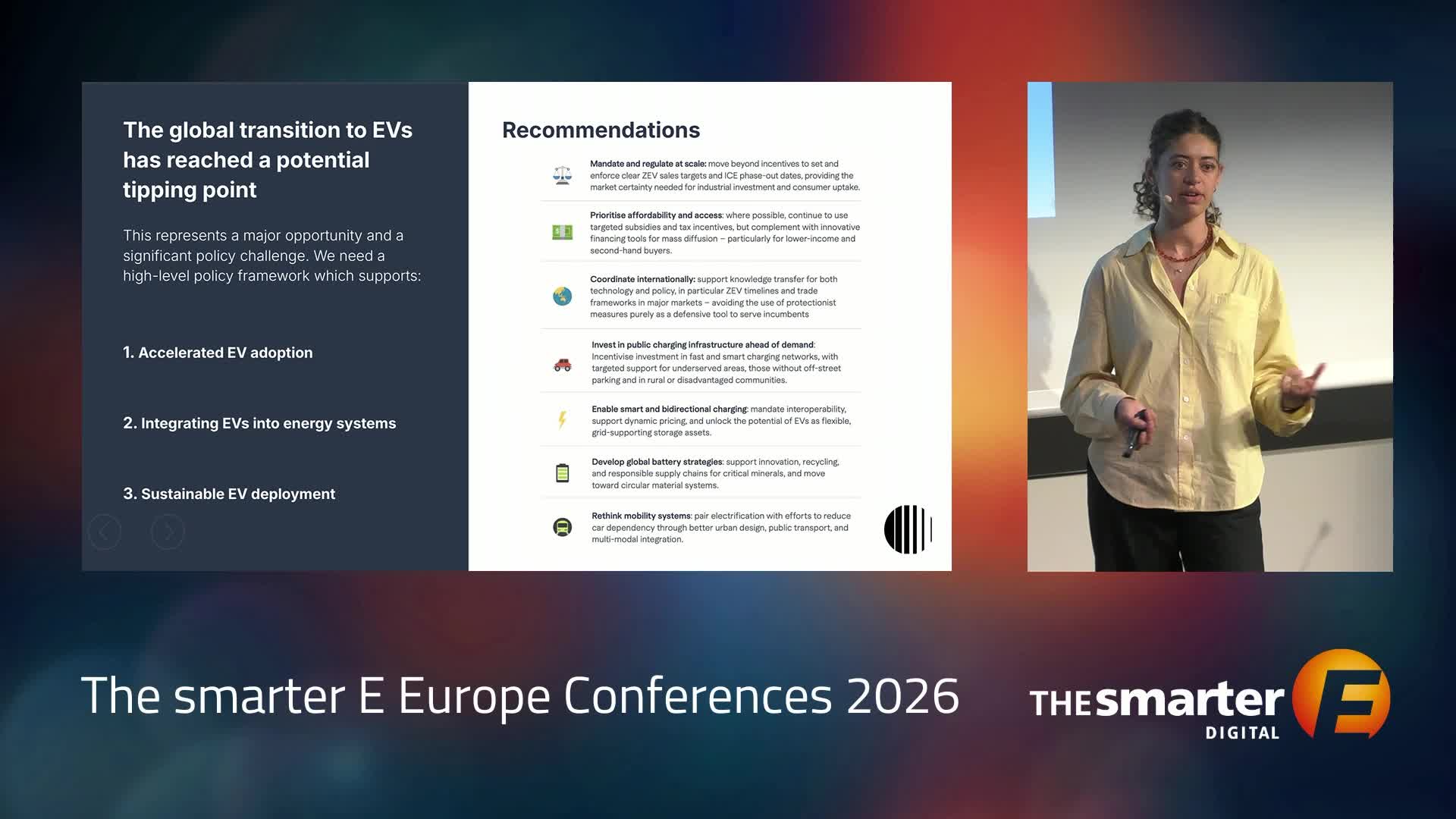
Recording of Monday, June 22, 2026 | The smarter E Europe Conferences 2026 | Language: English | Duration: 7:07 .
The Centre for Net Zero is actively researching smart electric vehicle (EV) charging and its potential benefits for energy systems. Amber Woodward, the organization's International Public Affairs Manager, reveals that households with EVs can nearly double their energy demand during peak times, which poses risks to electricity networks if not properly managed. However, EVs are typically charging only 20-30% of the time, creating opportunities for more flexible charging strategies. A study in the UK demonstrated that an AI-managed smart tariff could reduce peak demand by 42% among participating customers, enabling significant savings of around £650 annually. This tariff incentivizes more efficient charging behavior and aligns customer interests with grid stability. The Centre’s modeling forecasts that these strategies could prevent the curtailment of almost 15 terawatt hours of renewable energy by 2040, underscoring the necessity for effective policy and incentives to enhance the integration of EVs into energy systems.
Automated summarization by AI Conver
Speaker
Amber Woodward
International Public Affairs Manager
Center for NetZero
United Kingdom
As the number of electric fleets, depots and fast-charging hubs is rising across Europe, grid integration is becoming increasingly important. Large charging sites can either strain local feeders or become controllable and flexible loads that support grid stability if managed smartly.This session highlights the latest experiences from utility companies, network operators, fleet managers and technology providers who are turning e-mobility into an active part of the power system. We will explore how to align charging demand with grid capacity and market signals and also how we can successfully scale up e-mobility with increased demand-side flexibility. What are some best practices already in use? The panelists will also discuss the economic benefits for aggregators and end users as well as the organizational and regulatory conditions that are needed to transition from 'plugging in' to paying off through smart and bidirectional charging. The panel will highlight best practices for integrating demand-side flexibility into a resilient energy system.
Further Talks of this session:
Speaker
Katharina Kramer
Communication & Event Manager
E-Mobility Europe
Speaker
Anne Bicking
CEO
gridX GmbH
Germany
Speaker
Jannik Carl
Senior Energy Markets Manager
Kraken Technologies
Germany
Speaker
Jan Winkler
Head of Business Development
The Mobility House Energy GmbH
Germany