The Dso's Enabling Prosumers

premium account

Recording of Wednesday, June 19, 2024 | The smarter E Europe 2024 | Conference Program | Language: English | Duration: 12:22 .

DSOs Face Significant Challenges and Opportunities in Energy Transition, Emphasize Need for Investment and Smart Technologies

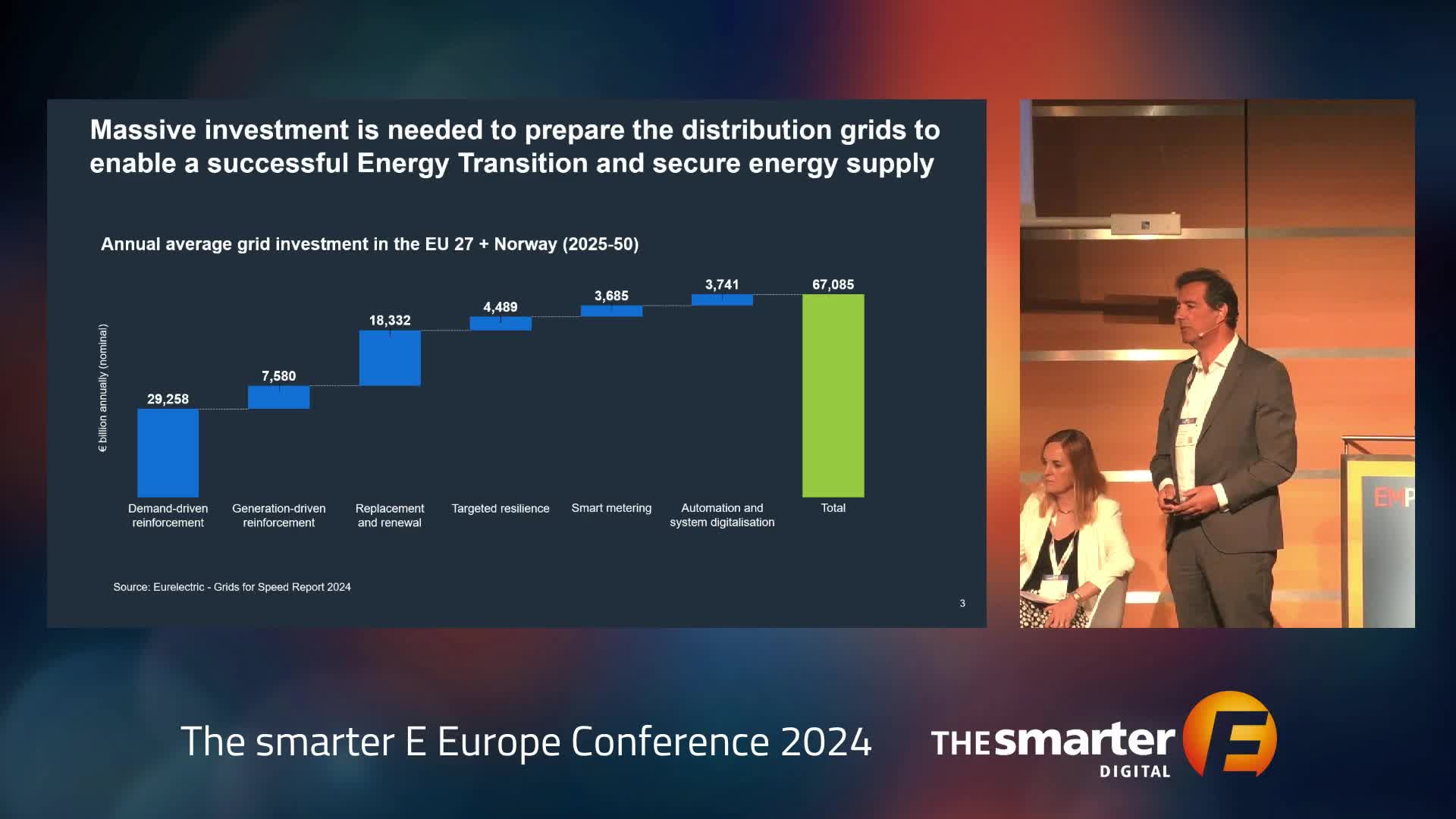
As a representative of Distribution System Operators (DSOs), the speaker addresses both challenges and opportunities in the energy sector. The primary challenge is the massive investment needed to modernize grids, estimated at 67 billion euros annually for Europe plus Norway, essential to manage the energy transition effectively. DSOs are now recognized as pivotal players in this transition, marking a shift from previously focusing solely on renewable incentives. At EDP, significant investments have been made across Brazil, Spain, and Portugal. In Iberia specifically, there has been substantial growth in connecting renewable power plants to grids - with notable increases projected from 2021 to 2024 for self-consumption and electric mobility initiatives. The transformation includes adapting grids initially designed for unidirectional flows into systems capable of handling bidirectional energy demands. Smart meters play a crucial role; Spain already boasts full smart meter installation while Portugal aims to achieve it by year's end. Lastly, EDP emphasizes transparency through open data initiatives and enhancing grid flexibility through new strategic endeavors initiated last year. This evolution turns DSOs from mere electrical operators into key data-centric entities critical for an efficient energy future.

Automated summarization by AI Conver

José Ferrari Careto
CEO of Networks Business
EDP Group

Active consumer involvement is a crucial aspect of the energy transition. Demand-side flexibility is essential for a flexible energy system that integrates the exponentially growing number of distributed energy resources. Both the system and society in general need consumers to adapt their energy usage to the available network capacity. Digitalization and new technologies - such as smart meters - as well as market-based solutions will allow consumers to become active players. However, being able does not necessarily mean being willing, so incentives are needed. This session will also address how our grid can be prepared to meet consumer expectations and how to deal with a flood of connection requests in a timely manner while ensuring security of supply.

Speaker

Carmen Gimeno
Secretary General
GEODE
Belgium

To Talk

Speaker

Andreas Jahn
Senior Associate
Regulatory Assistance Project (RAP)
Belgium

To Talk

Speaker

Sebastian Mahlow
Managing Director
ison GmbH
Germany

To Talk

Speaker

Dr. Frank Schlichting
CEO
Kiwigrid GmbH
Germany

To Talk

Speaker

Alex Schoch
Global Head of Flexibility
Octopus Energy
UK

To Talk

To Talk

Further Content
Webinar
Growth of the European Solar Market, Specifically, Romania

February 24, 2026

Webinar: EU Solar Market Overview with Focus on Romania

The smarter E Europe Exhibition Program 2025
DC Microgrids as the Next Frontier in Grid Modernization and DER Integration

Wednesday, May 07, 2025, 11:00 am - 12:25 pm

The smarter E Europe Exhibition Program 2025 | Exhibition Program

premium account

Discover how next-gen distribution grid technologies are addressing the challenges of renewable integration and dynamic energy demands. This session offers insights into the latest developments in AI-driven data analytics and the transformative role of IoT in grid management.

Irene Guerra Gil, Mark Bruno
Staying Home, with Smart Energy Management

The smarter E Podcast Episode 245 | Language: English

December 11, 2025

Irene Guerra Gil and Mark Bruno explain how smart home energy systems and building initiatives cut costs and emissions.

The smarter E Europe Conferences 2025
Factors That Influence the Success of a Minigrid Project

Wednesday, May 07, 2025, 11:00 am - 12:30 pm

The smarter E Europe Conferences 2025 | Conference Program

premium account

Off-grid solar systems are often the least expensive option for rural electrification. Solar home systems can power individual households, while mini-grids can supply entire villages. Each comes with its own advantages, disadvantages, and challenges. The aim of this session is to explore challenges as well as success stories. It takes well-functioning components such as battery systems, charge management and inverters to make projects successful. Proper system sizing, maintenance and repair management, as well as a robust financial concept are also necessary. If one of these elements is missing, the electrification will not be sustainable. This session will focus on the aspects mentioned above. The speakers will present successful and unsuccessful approaches and discuss what can be learned from them.

The smarter E Europe Conferences 2025
Q&A Session of of the Session Off-Grid: Rural Electrification Based on Solar Systems - Lessons Learned

Wednesday, May 07, 2025, 11:00 am - 12:30 pm

The smarter E Europe Conferences 2025 | Conference Program

premium account

Off-grid solar systems are often the least expensive option for rural electrification. Solar home systems can power individual households, while mini-grids can supply entire villages. Each comes with its own advantages, disadvantages, and challenges. The aim of this session is to explore challenges as well as success stories. It takes well-functioning components such as battery systems, charge management and inverters to make projects successful. Proper system sizing, maintenance and repair management, as well as a robust financial concept are also necessary. If one of these elements is missing, the electrification will not be sustainable. This session will focus on the aspects mentioned above. The speakers will present successful and unsuccessful approaches and discuss what can be learned from them.

You are using an outdated browser

The website cannot be viewed in this browser. Please open the website in an up-to-date browser such as Edge, Chrome, Firefox, or Safari.