Recording of Monday, June 22, 2026 | The smarter E Europe Conferences 2026 | Language: English | Duration: 8:18 .
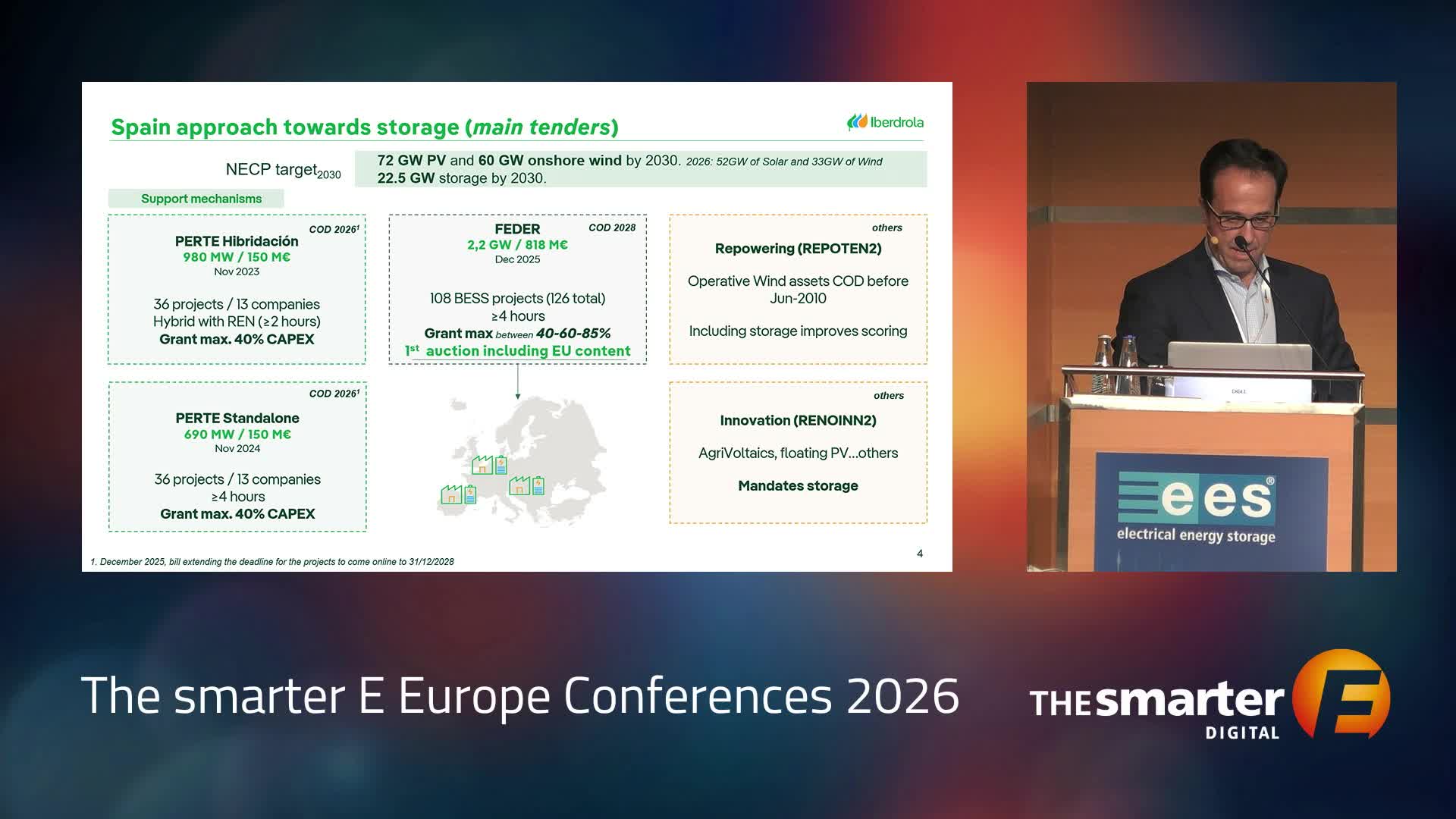
Rafael Mallo, an energy sector expert at Iberdrola with 20 years of experience, oversees the company's storage projects. Iberdrola is the second-largest utility in the world, with a market capitalization of €160 billion and an installed power capacity of 59 gigawatts across several countries including the US, Europe, and Brazil. The company's ambitious investment plan of €58 billion is directed towards enhancing networks and expanding renewable energy sources. Currently, renewable energy makes up 60% of Spain's energy mix, with 160 gigawatts of installed capacity primarily from solar and wind. By 2030, the goal is to achieve around 70 gigawatts of solar and 60 gigawatts of wind power. To support this, an additional 20 gigawatts of energy storage capacity is targeted to bolster reliability. A variety of support mechanisms such as PERTA grants and federal auctions have been established to facilitate energy projects, resulting in substantial investments and competition in the market. Evaluations of project grants prioritize socioeconomic impacts, location, and the employment potential of projects, with added bonuses for those leveraging European components. European funds have further strengthened renewable energy storage development, particularly through initiatives that encourage local manufacturing and a more competitive energy landscape.
Automated summarization by AI Conver
Rafael Mallo
Energy Storage Project Manager
Iberdrola
Spain
The European market for battery cells is currently heavily focused on the automotive sector. Companies therefore continue to rely predominantly on Asian production sites for stationary battery storage. The recent bankruptcies of European cell manufacturers are further exacerbating this dependency, while new players are entering the market, both with conventional lithium-ion technology and with alternative cell chemistries. At the same time, the first European governments are initiating subsidy programs for stationary battery storage systems that require a minimum quota of European components. Will this approach prevail across Europe?While the expansion of storage capacities is being promoted politically, there are also countervailing trends, such as the discussions in the German Federal Ministry of Economics about a possible restriction of the expansion. This session highlights key developments, challenges and future paths for the European storage market.
Further Talks of this session:
Speaker
Patrick Clerens
Secretary General
Energy Storage Europe
Speaker
Vincent Le Quintrec
Global Sales and Marketing Director
SAFT
France
Speaker
Lars Stephan
Director Marketing, Policy and Public Affairs (EMEA)
Fluence
United Kingdom
Speaker
Céline Combé
Head of Business Development ESS
PowerCo SE
Germany