Opportunities and Developments in Balance of Systems 2

premium account

Recording of Tuesday, June 18, 2024 | The smarter E Europe Conferences 2024 | Conference Program | Language: English | Duration: 8:26 .

"Exploring the Advancements and Challenges of Solar Trackers: A Comprehensive Overview"

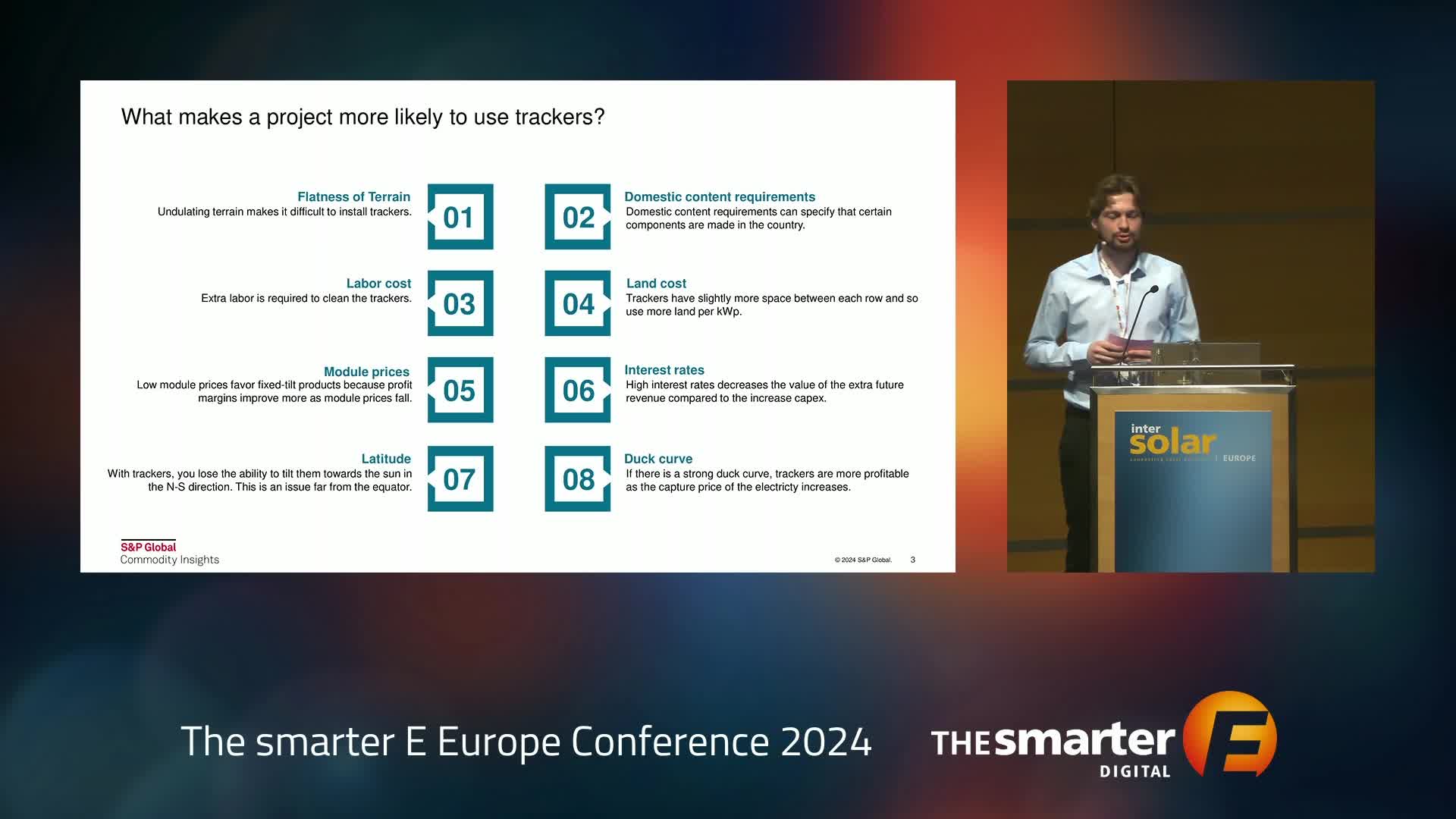
The presentation, led by the speaker and followed by Liam, delves into research on solar trackers versus fixed tilt systems. Key factors affecting tracker adoption include labor and land costs, with trackers requiring more workers for maintenance and additional space per megawatt peak due to wider row spacing. Module price fluctuations also impact cost-effectiveness; as module prices drop, fixed tilt projects become more attractive due to their lower initial capital expenditure (capex). Latitude affects tracker performance because they function better near the equator. Different tracker configurations are discussed: 1P (one motor per row) vs. multi-row setups which save on motors but increase drive shaft and R&D expenses; single portrait vs. dual portrait arrangements where duals allow higher density installation but at increased risk of wind damage. In 2023, global shipments hit 94 gigawatts of trackers with Europe favoring the versatile yet complex 2P models suited for irregular terrains. Innovations focus on reducing steel use in construction—cutting costs and easing installation—and enhancing slope tolerance via all-terrain articulating joints that adapt to uneven ground profiles. Prefabricated products offer rapid deployment without skilled labor or extensive equipment needs, crucial for mining operations adjusting based on commodity market trends. Agrivoltaics integrates solar PV into farmland using agri-tracker designs that accommodate heavy machinery through strategically spaced rows and adjustable panel positions, optimizing both agricultural output and renewable energy generation.

Automated summarization by AI Conver

Joe Steveni
Research Analyst - Clean Energy Technology
S&P Global

The advances in technology along the solar value chain in recent years have been breathtaking: Innovations have included considerably larger wafers, new cell technologies, much higher-efficiency solar modules, smarter inverters with management systems that can control fully electrified high-tech homes and less material-intensive fixed or tracking mounting systems that can be installed faster and boost system yields. This session will provide an overview of the latest technologies.

Further Talks of this session:

Speaker

Dr. Harry Wirth
Director, Division Power Solutions
Fraunhofer Institute for Solar Energy Systems ISE
Germany

To Talk

Speaker

Molly Morgan
Senior Research Analyst
Exawatt
United Kingdom

To Talk

Speaker

Arvid Bürkle
Head of Product Lifecycle Management
KACO new energy GmbH - A Siemens Company
Germany

To Talk

Speaker

Dr. Peter Fath
CEO
RCT Solutions GmbH
Germany

To Talk

Speaker

Helena Li
Executive President
Trina Solar
Singapore

To Talk

Further Content
Webinar
Mixed Investment Solar Projects in Mexico: The 54% Model Explained

January 29, 2026

Mexico has introduced a new mixed investment scheme for renewable power generation, requiring a minimum 54% direct or indirect participation by CFE.

Anna Darmani, Principal Analyst from Wood Mackenzie
Big BESS Is Here to Save the Day

The smarter E Podcast Episode 246 | Language: English

January 8, 2026

Utility-scale batteries are booming in Europe. Discover key BESS trends, market impacts, and what to expect for large-scale storage in 2026.

The smarter E Europe Conferences 2025
Factors That Influence the Success of a Minigrid Project

Wednesday, May 07, 2025, 11:00 am - 12:30 pm

The smarter E Europe Conferences 2025 | Conference Program

premium account

Off-grid solar systems are often the least expensive option for rural electrification. Solar home systems can power individual households, while mini-grids can supply entire villages. Each comes with its own advantages, disadvantages, and challenges. The aim of this session is to explore challenges as well as success stories. It takes well-functioning components such as battery systems, charge management and inverters to make projects successful. Proper system sizing, maintenance and repair management, as well as a robust financial concept are also necessary. If one of these elements is missing, the electrification will not be sustainable. This session will focus on the aspects mentioned above. The speakers will present successful and unsuccessful approaches and discuss what can be learned from them.

The smarter E Europe Conferences 2025
Setting the Scene "Off-Grid"

Wednesday, May 07, 2025, 04:00 pm - 05:30 pm

The smarter E Europe Conferences 2025 | Conference Program

premium account

Photovoltaic prices have fallen continuously in recent years - a trend that should translate into a growing market for off-grid solutions. Declining costs are crucial for rural electrification in particular, making sustainable energy supply economically viable in remote regions. However, so far many of these price advantages have not yet reached the people that need them most. Do existing framework conditions to foster rural electrification still work in this new market reality? Which measures are needed to ensure that cost reductions reach our target group? This session discusses strategies for improving the availability of low-cost off-grid solutions, financing and innovative business models. A look at successful practical examples shows which political, economic and technological levers need to be pulled to make off-grid PV accessible on a large scale.

Renate Egan, Executive Director of ACAP
What’s Next in PV Cell and Module Tech

The smarter E Podcast Episode 244 | Language: English

November 27, 2025

UNSW and ACAP drive advances in solar tech. Prof. Renate Egan shares new PV research and how innovation will shape the industry in 2026.

You are using an outdated browser

The website cannot be viewed in this browser. Please open the website in an up-to-date browser such as Edge, Chrome, Firefox, or Safari.