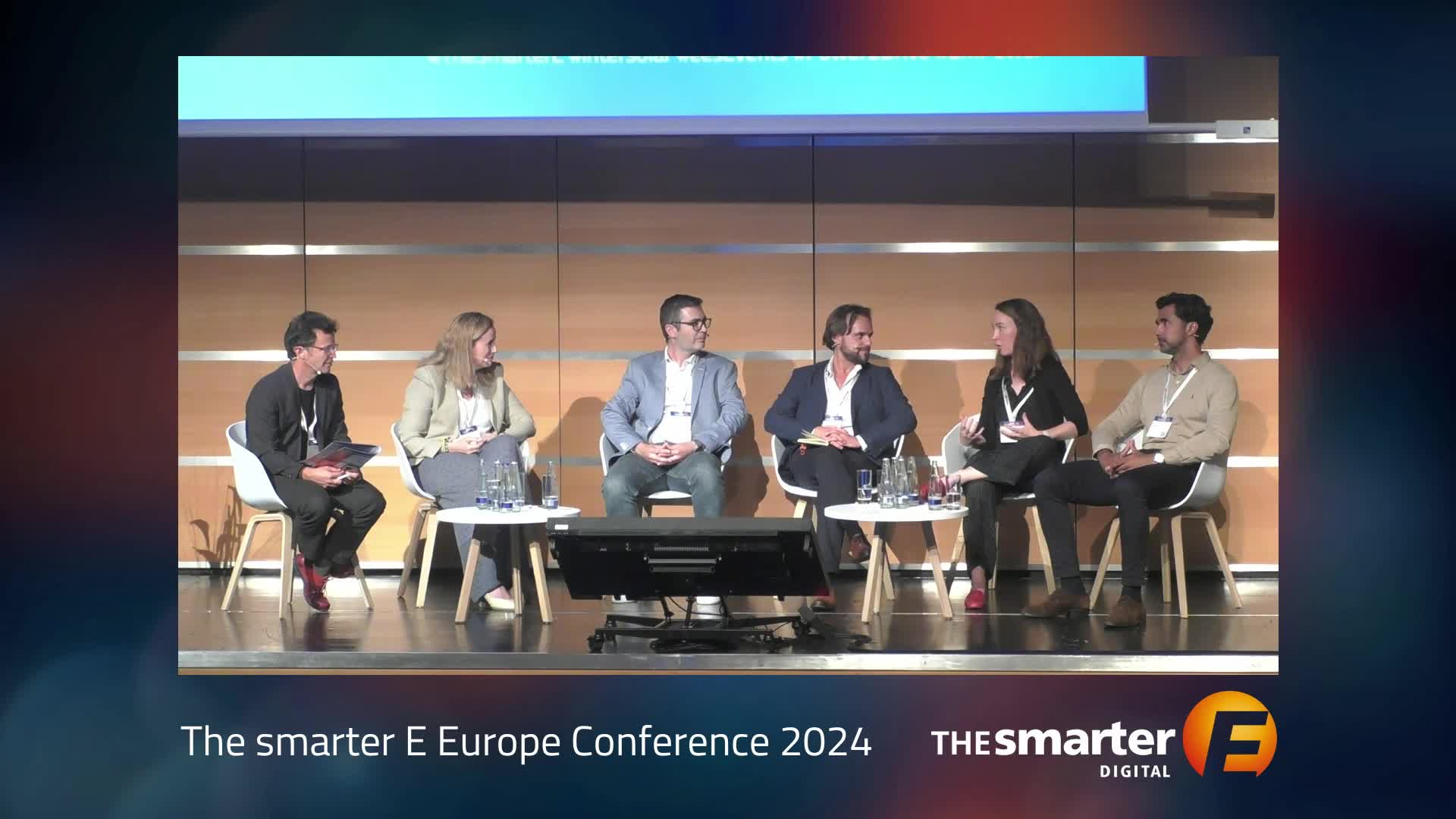
Panel Discussion

premium account

Recording of Tuesday, June 18, 2024 | The smarter E Europe | Conference Program | Language: English | Duration: 17:20 .

Panel Discusses Hurdles in Scaling Up Smart Charging and V2X Adoption, Citing Regulatory Challenges, Grid Congestion, Consumer Behavior Changes, and Lack of Standardization

The panel discussion revolves around the hurdles preventing the widespread adoption of smart charging and V2X (vehicle-to-everything) technologies. The primary challenge highlighted is balancing power flow due to extreme peaks in renewable energy production from PV (photovoltaic) and wind sources, which requires a shift in production strategy and load flexibility. Congestion problems within existing grid infrastructure also pose significant challenges, necessitating changes in grid operations to accommodate these new demands. Panelists pointed out that consumer behavior change is essential; customers are not yet accustomed to variable electricity tariffs compared to fixed fuel costs. Concerns among bus operators about ensuring readiness without disrupting services were noted as well. Other issues include insufficient rollout of smart meter gateways, particularly in Germany, highlighting the need for metering infrastructure improvements. Regulatory frameworks lag behind technological advancements, requiring standardization and interoperability enhancements alongside regulatory sandboxes for experimentation. In summary: overcoming technical barriers, enhancing customer education on flexible schemes, updating regulatory policies, and improving grid infrastructures are crucial steps toward scaling up smart charging solutions effectively across different regions.

Automated summarization by AI Conver

Explore the integration and impact of e-mobility on power grids. Join us for a deep-dive into the seamless integration of electric mobility with power systems and discuss challenges, breakthroughs, and the crucial role of smart grids. Learn about effective strategies for large-scale e-mobility deployment, drawing insights from AVERE's advocacy of sustainable transportation. Examine the transformative effects of e-mobility adoption on grids and infrastructure, discuss resilience, capacity planning and adaptive measures. The focus will be on three key areas: e-mobility power system integration, e-mobility deployment strategies, and their impact on the grid and infrastructure.

Further Talks of this session:

Speaker

Raphaël Héliot
Policy Officer
AVERE - The European Association for Electromobility
Belgium

To Talk

Speaker

Prof. Dr. Christof Wittwer
Director Business Area 'System Integration"
Fraunhofer Institute for Solar Energy Systems ISE
Germany

To Talk

Speaker

Begoña Cubian
Specialist New Initiatives: Sustainable Mobility
Iberdrola
Spain

To Talk

Speaker

Manuel Navarro
Sales Manager
Siemens SA
Portugal

Alexandre Neto
Sales Manager for Americas and Iberia of Microgrids and Renewables Integration
Siemens AG
Germany

To Talk

Speaker

Isabel Bohn
Advisor Flexibility
TransnetBW GmbH
Germany

To Talk

Speaker

Conference Partner

Bruno Moedim
Segment Owner-Energy Solutions
Kempower
The Netherlands

To Talk

Further Content
Gaëtan Masson and Delfina Muñoz
The Challenge in Turning Europe’s PV Research into an Industrial Reality

The smarter E Podcast Episode 266 | Language: English

October 1, 2026

Europe leads in solar research but lags in manufacturing. Jonathan Gifford explores industrial policy and tandem tech with experts.

Thaddäus Kreisig
Stack ’Em Up: Germany’s Big Battery Inflection Point – with Thaddäus Kreisig

The smarter E Podcast Episode 265 | Language: English

September 16, 2026

Discover how Germany's solar surge is driving a gigawatt-scale battery boom, the revenue models making projects viable, and the hurdles ahead.

Intersolar Middle East Conference 2026
Hype vs. Financial Close: What Separates the 20% of Solar Projects That Reach Construction

Wednesday, September 02, 2026, 02:30 pm

Intersolar Middle East Conference 2026 | Conference Program

premium account

This session explores how effective policy frameworks, streamlined regulations, and innovative financing solutions can work together to accelerate the global expansion of solar energy. Bringing together perspectives from policymakers, investors, and industry leaders, it will examine how supportive regulatory environments reduce investment risk, attract private capital, and enable the successful development of solar and hybrid energy projects. Through best practices, emerging funding mechanisms, and real-world case studies, participants will gain practical insights into mobilizing capital, fostering investor confidence, and creating the conditions for sustainable growth across both established and emerging solar markets.

Intersolar Middle East Conference 2026
The Self Managing Solar Farm: From AI and Digital Twins to Autonomous Energy Infrastructure

Wednesday, September 02, 2026, 01:15 pm

Intersolar Middle East Conference 2026 | Conference Program

premium account

Discover how advanced digital technologies are transforming solar operations. This session explores AI-driven analytics, IoT-enabled monitoring, and blockchain-based transparency to optimize performance, streamline maintenance, and enhance profitability. Learn how smart grids and data intelligence are shaping the next generation of efficient, resilient solar energy systems.

Intersolar Middle East Conference 2026
Optimizing the Solar Asset Lifecycle: Resilience, Digitalization, and Circular Economy

Thursday, September 03, 2026, 12:45 pm

Intersolar Middle East Conference 2026 | Conference Program

premium account

Explore strategies for maximizing the resilience, performance, and sustainability of solar assets throughout their entire lifecycle. This session brings together best practices in resilient system design, advanced monitoring, predictive operations and maintenance (O&M), and asset lifetime optimization with circular economy approaches such as PV panel recycling, battery repurposing, and ESG-driven business strategies. Learn how innovation, digitalization, and evolving regulations are helping the industry improve reliability, extend asset value, recover critical materials, and reduce environmental impact while creating more sustainable and profitable solar ecosystems.

You are using an outdated browser

The website cannot be viewed in this browser. Please open the website in an up-to-date browser such as Edge, Chrome, Firefox, or Safari.